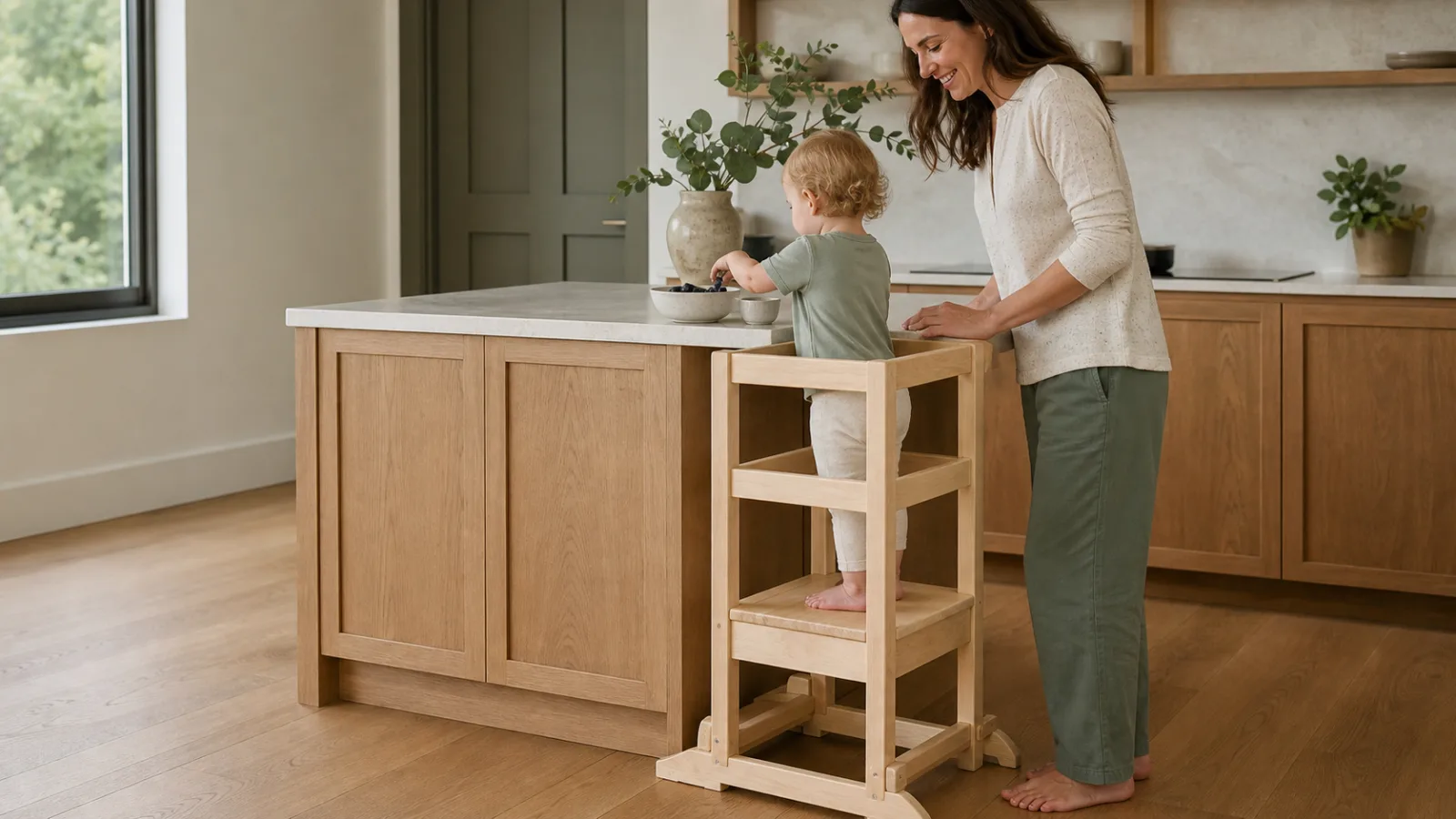
There is no single age at which every child is ready for every toddler tower. In our 25-model selection, 22 records have a published manufacturer age range: 17 start at 18 months and five start at 2 years. Three remain unresolved or unverified. Those numbers are product eligibility labels, not a site recommendation or a developmental clearance. Start with the exact model's manual, then check how the child enters, stands, follows directions, fits the guard, and exits while an adult actively supervises nearby.
Four gates before first use
1. Exact-model eligibility
Confirm the model, mode, age, weight, height, and any stated independent-standing or entry requirement in the matching manual.
2. Observed readiness
Watch the child enter, stand with feet on the platform, follow a simple direction, and exit through the intended opening.
3. Physical fit
Measure the work surface, use a documented platform position, and check the guard around the standing child.
4. Safe unit and setting
Clear the recall identity, confirm the assembled locks and fasteners, prepare the counter, and supervise actively nearby.
What the selected model records actually say
This receipt is generated from the same validated 25-model dataset used by the comparison hub. Missing and conflicting age fields stay unresolved instead of being estimated.
- Selected model records
- 25
- Published age ranges
- 22
- Unresolved or unverified
- 3
17 selected models publish this starting age.
5 selected models publish this starting age.
An open-ended label still does not override fit, readiness, or other exact-model limits.
These are attributed manufacturer labels, not Toddler Home Brief recommendations or developmental clearances. Records checked July 20, 2026.
The short answer: age opens the gate, readiness decides the day
First, the child has to fall within every limit the manufacturer gives for the exact model and mode being used. That can include a minimum age, maximum age, weight limit, height limit, or a requirement such as standing independently or entering and exiting without help. If the model says 2 years and older, an advanced 20-month-old does not meet that product's instructions.
Meeting the printed age is only the first gate. A child also has to use the steps, standing platform, entry, and guard in the way the manual expects. Age cannot tell you whether an individual child will freeze on a step, climb the outside, sit on a rail, lean far over the guard, or follow a simple direction to step down. Observe the actual behavior rather than treating a birthday as automatic clearance.
Read the exact age label before applying a general rule
The selected records show why a universal starting age is misleading. Seventeen verified manufacturer ranges start at 18 months and five start at 2 years. Four of the published ranges do not state a maximum age, and three selected records remain unresolved or unverified. One unresolved record has a product page that says 18 months and older while its manual says the product is not for children under 3. Another has different maximum ages on its product page and in its manual.
When first-party sources conflict, use neither number as a shortcut. Identify the model, SKU, revision, and manual version, then ask the manufacturer to reconcile the instructions in writing. Our database leaves the field unresolved because choosing the more convenient number would hide a decision-relevant conflict.
Five readiness observations to make before first use
Watch the child on the floor before placing the tower at a counter. Can they approach the intended entry, place each foot deliberately, move onto the standing platform, remain upright without using the guard as a seat, and reverse the sequence to get down? Compare those observations with the exact manual. Do not teach around a restriction by lifting a child over the guard or placing them directly onto the platform unless the manufacturer explicitly instructs that method.
Then try one short, low-distraction task with active, close adult supervision. The useful signs are controlled movement, feet staying on the platform, hands used for the task rather than pulling on the rails, and a response to a simple direction to stop or step down. A child who immediately climbs the exterior, bounces, perches, leans past the guard, or repeatedly tries to leave from the side is showing that this setup is not ready for use today.
Independent standing is not a universal product clearance
Some manufacturers explicitly require independent standing or independent entry and exit. Those requirements belong to those products. They should not be copied onto a different tower whose manual gives another minimum age or entry method. Likewise, independent walking alone does not answer whether a child can manage open steps, stay within the guarded area, or fit the platform and rail at the selected height.
Avoid turning a developmental milestone into a home test that overrules the product. The safer sequence is exact-model eligibility first, observed behavior second, physical fit third, and active supervision every time. If any one of those gates fails, wait or choose a different product rather than trying to compensate with coaching, a higher platform, or an added cushion.
Age and weight do not answer physical fit
A child can sit within the published age and weight range while fitting the guard poorly. Platform height changes where the upper rail reaches on the body, and growth changes both counter reach and the ability to lean over an opening. Measure the exact work surface and the child's standing elbow height, install only a documented platform position, and check the guard with the child standing normally inside.
A large weight limit is a structural claim from the manufacturer, not a promise that the guard, entry, or platform suits every child below that number. Check height limits when published, the way the rail surrounds the body, and whether the child still needs a guarded standing area for the intended task. Our height and counter-fit guide covers the measurement sequence in detail.
Supervision is part of the setup, not a rescue plan
Standing-tower standards work has explicitly discussed supervision language, guard height, platform adjustment, and warning design. That work does not create a universal supervision distance or approve a model. Follow the exact instructions and remain actively engaged close enough to stop the activity when the child changes behavior, the tower shifts, or the task introduces a new hazard.
Prepare the counter before the child enters. Remove knives, hot cookware, cords, small magnets, breakable containers, and anything that invites a long reach. Keep the tower on the surface and in the position required by the manual. A guard does not turn the tower into unsupervised containment, a high chair, or a place to leave a child while an adult steps away.
When to pause or stop using the tower
Pause use when the child repeatedly climbs outside, sits or perches on a rail, leans far over the guard, cannot enter or exit as directed, or no longer responds reliably to the supervising adult. Recheck after a growth spurt, a platform change, a move to another counter, or any change in the child's movement or behavior. Readiness can change from one setting or day to another.
Stop using the product when any stated age, height, or weight limit is exceeded, the child no longer fits the guard, a required lock or fastener does not engage, the unit becomes unstable, the identity label cannot be reconciled with a recall, or the manufacturer issues a stop-use instruction. Do not pass a suspect unit to another family. Follow the official recall or disposal remedy for the exact model.
Age label, readiness, and fit answer different questions
All four checks have to agree. Passing one column does not compensate for failing another.
| Check | Question it answers | What does not count as proof |
|---|---|---|
| Manufacturer age and limits | Is this child eligible under the exact product's instructions? | A general online age range or another model's manual |
| Observed readiness | Can this child enter, stand, follow direction, and exit as intended? | A birthday, independent walking alone, or a one-time assisted attempt |
| Physical fit | Do the platform, guard, child, counter, and footprint work together? | Overall tower height, weight capacity, or a lifestyle photo |
| Unit and recall identity | Is this exact model, revision, lot, and repair state cleared for use? | A familiar brand name or a search that ignores the date code |
Complete the decision
Toddler tower age and readiness questions
Can a 12-month-old use a toddler tower?
Is 18 months always the right starting age?
Is independent walking enough for a toddler tower?
When should a child stop using a toddler tower?
Does a high weight limit mean an older child can keep using it?
Method and Sources
How this page is checked
- The age receipt is derived at render time from the 25 selected catalog records. It counts only structured age ranges with a published value and leaves unresolved or unverified records out of the distribution.
- All age ranges are attributed manufacturer claims. Toddler Home Brief has not converted them into developmental recommendations or independently tested readiness.
- First-party conflicts remain unresolved. The page does not choose a lower or higher number when product pages and manuals disagree.
- CPSC and ASTM task-group materials inform the discussion of hazards and standards work, but they do not supply a universal starting age or approve any model.
Sources
- Toddler Home Brief source-backed 25-model comparison
- ASTM children's step stools and standing towers task-group meeting log, December 2024
- ASTM standing-tower and step-stool performance task-group meeting log, September 2024
- CPSC Simplay3 toddler tower recall, August 2023
- CPSC Boon PIVOT toddler tower recall, July 2026
- Piccalio Foldable Toddler Tower product page
- Little Partners The Learning Tower product page
- Lalo The Tower product page
- Sprout Sous-Chef Toddler Tower product page
Keep reading
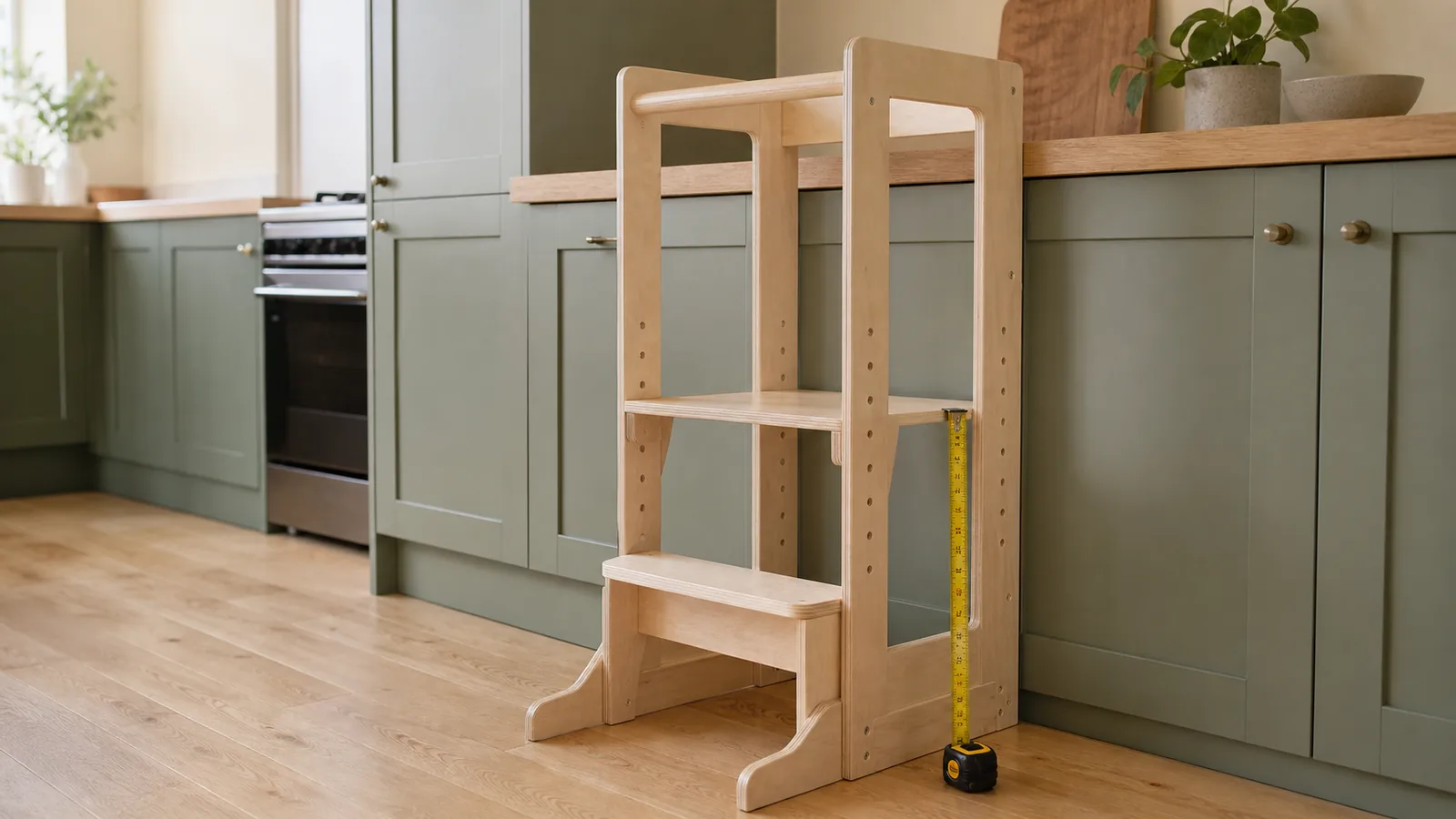
Toddler Tower Height and Counter Fit
Measure your work surface and child, calculate a starting platform height, and compare it with exact published tower positions without mistaking overall height for fit.
Read next
How to Choose a Toddler Tower
A practical, safety-first guide to choosing a toddler tower: how to fit it to your counter height, read guard and stability design against the real recall hazards, judge foldable versus fixed, and run a pre-purchase checklist on any model.
Read next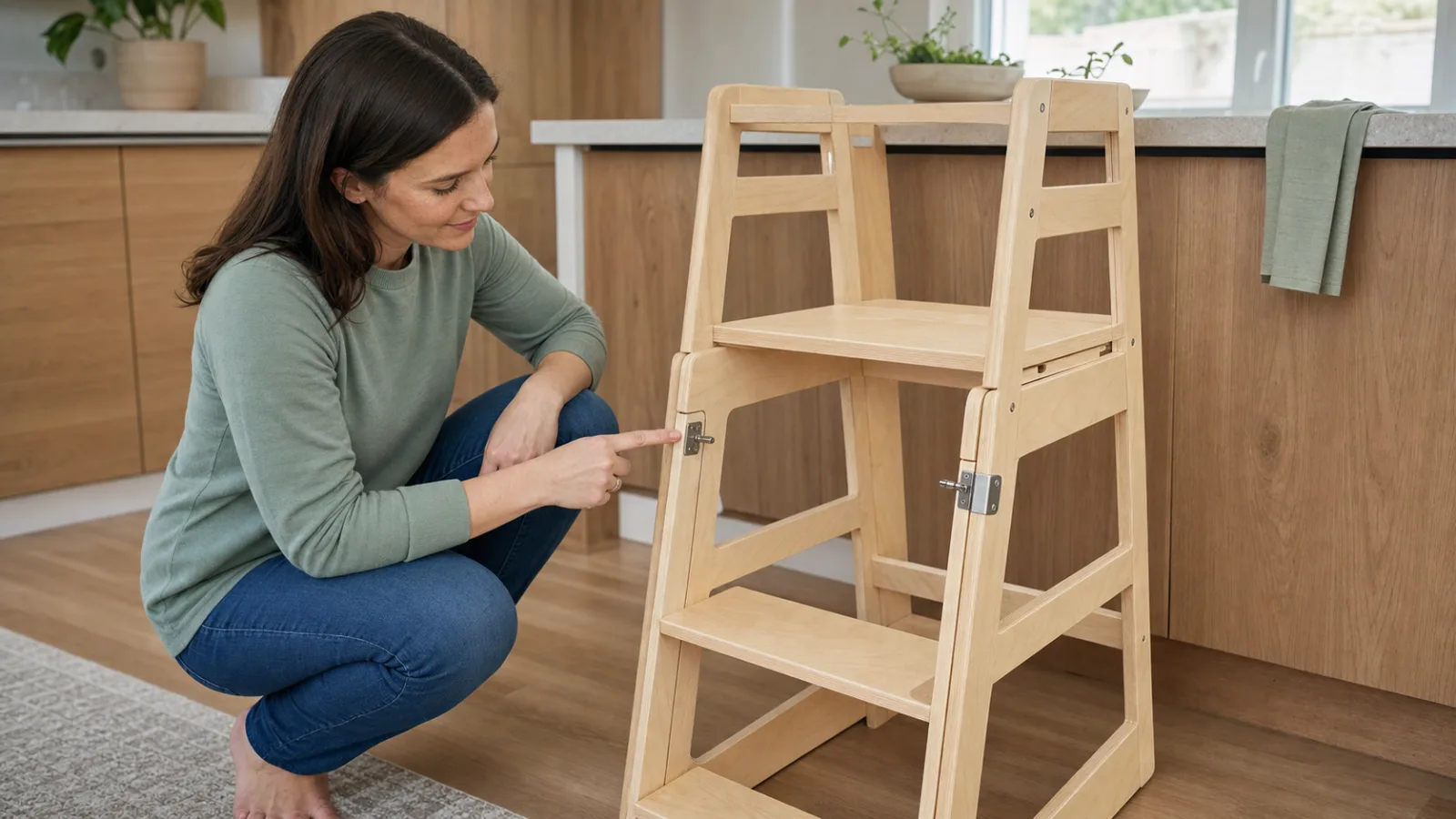
Foldable Toddler Tower Safety: Lock and Setup Checks
How to identify every lock in a foldable toddler tower's manual, check the empty setup before use, recognize stop-use conditions, and interpret folding-related recalls.
Read next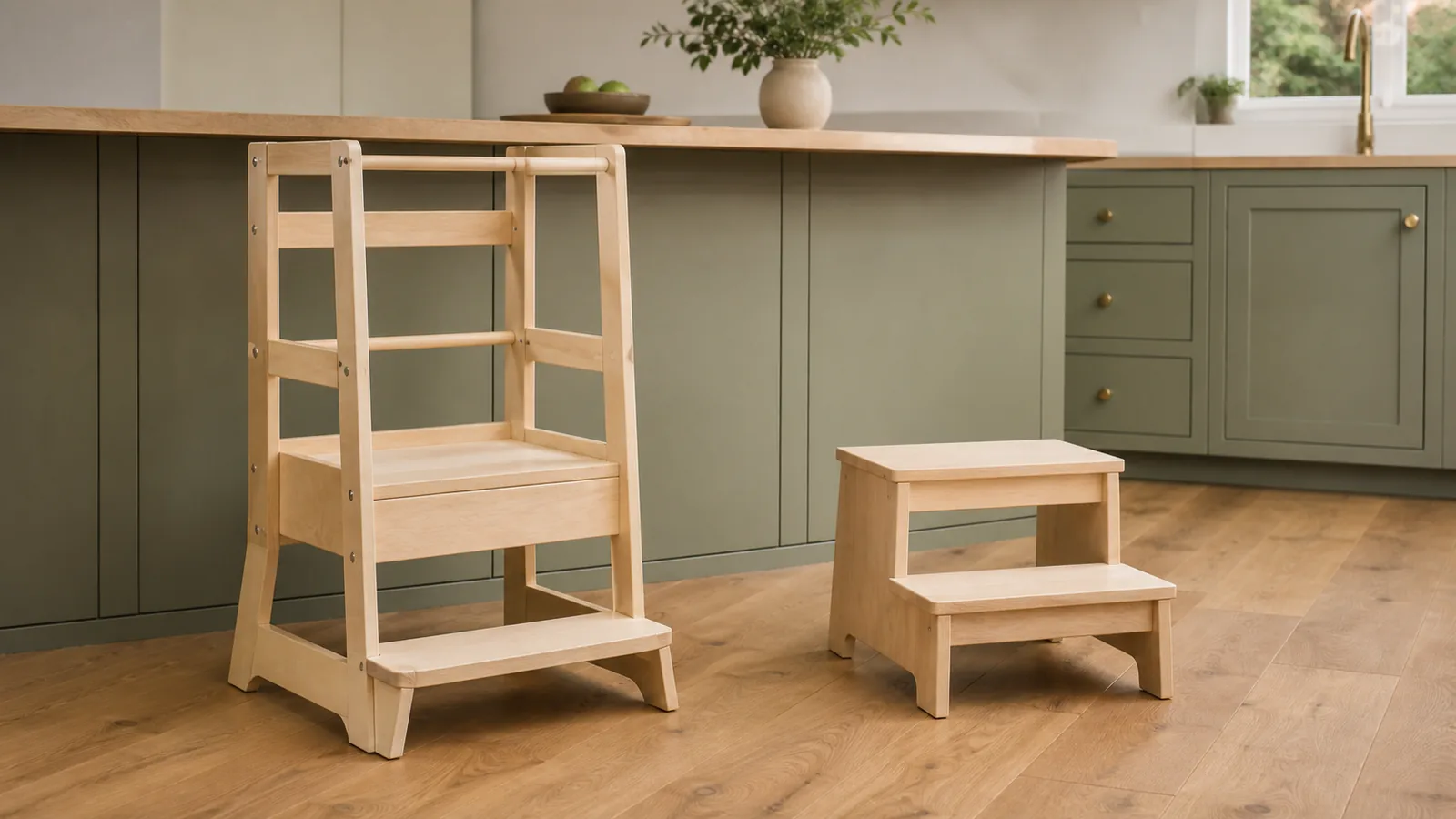
Toddler Tower vs Step Stool
How a guarded toddler tower differs from a low child step stool, and how to choose by readiness, surface height, task, footprint, and exact-product evidence.
Read next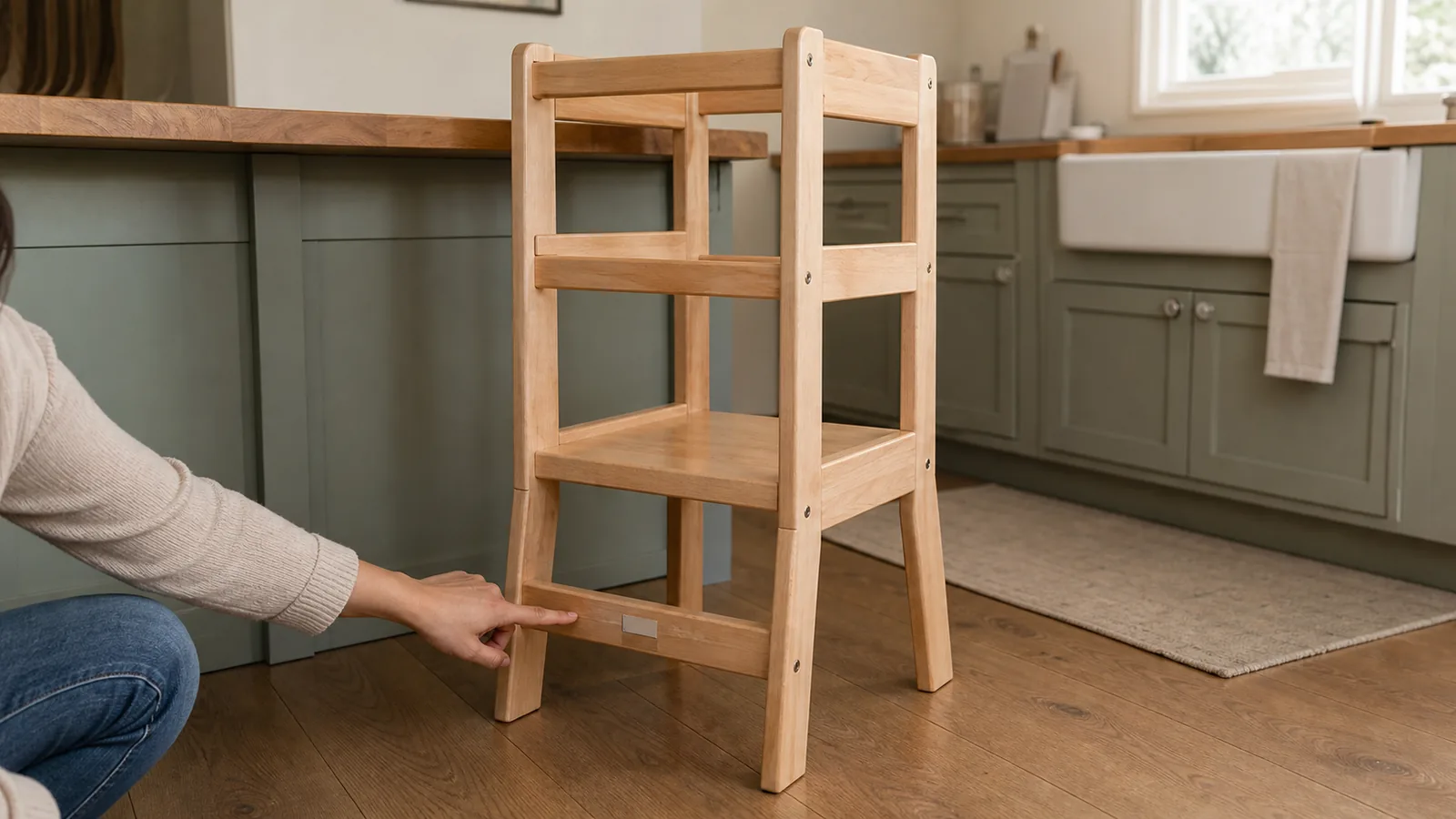
Toddler Tower Safety Standards and Recalls
What safety standards actually exist for toddler towers, every official CPSC tower recall we track, and how to check a specific model before you buy or keep using it.
Read next