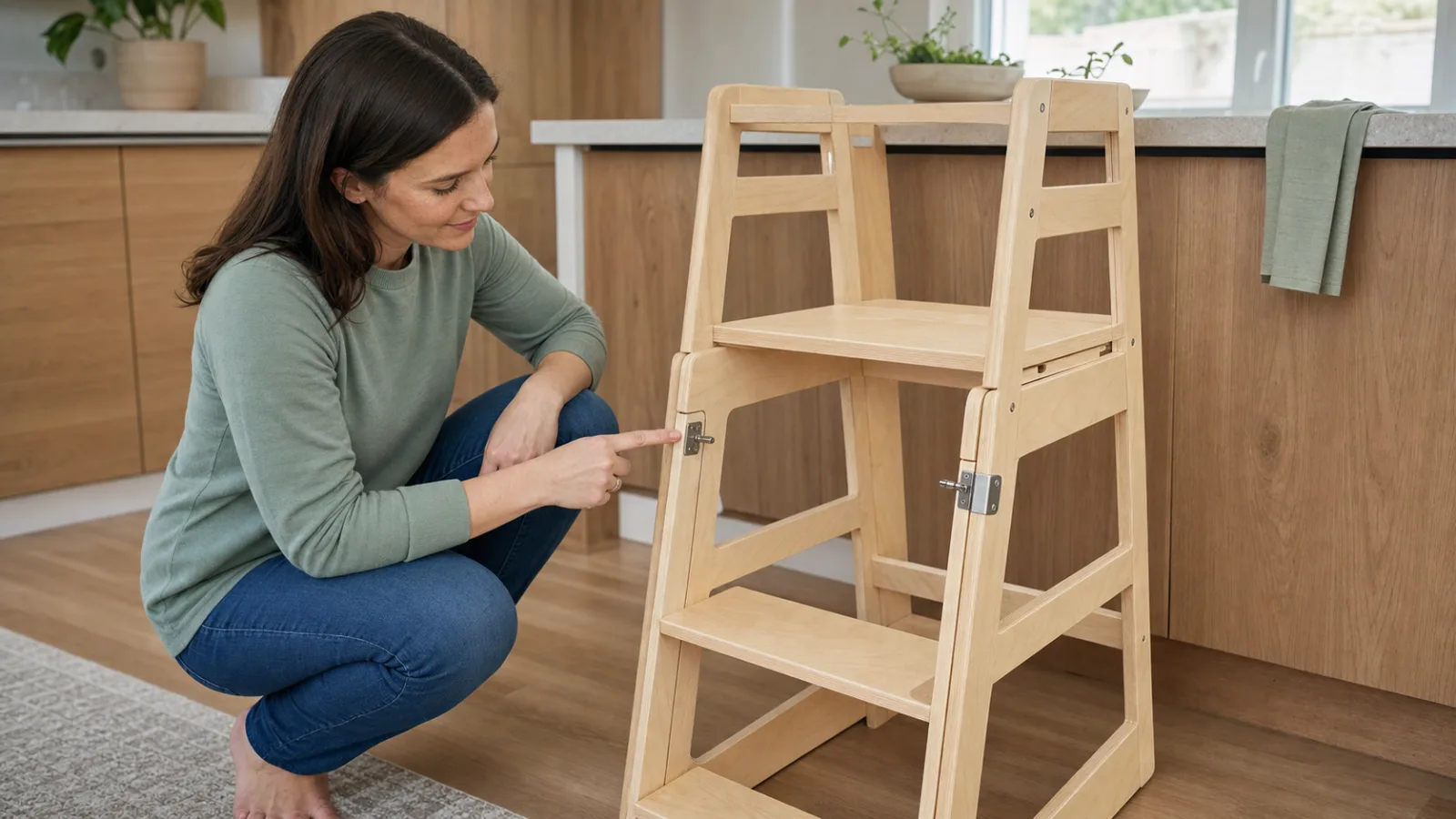
A foldable toddler tower is not cleared for use just because its frame looks open or one latch makes a sound. The reviewed manuals use different systems: paired rail buttons, platform ledges, side-panel locks, sliding latches, rotating platform latches, and stabilizing clips. Identify the exact model and matching manual, complete its full opening sequence while the tower is empty, and confirm every required lock before the child approaches. If a part will not engage, the frame shifts, or the unit may fall within a recall, stop using it rather than improvising a fix.
The empty-tower setup sequence
1. Match the unit
Use the physical model, revision, lot, and date code to find the matching manual and recall scope.
2. Open every structure
Fully position the frame, guard, side panels, platform, step, and conversion parts while no child is present.
3. Confirm every control
Check each button, latch, clip, pin, ledge, or lock named in the manual, including paired controls on both sides.
4. Stop on any mismatch
Do not use a shifting platform, incomplete lock, damaged part, improvised repair, or unit with unresolved recall identity.
What the selected folding records document
This receipt is generated from the validated comparison dataset. It includes complete folding frames, partial folding steps, and convertible products whose records document folding behavior, while preserving missing folded dimensions.
- Selected model records
- 25
- Documented folding behavior
- 14
- Numeric folded dimensions
- 3
Guard rails and platform fold. Setup requires both rails locked, platform unfolded, and safety latch engaged.
Folds without tools. Use requires both side panels and the platform ledge to be locked; folding releases the platform button and both side locks.
Folds to a 10.5-inch depth using a sliding latch illustrated in locked and unlocked positions.
The tower folds to a 6.3-inch depth for storage and uses a manufacturer-described secure locking mechanism when open.
Eleven of the documented folding records do not publish numeric folded dimensions. Mechanism descriptions are attributed manufacturer evidence, not hands-on lock testing. Records checked July 20, 2026.
The short answer: the mechanism adds a setup state
A fixed frame still needs correct assembly, but a foldable frame can move between stored and usable states. That makes the opening sequence part of every use. The child should not enter until the structure is fully open, the platform and guard are in their intended positions, and every lock named in the exact manual is engaged.
Do not turn this into a generic pull, shake, or load test. Manufacturers use different materials and lock designs, and an improvised force test can miss a partially engaged component or damage one. Use the visual, tactile, and positional checks the manual provides, with the tower empty. If the instructions do not tell you how to recognize the usable state, ask the manufacturer rather than inventing a test.
Clear the identity and recall gate before touching the lock
Find the brand, model number, SKU, revision, and any lot or date code on the physical unit. Match those details to the manual and the official recall record. A product name alone is not enough. The recalled Little Partners Grow 'N Stow scope, for example, depends on model LP01711 and specific date codes, while the Guidecraft notice lists particular item and lot combinations.
A repair kit also has to be reconciled at the unit level. The Grow 'N Stow recall remedy replaces a crossbar and identifies the new part with a sticker. Do not assume a secondhand listing, open box, or verbal claim proves the repair was completed. Follow the official notice and manufacturer instructions, and keep a stop-use product away from children until the required remedy is installed and verified.
Run the empty setup check in the manual's order
Place the empty tower on the level surface and in the orientation required for use. Open the frame completely. Position the guard rails, side panels, platform, step, and any conversion pieces exactly as shown. Then engage each required button, latch, clip, pin, or ledge in the stated order. A visible gap, off-center platform, twisted side, or part that stops short is a reason to reset the empty tower, not to add the child and see whether it settles.
After the sequence, confirm that each component occupies the manual's illustrated locked position. Check both sides when the design has paired controls. Make sure no fabric, storage item, wall, cabinet edge, or trapped debris prevents full movement. Only then place the tower where the manufacturer requires it for use and preserve the adult's path around it.
One click is not proof that every lock is engaged
Some systems have more than one confirmation point. The Guidecraft FLEX manual requires both guard rails to lock, the platform to unfold, and a safety latch to engage. Little Partners EZ Fold 'N Grow uses side-panel locks and a platform ledge. Guidecraft Classic and Contemporary instructions describe platform latches plus two clips with different roles. Hearing one sound cannot establish the state of parts you did not inspect.
Other records are less specific in public-facing text. Piccalio describes a secure locking mechanism, while the Simplay3 folding model illustrates a sliding latch in locked and unlocked positions. Use the exact diagrams for the physical unit. If the product has been revised, a current web page may not describe an older mechanism in your kitchen.
Platform support deserves its own check
The standing platform is not just another shelf. Recent official notices show why its support path matters. The Grow 'N Stow platform could collapse, and the recalled Guidecraft platform could loosen, become unstable, or detach. Those notices apply to exact scopes, not every tower from either brand, but the failure modes show why platform locks, ledges, fasteners, and repair state cannot be treated as cosmetic details.
With the tower empty, verify that the platform is installed in a documented position, oriented correctly, and supported by every required ledge, latch, pin, bolt, or clip. Do not use a platform that rocks, bows, shifts, or has missing, loose, substituted, or damaged hardware. Tighten only the parts and to the degree the manual directs. Extra screws, tape, wedges, or homemade crossbars are not substitutes for the specified mechanism or recall remedy.
Storage dimensions and safe setup are separate questions
A tower may be described as foldable without publishing a folded width, depth, and height. The evidence receipt below keeps those missing measurements visible. Do not estimate storage clearance from a photo, and do not force a folded frame into a gap that presses on a latch, bends a rail, or requires lifting by a moving part.
Measure the storage route as well as the final gap. Leave room to grasp the locations the manual permits, unfold the product without hitting a cabinet or appliance, and complete the lock sequence where you can see both sides. Store the tower so a child cannot unfold, climb, or pull it over. Folding is a storage feature, not permission to carry or move the tower with a child inside.
Stop-use signs are more important than convenience
Stop before use when any required control does not reach its locked position, springs back, feels unusually loose or stiff, or no longer matches the manual's diagram. Also stop for a shifting platform, spreading sides, cracked wood or plastic, bent metal, elongated fastener holes, missing hardware, damaged feet, a frame that will not sit level, or an identity label that cannot be reconciled with a recall.
During supervised use, end the activity immediately if the frame shifts, leans, opens, folds, clicks unexpectedly, or the platform moves. Remove the child first. Do not troubleshoot with the child standing inside. Contact the manufacturer for the exact inspection, replacement part, or remedy, and report a defect or injury through SaferProducts.gov when appropriate.
Different mechanisms require different confirmations
Examples are taken from current manufacturer pages or manuals checked July 20, 2026. They illustrate why the matching instructions matter and are not interchangeable setup directions.
| Model family | Documented mechanism | What the record does not prove |
|---|---|---|
| Guidecraft Kitchen Helper FLEX | Both guard rails locked, platform unfolded, safety latch engaged | Hands-on latch reliability or published folded dimensions |
| Little Partners EZ Fold 'N Grow | Both side panels and platform ledge locked for use | That another Little Partners model uses the same sequence |
| Simplay3 Folding Step Stool 22403 | Sliding latch illustrated in locked and unlocked positions | Recall clearance for separate adjustable model 41807 |
| Guidecraft Classic and Contemporary | Rotating platform latches, locking Clip A, stabilizing Clip B | Whether a physical item and lot falls outside recall 26-490 |
| Piccalio Foldable Toddler Tower | Manufacturer-described secure locking mechanism when open | Independent lock testing or a universal audible-click check |
Check the exact model
Foldable toddler tower safety questions
Are foldable toddler towers less safe than fixed towers?
Does an audible click mean the toddler tower is locked?
Should I test the tower by pushing or standing on it?
Can I move or fold a toddler tower with my child inside?
Can I keep using a recalled tower after installing the repair kit?
How often should I check the folding locks?
Method and Sources
How this page is checked
- The folding evidence receipt is derived at render time from reviewed selected-model records. A product appears only when its structured fold-design field documents folding behavior.
- Numeric folded dimensions count only records with a published dimensional value. A folding claim without measurements remains missing rather than being estimated from an image.
- Mechanism descriptions are attributed manufacturer or manual evidence. Toddler Home Brief has not yet performed hands-on cycle, misuse, pinch-point, or lock-reliability testing.
- Recall examples apply only to the official model, item, lot, date-code, and remedy scopes. They illustrate failure modes without transferring recalled status to unrelated products.
Sources
- CPSC Little Partners Grow 'N Stow recall, November 2025
- CPSC Guidecraft Kitchen Helper recall, May 2026
- CPSC Onasti toddler tower recall, March 2025
- CPSC Boon PIVOT toddler tower recall, July 2026
- Guidecraft Kitchen Helper FLEX instruction manual
- Little Partners EZ Fold 'N Grow LP0172 manual
- Simplay3 model 22403 folding tower instructions
- Guidecraft Kitchen Helper assembly instructions
- Piccalio Foldable Helper Tower assembly manual
Keep reading
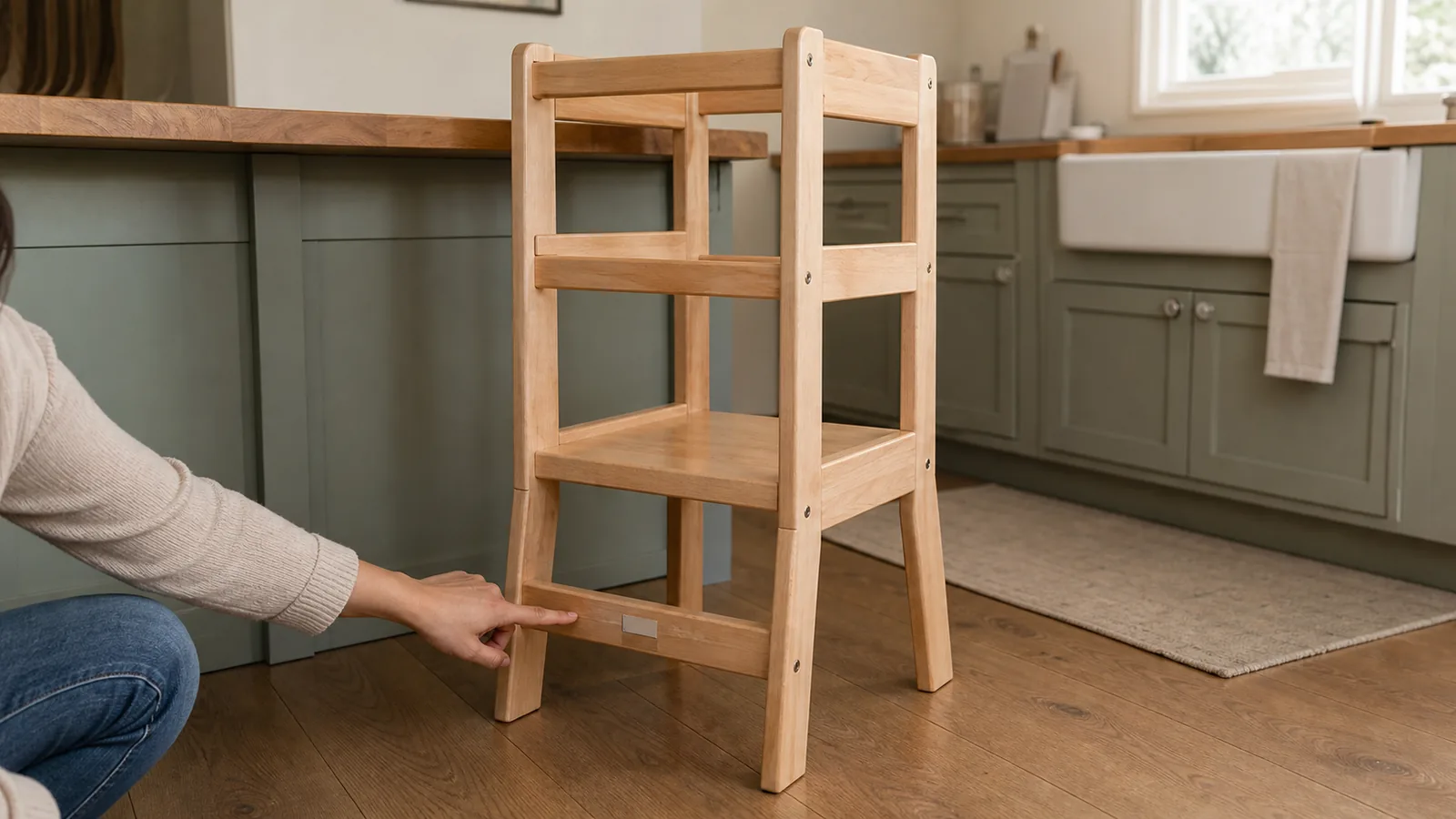
Toddler Tower Safety Standards and Recalls
What safety standards actually exist for toddler towers, every official CPSC tower recall we track, and how to check a specific model before you buy or keep using it.
Read next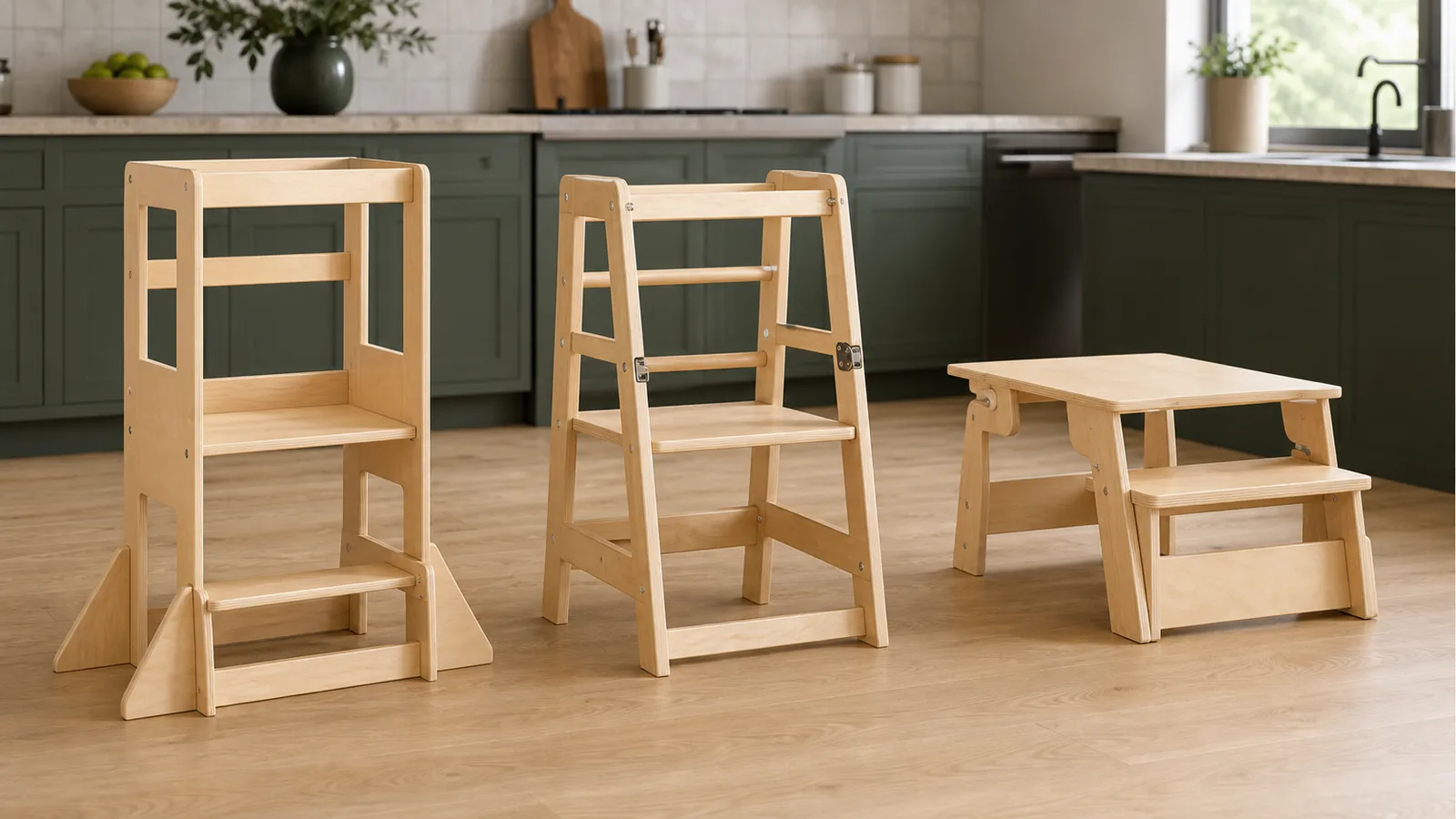
Fixed vs Foldable vs Convertible Toddler Towers
How fixed-frame, foldable, and convertible toddler towers differ in footprint, locks, storage, platform fit, and extra modes, with source-backed examples.
Read next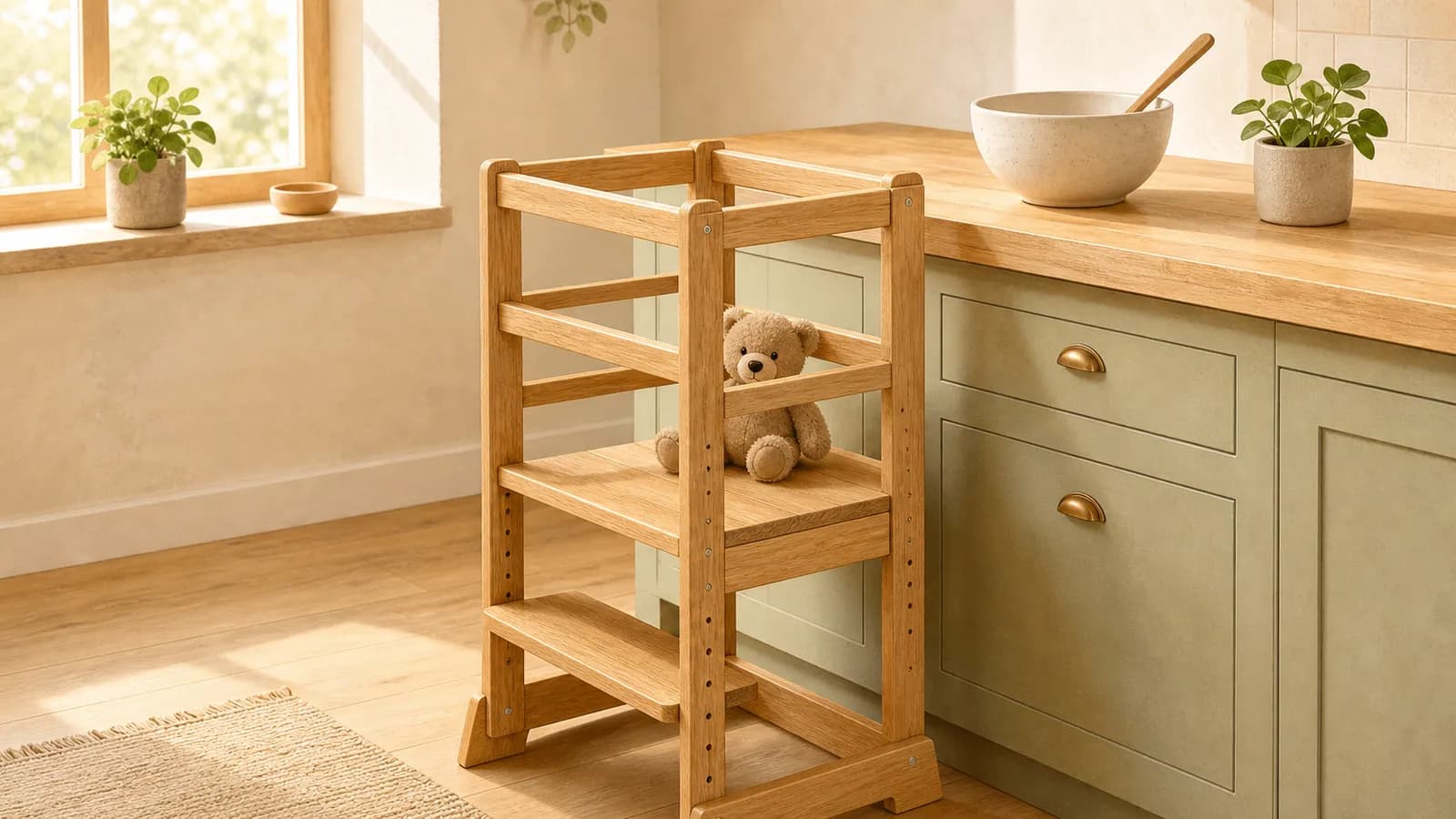
How to Choose a Toddler Tower
A practical, safety-first guide to choosing a toddler tower: how to fit it to your counter height, read guard and stability design against the real recall hazards, judge foldable versus fixed, and run a pre-purchase checklist on any model.
Read next
What Age Is a Toddler Tower For?
Use the exact model's age label, the child's observed readiness, physical fit, and recall status to decide when a toddler tower is appropriate and when to stop using it.
Read next