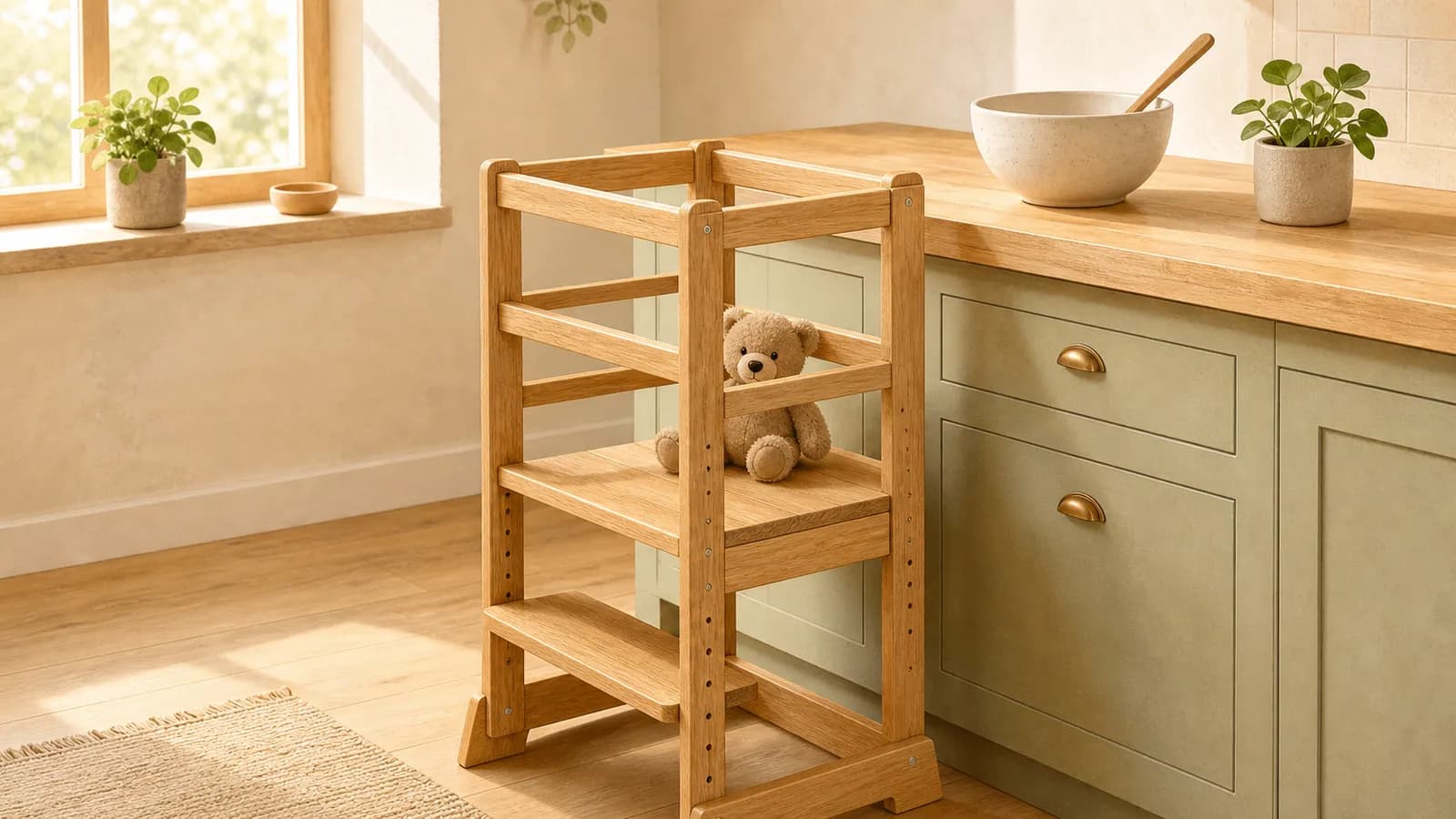
A toddler tower is one of the few things you'll buy specifically to lift your little one up to counter height, so it's worth a few minutes to get right. This guide walks you through what actually matters: whether the exact model has been recalled, whether it fits your counter, how its guard and base are built, and whether it'll really live in your kitchen instead of getting shoved in a closet. We don't crown a winner or rank brands here. What you'll get is the set of questions to ask, so you can size up any tower on its own merits, including ones we haven't gotten our hands on yet.
Start here: what actually decides it
1. The model's recall record
Check the exact brand, model, and date code against official recalls before you weigh a single feature. A familiar name doesn't mean it's been cleared.
2. Counter fit
How the platform height lines up with your measured counter decides whether the tower works at all. Adjustable platforms buy you more time.
3. Guard and stability
A guard on all four sides, a base wider than the platform, and a fold-lock that clicks firmly into place if it folds. These map straight to the real recall hazards.
4. Footprint and storage
The tower that gets used is the one that fits your kitchen and the way you'll really move and clean around it.
Start with the exact model's safety record
Before you fall for a photo or a price, ask one question first: has this exact model been recalled? A tower lifts your child up to counter height, and when these products fail, they fail in scary ways. Collapse, tip-over, and a head or torso getting stuck between the rails. Those are the kinds of accidents that land kids in the ER. Recalls come out regularly, and they hit big-name brands and cheap imports alike, so a familiar logo doesn't mean you're in the clear.
Get the details you'll need: the brand, model name, model number or SKU, and the date code if there's one on the label. Recalls usually name specific models and production runs, not a whole brand, so those little numbers matter. Run them through our recall checker, and because no outside tool is ever perfectly complete or up to the minute, double-check against CPSC's own recall page. If your model shows up, stop right there and follow the fix in the notice. No feature is worth keeping a known hazard in your kitchen.
We put this first on purpose. It's quicker than reading a spec sheet, it's free, and it rules out the worst outcomes before you spend any energy comparing the rest.
What a toddler tower actually is, and the job it does
A toddler tower (you'll also see them sold as learning towers, kitchen helpers, or standing towers) is basically an enclosed platform that lets your standing child reach the counter, sink, or island and be part of what's going on up there. It isn't really about decor, or even independence for its own sake. It's that a determined toddler is going to try to get up to the counter one way or another, and a platform with a guard on all sides is a much safer answer than the dining chair they'll drag over the second you turn around.
That's worth holding onto, because it tells you what to look for. A tower isn't a step stool, which sits lower, stays open, and suits an older, steadier kid grabbing a quick boost. It isn't a high chair, which straps a child in to eat. A tower is for a walking, climbing toddler who can get in and stand while you're right there beside them. Everything below comes back to that: it has to fit your counter, keep your child enclosed, resist tipping, and hold up to daily kitchen life.
Fit is the decision that matters most: counter height
If there's one measurement that makes or breaks a tower in your home, it's how the platform height lines up with the surface your child will use. Kitchen counters, islands, bathroom vanities, and accessible or custom work surfaces can differ enough to change the platform choice. Measure the exact surface, because that number matters more than how tall the tower is overall.
Use the child's standing elbow height to create a starting platform estimate, then check the nearest real platform position with the child and guard together. Set them too low and they may lean and stretch over the guard. Set them too high and the rail may sit too low on their body. An adjustable platform can extend the usable fit as your child grows, but only through the discrete positions and hardware sequence the manufacturer documents.
So before the finish or the color pulls you in, check the maker's platform-height range against your measured counter. A gorgeous tower that leaves your two-year-old six inches short is still the wrong tower, and no other feature makes up for it.
Footprint and storage: will it really live in your kitchen?
The tower that actually gets used is the one that fits your kitchen and how much furniture you can stand having underfoot. Measure the spot where it'll stand, then the route to wherever it gets stored, plus any doorway or cabinet it has to clear along the way. A wide anti-tip base is great for safety, but it also eats up real floor space in a small kitchen. That tension is completely normal, and the right call depends on your room, not on some ranking.
Be honest with yourself about whether it'll stay out or get put away. If it lives in one spot, what matters most is the footprint and how easily you can slide it aside to mop. If it needs to disappear between uses, a folding model or one light enough to lift changes the daily math, though folding brings a mechanism of its own (more on that just below). Storage isn't a small thing. A tower that's a pain to move is the one that ends up permanently jammed against the counter, or worse, gathering dust in the garage.
Stability and guard design: the features behind the recalls
It helps to read a tower's build against the failures that actually get products recalled, because the glossy photos won't show you those. The problems that keep coming up are falls, collapse, tip-over, and entrapment, and each one points to something you can look for.
For falls and climbing out, you want a guard on all four sides, including a rail or panel behind your child so they can't just step off the back, plus a platform set well below the top rail so the enclosure actually means something instead of reaching their ankles. For tip-over, a base wider than the platform, ideally with feet that splay outward, stands up to a kid leaning hard or bouncing. For collapse, on any tower that folds or bolts together, the lock or the fasteners are the whole game. They have to click firmly into place and stay there under a moving, wiggling child.
Entrapment comes down to spacing. Gaps between rails or slats that are big enough for a body but not a head, or the other way around, are the geometry behind the most serious recalls in this category. You usually can't get exact gap measurements off a listing, which is a good reason to lean toward makers who publish clear manuals, and to treat a tower with no documentation as an unknown rather than a steal. When a company won't publish a number, that silence tells you something too.
Foldable or fixed? Know the real tradeoff
Foldable towers solve a real problem, floor space, but they solve it by adding a hinge and a lock, and a lock is a part that can fail to catch. That's not a scare story: folding learning towers have been recalled for collapsing under kids. It doesn't make foldables bad across the board. It just means the fold-lock is the one feature to check hardest, every single time you set the tower up.
If a folding model is the only thing that fits your life, pick one whose lock clicks in firmly and audibly, read the manual for exactly how to tell it's locked, and turn that check into a habit rather than an afterthought. If you've got the floor space and don't need to move the tower much, a fixed-frame tower takes the mechanism, and its failure mode, off the table. That's one less thing to get right while you're rushing and your toddler is tugging at your leg.
There's no answer that's right for everyone. The right one is the tower that fits your kitchen and that you'll set up safely on a bleary-eyed weekday morning, because that's the moment that really counts.
Age, weight, and materials: the daily-life details
There is no universal starting age for a toddler tower. In the selected database, verified manufacturer minimums begin at either 18 months or 2 years, while several records remain unresolved. Treat the exact model's age, weight, height, and readiness instructions as eligibility gates, then confirm that the child can enter, stand, and exit in the way that model requires. Read our dedicated age and readiness guide for the full check.
Materials are mostly about daily life rather than a safety ranking. Wood towers are sturdy and common, some use plywood or engineered panels, and you'll find metal and plastic too. In a kitchen, what matters is that the surfaces your child touches and stands on wipe clean easily near food, that there aren't sharp edges or fasteners sticking out at their height, and that the finish is meant for children's products. Assembly is worth a thought too: a tower that's fiddly or confusing to build is one that's easier to build wrong, so clear instructions and sensible hardware really do count, even if they're nobody's idea of exciting.
A pre-purchase checklist for any tower
Whatever tower you're eyeing, even one we've never tested, you can size it up yourself with a short checklist. It's the same logic our own protocol follows before we'd ever recommend a tower, boiled down to what you can do from a product page and a manual.
Confirm the exact model isn't under a current recall. Measure your counter and check it against the stated platform-height range, ideally with room to adjust. Make sure there's a guard on all four sides, including behind your child, and a base wider than the platform. If it folds, find the lock in the manual and understand how to confirm it. Check the age and weight rating in the manual, not just the listing. Look for real documentation from the maker, a manual, specs, a registration card, because a company that stands behind its product is happy to tell you how it works. And plan to register it after you buy, since that's how recall fixes actually reach you.
If a tower clears all of that, you've made a genuinely informed choice. If it trips on any point, that's not a reason to guess. It's the tower showing you what it hasn't proven yet.
Match the tower to your situation
A starting point for weighting the criteria, not a product recommendation. Confirm every figure against the exact model's manual and recall status.
| Your situation | Weight most heavily | Double-check |
|---|---|---|
| Small kitchen, tower must be put away | Narrow footprint, easy to fold or lift | That the fold-lock positively engages every time |
| Considering a first tower | Exact-model age label, entry method, adjustable platform, full guard | That the child meets every stated limit and can use the tower as the manual requires |
| Tight budget | Recall status and published documentation first | That a low price is not standing in for a missing manual |
| Bathroom or lower vanity use | Platform range that reaches a 30 to 32 in surface | Stability on the smaller floor area near a vanity |
| Multiple caregivers or a rental | Simple, obvious setup and a clear locking method | That anyone using it can confirm it is locked without the manual |
Common questions about choosing a toddler tower
What age is a toddler tower for?
What height should a toddler tower be?
Are foldable toddler towers safe?
How much should I spend on a toddler tower?
Is a toddler tower better than a step stool?
Before you buy
Method and Sources
How this page is checked
- This guide gives you decision criteria. It doesn't rank products or name a recommended tower, and no model on this site is recommended until it completes the hands-on protocol described in our methodology.
- Safety statements reflect the failure modes named in official CPSC recall notices and the category's ongoing standards work. The recall ledger behind the checker is re-verified on a weekly service level.
- Counter and vanity heights are typical US figures offered as guidance, so measure the exact surface your child will use, and confirm age, weight, and platform-height ranges in your specific model's manual.
Sources
Keep reading
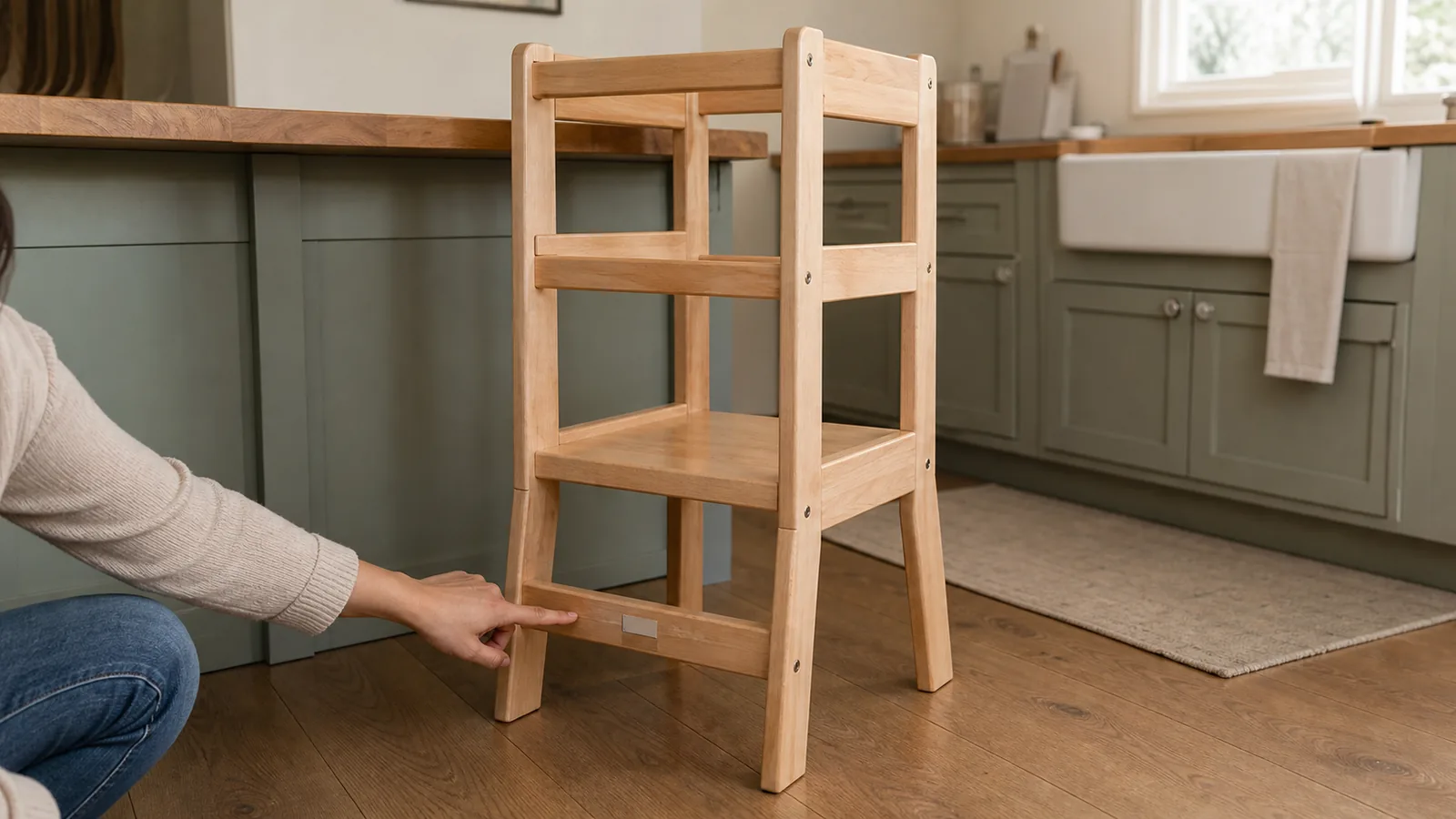
Toddler Tower Safety Standards and Recalls
What safety standards actually exist for toddler towers, every official CPSC tower recall we track, and how to check a specific model before you buy or keep using it.
Read next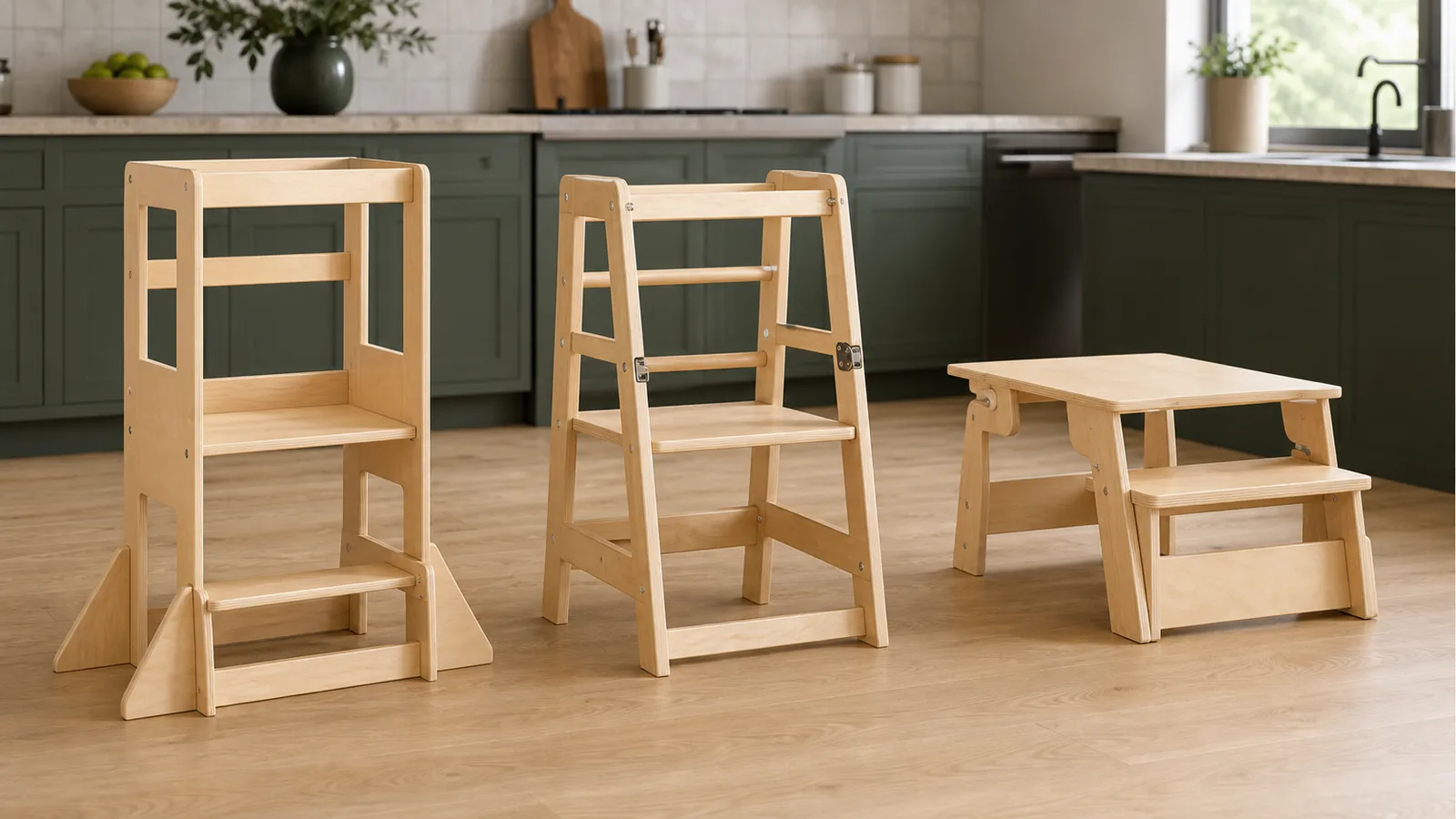
Fixed vs Foldable vs Convertible Toddler Towers
How fixed-frame, foldable, and convertible toddler towers differ in footprint, locks, storage, platform fit, and extra modes, with source-backed examples.
Read next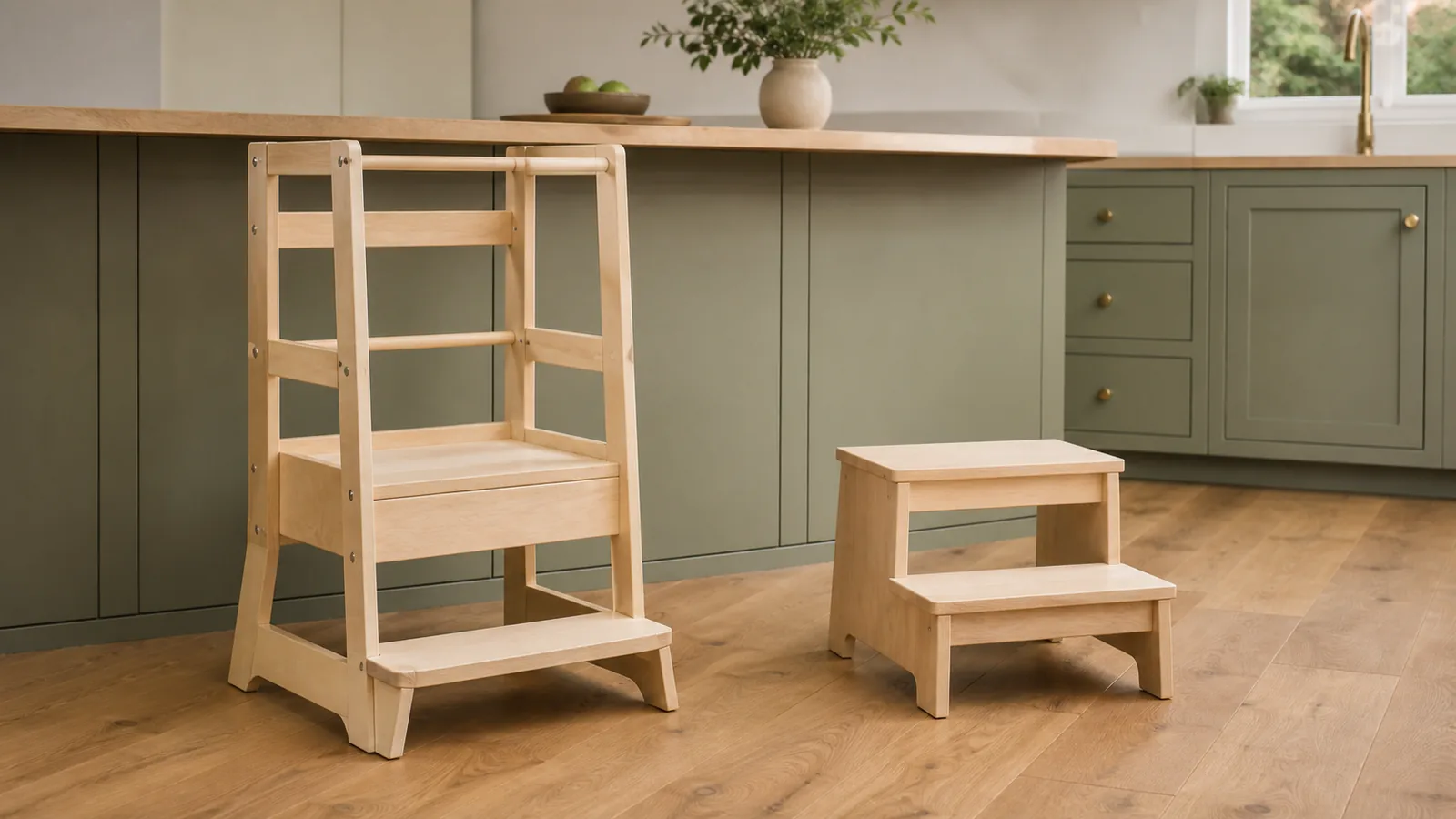
Toddler Tower vs Step Stool
How a guarded toddler tower differs from a low child step stool, and how to choose by readiness, surface height, task, footprint, and exact-product evidence.
Read next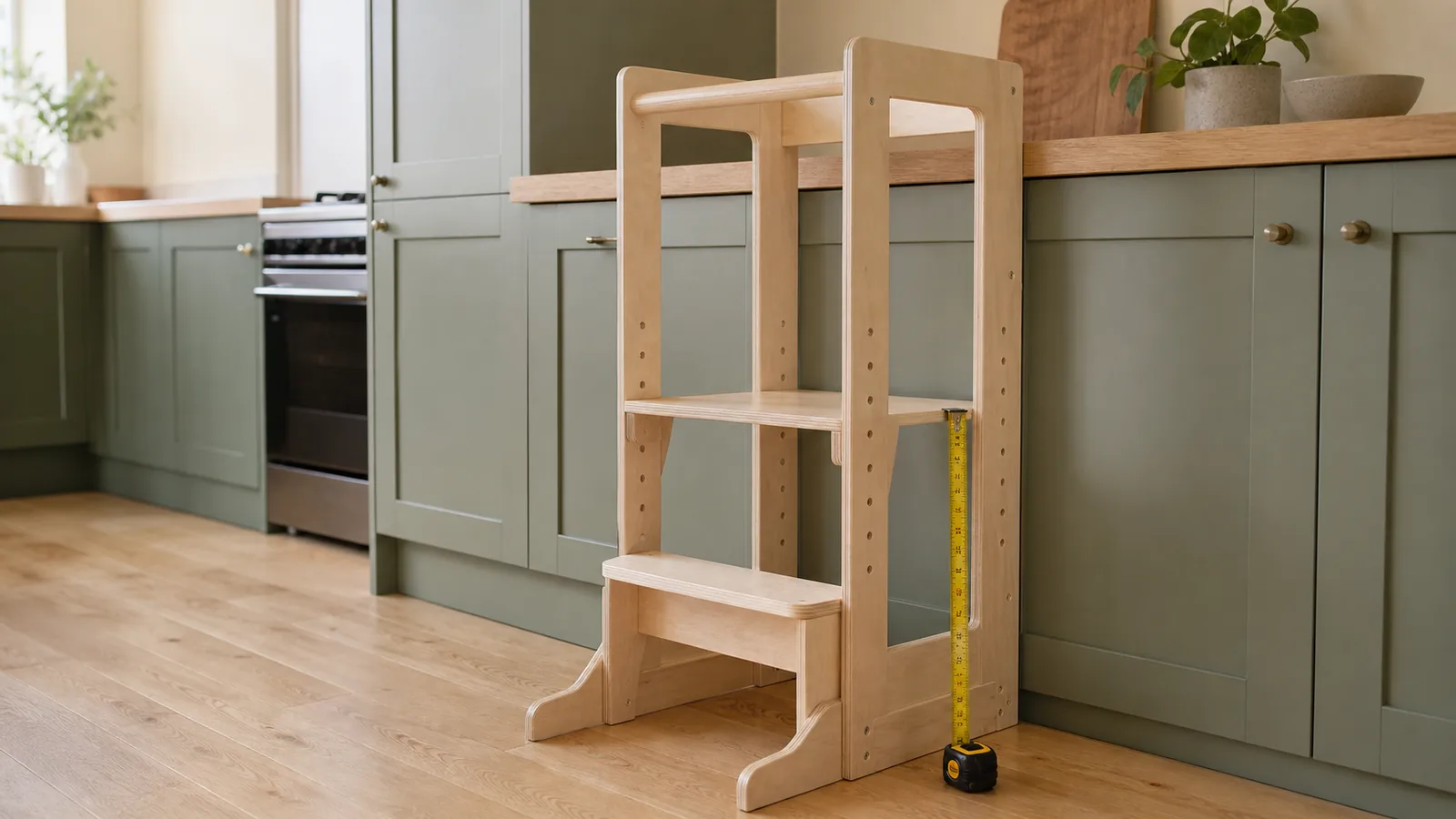
Toddler Tower Height and Counter Fit
Measure your work surface and child, calculate a starting platform height, and compare it with exact published tower positions without mistaking overall height for fit.
Read next