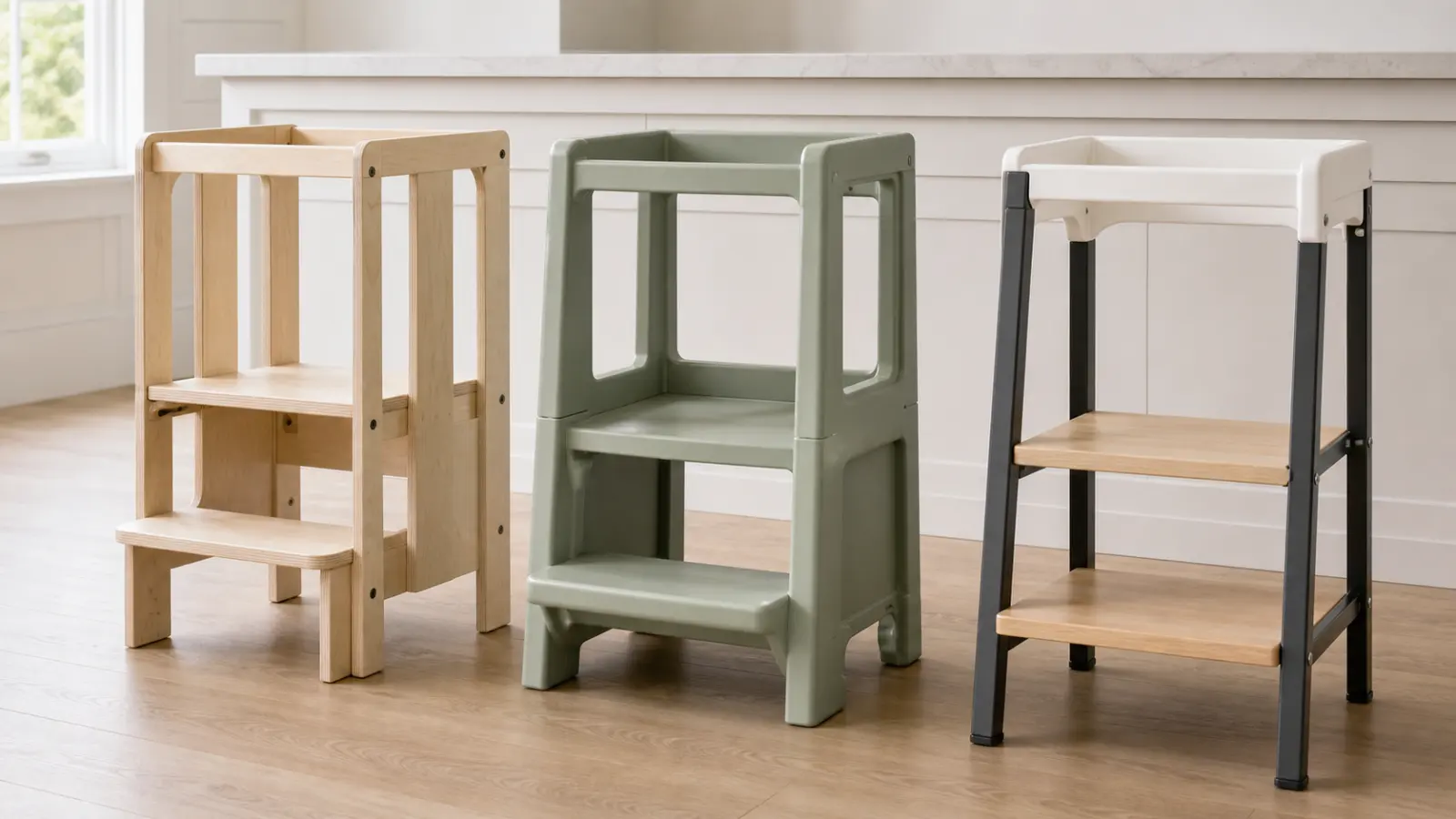
Material should refine a toddler tower shortlist, not choose the winner. Start with the exact model, recall status, footprint, platform and guard fit, assembly, locks, and placement rules. Then compare the published composition, assembled weight, finish, replaceable parts, and exact care instructions. In the current 25-model selection, 15 records are wood-dominant, two are plastic-dominant, three use mixed construction, and five still lack a verified material composition. Only 10 publish an assembled weight. Those gaps make broad claims such as wood is sturdier, plastic is lighter, or either material is easier to clean unreliable.
Compare material in the right order
1. Clear identity
Match the exact model, revision, lot, date code, manual, recall scope, and completed remedy before comparing construction.
2. Clear functional fit
Check the platform, guard, footprint, locks, floor contact, placement, and supervision rules for the exact unit.
3. Map every material
Separate the frame, panels, finish, hardware, straps, fabric, feet, mats, and moving controls.
4. Match ownership
Use exact weight, cleaning, drying, storage, parts, and condition evidence to resolve the practical tradeoff.
What the 25 selected material records actually show
This receipt classifies only published composition and keeps five unknown records unresolved. The examples pair exact manufacturer material statements with exact-model care manuals and real product images. Click any image to inspect it at a larger size.
- Selected model records
- 25
- Published material records
- 20
- Published assembled weights
- 10
Wood, plywood, bamboo, or manufacturer-described wood construction dominates the published composition.
Published composition is plastic without a wood or metal structure named in the same record.
The record names plastic plus metal, steel, wood, or fabric as structural or functional components.
Wood-dominant construction · 15 lb manufacturer-stated weight
FSC-certified birch plywood and solid New Zealand pine with a non-toxic, zero-VOC water-based finish or paint.
The manual keeps the tower indoors and away from heat and wet surroundings, then specifies a damp-cloth wipe followed by drying with a soft clean cloth.
Wood-dominant construction · 15 lb manufacturer-stated weight
Baltic birch plywood, manufacturer-described environmentally and child-friendly finishes, vegetable-tanned leather, and non-marking slip-resistant felt foot pads.
The guide uses a mild wood-specific cleaner for the frame, describes the finish as water-resistant rather than waterproof, and gives the leather strap its own damp-cloth method.
Plastic-dominant construction · 15 lb manufacturer-stated weight
Durable double-wall plastic made in the United States.
The instructions specify mild soapy water for general cleaning and prohibit use when either the product or floor is wet.
Mixed-material construction · Assembled weight not yet verified
Reinforced steel frame, beech wood, and plastic platform, step, and guard rail.
The manual specifies mild soap and water on a damp cloth and excludes window cleaners and cleaning abrasives because they can scratch or damage the protective coating.
Mixed-material construction · Assembled weight not yet verified
Manufacturer composition: 50 percent metal, 48 percent plastic, and 2 percent fabric.
The manual uses a soft clean cloth and mild soap for the main assemblies, while the fabric mesh pocket is wipe-cleaned and air-dried.
5 selected records still lack a verified material composition. These buckets describe published composition, not safety, durability, stability, cleanability, or environmental impact. Sources checked July 20, 2026.
The short answer: choose the exact construction, not a material stereotype
A wood label can describe solid hardwood, birch plywood, layered birch and poplar, pine, bamboo, melamine-faced panels, or a combination with leather, felt, paint, and metal fasteners. A plastic tower can be double-wall molded plastic or part of a product that also uses metal and fabric. A mixed-material tower can place different loads on steel, wood, plastic, fabric, mats, castors, fasteners, and hinges. The category name does not describe every working part.
Use material to ask better questions. What exactly carries the platform and guard? Which surfaces contact the floor? What finish covers wood edges? Which components get wet during cleaning? How much does the assembled product weigh? Which parts can be replaced? The answers must come from the exact model record and manual.
What the selected market actually contains
Of the 25 selected model records, 20 publish enough composition detail to classify. Fifteen are wood-dominant, including hardwood and plywood frames, birch and poplar laminations, pine, bamboo, and manufacturer-described wood whose species is not disclosed. Two Simplay3 records are plastic-dominant. Three products combine plastic with steel or metal and, depending on the model, wood or fabric. Five material records remain unverified.
These are evidence categories, not performance grades. Wood-dominant does not mean solid wood throughout. Plastic-dominant does not establish wall thickness, resin, reinforcement, surface grip, or impact behavior. Mixed construction does not prove that the strongest material carries every relevant load. A missing composition remains unknown rather than being inferred from a product photo.
Material does not establish stability or safety
Stability depends on the complete geometry and usable state: full footprint, base width, feet or stabilizers, center of mass, platform position, guard, fasteners, locks, floor contact, placement orientation, child movement, and adult supervision. None of those can be replaced by the word wood, plastic, steel, or bamboo. A heavy material can be arranged poorly, and a light material can be used in a wide molded base. Neither conclusion can be reached without the exact design and a physical test.
Run the identity and recall gate before comparing materials. A recalled item and lot, missing repair, wrong revision, substituted part, or incomplete lock remains a stop regardless of composition. Then compare the exact platform and guard fit with the child and counter. Material becomes relevant only after those more consequential gates pass.
Do not infer weight from wood or plastic
Only 10 selected records publish assembled weight. The published examples overlap: Piccalio states 15 pounds for its Foldable wood tower and 16.05 pounds for its Convertible model; Franklin+Emily states 15 pounds; Lalo states 16.3 pounds; RAD states 18 pounds; and the Costway bamboo tower states 15.5 pounds. Simplay3 states 15 pounds for its current adjustable plastic model. That overlap is enough to reject a simple material-based weight rule.
If carrying or storage matters, require the exact assembled weight plus the open and folded dimensions, carry points, lock sequence, and the route through your home. A low number does not show that a tower is balanced or comfortable to lift. Never move or carry any tower with a child inside, and do not use a rail, strap, guard, or platform as a handle unless the manual identifies it for that purpose.
Cleaning follows the finish and component map
Wood towers need the care method for the exact finish, panel edges, joints, straps, mats, feet, and hardware. Piccalio directs a damp-cloth wipe followed by drying with a soft clean cloth and keeps its Foldable tower away from wet surroundings. Franklin+Emily specifies a mild wood cleaner, calls its finish water-resistant rather than waterproof, and treats the leather strap separately. A generic wooden surface recipe would erase those differences.
Plastic does not automatically authorize a hose, soak, disinfectant, abrasive pad, dishwasher, or solvent. The Simplay3 Adjustable instructions specify mild soapy water and say not to use the product or floor while wet. Mixed products are component-specific: Guidecraft FLEX excludes window cleaners and abrasives from its coated surfaces, while Ingenuity distinguishes its main assemblies from an air-dried mesh pocket. Use the narrowest instruction for each part.
Wet use is a separate hazard from material damage
A surface can tolerate limited cleaning moisture and still be unsafe to climb while wet. Water can reduce grip on a platform, step, floor, foot, mat, or adult route before any structural damage appears. That is why the Simplay3 instructions prohibit use when the product or floor is wet, and the reviewed Little Partners manual tells adults not to let children climb when its product is wet.
After a spill, remove the child first. Follow the exact cleaning method, dry every permitted surface, and inspect the platform, edges, joints, feet, mats, fasteners, hinges, and locks. Keep the tower out of use for swelling, lifted layers, softened finish, corrosion, a slippery or displaced mat, cracking, changed shape, looseness, or a control that no longer reaches its documented position.
Inspect damage by construction type
On wood and wood panels, inspect for cracks, splinters, crushed fibers, enlarged fastener holes, delamination, swelling, lifting edge treatment, finish loss, and joints that no longer sit flush. Bamboo and plywood are not interchangeable, and damage at a laminated edge can differ from a surface mark on solid material. Do not sand, glue, fill, repaint, or seal a structural area unless the manufacturer supplies that remedy.
On molded plastic, inspect for cracks, stress whitening, deep gouges, sharp edges, deformation, loose inserts, changed fit, and wear at hinges or fastener locations. On metal and mixed construction, inspect for bending, corrosion, cracked coatings, loose connections, worn pivots, and separation where different materials meet. Cosmetic appearance alone cannot clear a damaged joint or hidden connection.
Read finish and sustainability language narrowly
Current product pages use phrases such as non-toxic, zero-VOC, water-based, child-safe, FSC-certified, sustainably sourced, formaldehyde-free, and BPA-free. These statements describe different claimed attributes and often apply to only a material, finish, collection, or sourcing program. They do not automatically establish the complete product's stability, cleanability, durability, emissions, recall status, or suitability for a particular child.
Record each statement with its exact source, model, variant, region, and date. Look for the underlying certificate or test document when the claim affects your decision. If the manufacturer does not publish the species, panel composition, finish, or applicable report, keep that field unresolved rather than translating marketing language into a broader conclusion.
Use a five-gate material decision
Gate one is identity and recall: match the physical model, revision, lot, date code, and remedy state. Gate two is functional fit: measure the counter, platform, guard, open footprint, and adult route, then verify every lock and placement rule. Gate three is composition: identify the structural materials, finish, floor contacts, straps, mats, fabric, and hardware rather than one headline material.
Gate four is ownership fit: compare exact weight, cleaning method, drying, storage, replacement parts, and expected exposure to spills or transport. Gate five is condition: inspect the actual unit after assembly, cleaning, impact, adjustment, storage, and ordinary use. A material preference can break a tie only after all five gates have enough evidence.
Material questions to resolve before buying
These are evidence questions, not default advantages. The exact construction and manual decide each cell for a specific model.
| Decision | Wood-dominant record | Plastic-dominant record | Mixed-material record |
|---|---|---|---|
| Composition | Species, solid or panel construction, laminations, exposed edges, finish, and non-wood parts | Molding method if stated, wall or rib structure, inserts, hardware, feet, and surface texture | Which material carries each load and how wood, plastic, metal, fabric, mats, and fasteners connect |
| Weight and moving | Published assembled weight, balance, permitted carry points, and fixed or folding geometry | Published assembled weight, molded size, balance, carry points, and folding controls | Published assembled weight plus how distributed components affect folding, lifting, and storage |
| Cleaning | Finish-specific cleaner, permitted moisture, edge and joint protection, separate strap or mat care, drying | Permitted soap, excluded chemicals or abrasives, seams and hardware, complete drying before use | Separate instructions for coated, plastic, metal, fabric, wood, and anti-slip components |
| Damage check | Cracks, splinters, delamination, swelling, enlarged holes, finish loss, and changed joint fit | Cracks, stress whitening, deformation, sharp gouges, loose inserts, and changed hinge or fastener fit | Bending, corrosion, coating failure, worn pivots, separation, and movement where materials meet |
| Evidence stop | Unknown panel composition, finish, exposed-edge treatment, weight, care method, or replacement route | Unknown composition, weight, cleaning limits, repair method, or structural change after impact or heat | Unknown load path, connection method, component care, compatibility, or replacement-part identity |
Continue with the model-level checks
Wood and plastic toddler tower FAQ
Are wooden toddler towers safer than plastic ones?
Are plastic toddler towers easier to clean?
Are plastic toddler towers lighter than wood towers?
Is bamboo the same as a wooden toddler tower?
Does a non-toxic or zero-VOC finish prove a tower is safe?
Can I disinfect or hose down a toddler tower?
Method and Sources
How this page is checked
- The materials receipt is generated from the validated 25-model selection. Counts update when an accepted catalog material or weight field changes.
- The classification is descriptive: wood-dominant, plastic-dominant, mixed construction, or not verified. It does not score environmental impact, stability, durability, safety, or cleanability.
- Care examples are paraphrased from exact manufacturer manuals and apply only to the named models and components.
- No selected model has been hands-on tested by Toddler Home Brief, so the guide does not rank materials or make a purchase recommendation.
Sources
- Piccalio Foldable Toddler Tower product page
- Piccalio Foldable Helper Tower assembly manual
- Franklin+Emily Toddler Tower product page
- Franklin+Emily Toddler Tower use and care guide
- Simplay3 Toddler Tower Adjustable Stool product page
- Simplay3 Toddler Tower Adjustable Stool instructions
- Guidecraft Kitchen Helper FLEX product page
- Guidecraft Kitchen Helper FLEX instruction manual
- Ingenuity Table-to-Tower 2-in-1 Step Stool product page
- Ingenuity Table-to-Tower 2-in-1 Step Stool owner's manual
Keep reading
How to Choose a Toddler Tower
A practical, safety-first guide to choosing a toddler tower: how to fit it to your counter height, read guard and stability design against the real recall hazards, judge foldable versus fixed, and run a pre-purchase checklist on any model.
Read next
How to Clean and Maintain a Toddler Tower
A model-specific routine for cleaning toddler tower surfaces, drying spills, checking hardware and locks, and recognizing damage that should stop use.
Read next
Toddler Tower Height and Counter Fit
Measure your work surface and child, calculate a starting platform height, and compare it with exact published tower positions without mistaking overall height for fit.
Read next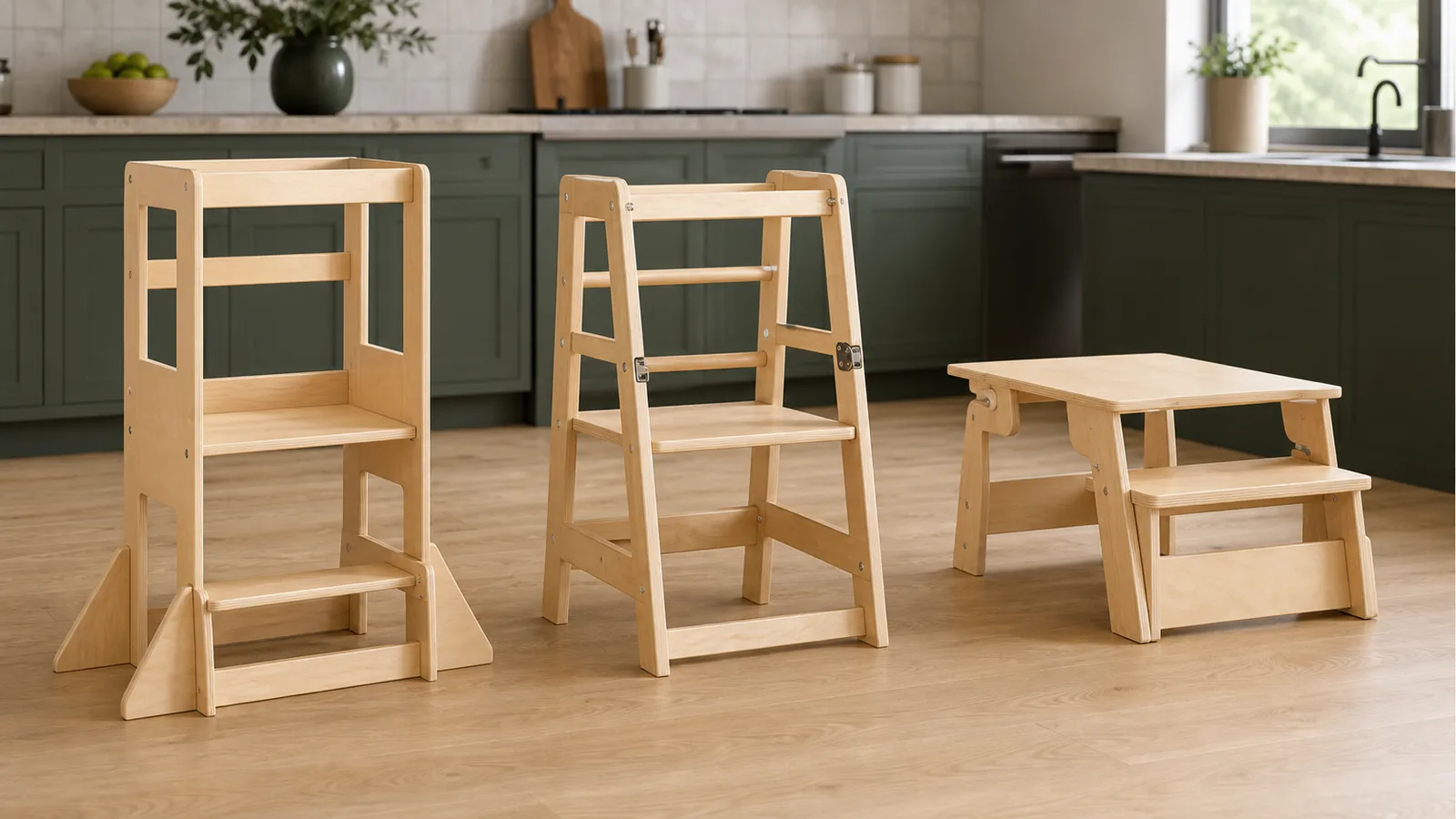
Fixed vs Foldable vs Convertible Toddler Towers
How fixed-frame, foldable, and convertible toddler towers differ in footprint, locks, storage, platform fit, and extra modes, with source-backed examples.
Read next