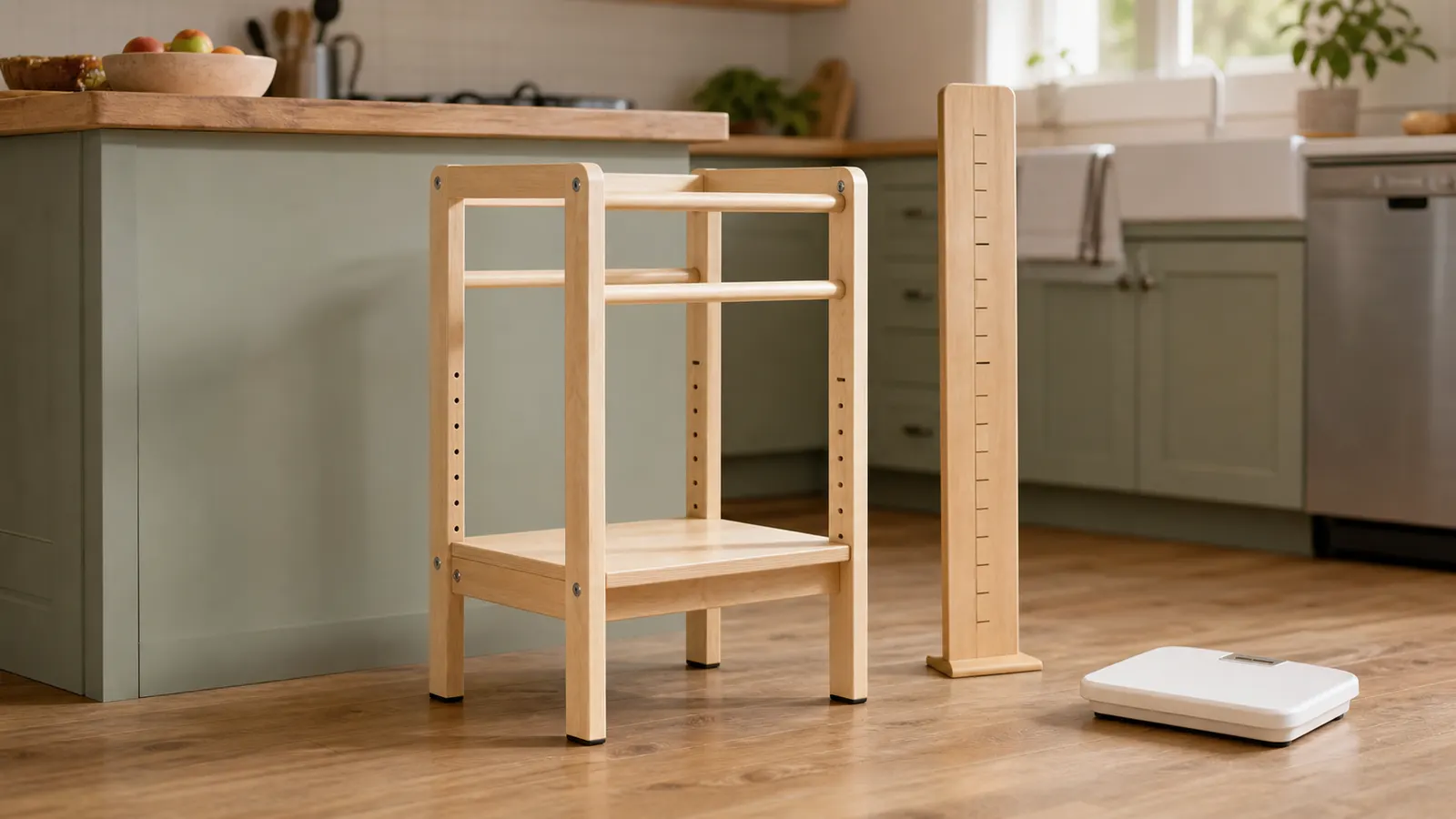
A child has outgrown a toddler tower when the first controlling limit fails, not when a generic birthday arrives. That limit may be the exact model's maximum age, child height, weight, waist or bellybutton relationship to the guard, ability to enter and exit as instructed, behavior in the tower, remaining platform adjustment, product condition, or an official stop-use notice. Check every gate together and stop at the earliest one. A generous weight rating does not override poor guard fit, and an open-ended age label does not mean indefinite use.
Four reasons to stop or pause tower use
Published limit
The child exceeds the exact model and mode's maximum age, height, weight, or other stated boundary.
Fit or behavior
The guard relationship fails, no platform position works, or the child cannot use the documented entry and standing area.
Product condition
A structural part, platform, guard, foot, fastener, strap, net, hinge, latch, or finish is unresolved.
Recall or instruction
An official notice, manufacturer message, or exact manual says to stop, repair, replace, or retire the product.
Published limits and exact-model outgrowing gates
This receipt is generated from the selected 25-model catalog. It separates maximum-age coverage, open and unresolved age fields, weight limits, numeric height examples, relative guard-fit rules, behavior conditions, source links, and real enlargeable product images.
- Selected model records
- 25
- Published maximum ages
- 18
- Published weight limits
- 24
4 are open-ended and 3 remain unresolved.
1 selected model still lacks a verified child-weight limit.
Two numeric height examples and three relative guard-fit examples stay model-specific.
Stop-use limit
Simplay3 Toddler Tower Folding Step Stool- Age:
- 18 months through 4 years
- Weight:
- 43 lb maximum
- Height or guard fit:
- No numeric child-height maximum is published in the current record.
- Behavior or readiness:
- The child must remain within the documented 18-month through 4-year tower-use range.
Stop tower use when either the stated age or weight maximum is exceeded. Do not substitute another model's higher limit.
Stop-use limit
Ingenuity Proper Positioner Create Up Multi-Mode Folding High Chair - Soulful Skies- Age:
- 18 months through 4 years
- Weight:
- 55 lb maximum
- Height or guard fit:
- The manual says to stop tower use when the child's waist is above the guard rail.
- Behavior or readiness:
- Use only the complete tower configuration and keep the child within the tower-mode age range.
Stop at the first age, weight, or guard-fit limit, even when another mode of the product has different limits.
Stop-use limit
CYBEX Lemo Training Tower- Age:
- Age maximum unresolved: current official sources conflict between approximately 4 and 5 years
- Weight:
- 55 lb maximum
- Height or guard fit:
- The manual adds a 110-centimeter child-height maximum to the 55-pound limit.
- Behavior or readiness:
- The child must stand independently and use the complete accessory on a compatible current-generation chair.
Do not resolve the age conflict by choosing the later number. Stop at the verified height or weight limit and ask CYBEX for the exact current age instruction.
Adjust, then stop
Sprout Sous-Chef Toddler Tower- Age:
- No fixed age range: current guidance uses standing readiness and a 28- to 44-inch height chart
- Weight:
- 150 lb maximum
- Height or guard fit:
- Published platform bands are 28 to 32, 32 to 38, and 38 to 44 inches. Lower the platform when the bellybutton rises above the side panels.
- Behavior or readiness:
- Rocking, side climbing, or climbing through the top onto another surface is manufacturer-described misuse.
Move through documented platform positions as the child grows and stop beyond the published 44-inch range or for unresolved misuse or fit.
Stop-use limit
Lalo The Tower- Age:
- 18 months through 6 years
- Weight:
- 200 lb maximum
- Height or guard fit:
- The manufacturer says to discontinue use when the child's waist is above the top rail.
- Behavior or readiness:
- The child must be able to climb in and out independently before and during use.
Stop when the child exceeds the published age or weight range, loses independent entry or exit, or rises above the rail-fit limit.
Guard configuration gate
Little Partners EZ Fold 'N Grow Learning Tower®- Age:
- 18 months through 6 years
- Weight:
- 75 lb maximum
- Height or guard fit:
- No numeric child-height maximum is published in the current record.
- Behavior or readiness:
- The manual recommends removable netting for every child under 24 months and until the child can stand with good balance.
Treat balance as a guard-configuration gate, not permission to exceed the model's published age, weight, or other use instructions.
Published limits are attributed manufacturer instructions, not developmental recommendations. Stop at the first exact-model limit, unresolved fit or behavior change, product-condition failure, or official stop-use notice. Records checked July 20, 2026.
The short answer: stop at the first failed gate
Check seven things before every continued-use decision: exact-model age range, child-height range, weight limit, guard relationship, documented entry and exit ability, behavior during use, and product condition or recall status. If one fails, stop use or make only the exact adjustment the manual permits. Do not average the limits or choose the most generous one.
Some failures are permanent for tower mode, such as exceeding a maximum age, height, or weight. Some may be temporary, such as losing reliable balance during illness, repeatedly misusing the structure, or waiting for a correct guard configuration or manufacturer response. Product damage and official stop-use notices always override developmental fit.
Match the physical tower before reading any cutoff
Photograph the brand, model, item or SKU, revision, lot or date code, and every permanent label. Save the current manual and any accessory or conversion instructions. A product family can contain different platform positions, guards, capacities, age ranges, and recalled production windows. Another model's higher rating cannot be borrowed.
Record whether the child is using a standalone tower, a tower accessory on a host chair, a high-chair conversion, a slide or desk mode, or a repaired recall unit. Limits can change by mode. Confirm that every required component and remedy is present before deciding whether the child still fits.
Treat the published maximum age as one limit, not the answer
In the selected 25-model set, 18 products publish a numeric maximum age, four publish an open-ended starting age without a maximum, and three have unresolved age records. Published upper ranges commonly end at 4, 5, or 6 years, but that does not create a category-wide cutoff. The exact product and mode control.
A child can fail another gate before the maximum birthday through height, guard fit, behavior, weight, condition, or recall status. A child also does not automatically remain eligible until the published age when the manufacturer requires independent standing, entry, exit, or another ability that is no longer present. Open-ended wording means the age field is incomplete, not that all later ages are approved.
Use weight as a ceiling, never as a fit test
Twenty-four selected models publish a child-weight limit, while Franklin+Emily remains unresolved in the current record. The published values vary widely. Weight is only a maximum load condition stated by the manufacturer. It does not prove the guard reaches the right part of the child's body, the platform is at the correct height, the child can enter safely, or the product remains stable in a real kitchen.
Stop when the exact limit is exceeded. Do not use an adult-rated or unusually high capacity to extend child use past the model's age, height, rail-fit, or behavior gate. Do not test the limit by adding weight, climbing on the tower, or asking another person to stand on it unless the exact instructions permit that use.
Check child height and the guard relationship
Some manufacturers publish a numeric height maximum. CYBEX adds a 110-centimeter maximum to the Lemo Training Tower's 55-pound limit. Sprout publishes a 28-to-44-inch child-height chart for its Sous-Chef tower. These numbers belong only to those exact products and configurations.
Other manufacturers use a relative fit rule. Lalo says to discontinue use when the child's waist is above the top rail. The Ingenuity Create Up manual uses the same waist-above-guard stop signal for tower mode. Sprout says to lower the platform when the child's bellybutton rises above the side panels. Inspect the relationship with the child standing normally on a documented platform position, not crouching, leaning, or standing on toes.
Adjust the platform only within documented positions
A higher platform can help a smaller child reach the work surface while keeping the guard at the intended body area. As the child grows, move to the next lower manufacturer position using the exact empty-product sequence. Recheck platform supports, hardware, guard, entry, adult reach, and counter fit after every change.
The tower is outgrown when no documented platform position restores acceptable guard fit and task height within every other limit. Do not drill a new hole, place a board on the platform, add a cushion, remove a rail, reverse a panel, raise the work surface, or use an intermediate position to gain more time.
Behavior and readiness remain continuing gates
Readiness is not a one-time milestone. The child must continue to use the documented entry, stand with the required balance, respond to supervision, and stay within the standing area. Lalo requires independent entry and exit. Little Partners ties removable netting to age and good balance. Sprout describes rocking, side climbing, and climbing through the top onto another surface as misuse.
Pause use when the child repeatedly climbs the exterior, sits or hangs on a rail, rocks the frame, tries to move it while inside, reaches an unsafe appliance or surface, exits through an unintended opening, or cannot follow the task boundary. An accessory is not a substitute for stopping an unresolved behavior. Reintroduce only when the exact manual permits the setup and close supervision can control the situation.
Separate an adjustment from a stop-use condition
A platform that can move down one documented level is an adjustment. A removable net or guard used as the manufacturer instructs is a configuration decision. A child temporarily unable to enter reliably may need a pause. By contrast, exceeding an exact maximum, rising above a nonadjustable guard, lacking any remaining platform position, or losing the ability required by the manual ends tower-mode eligibility.
Write the condition and response down. If the answer depends on a missing or conflicting source, keep the tower out of use and ask the manufacturer using the physical identifiers. Do not convert uncertainty into permission simply because the child used the product previously without an incident.
Product condition and recalls override growth fit
A child can still fit the age, height, and weight fields while the product itself has become unsuitable. Stop for a missing label, unresolved recall identity, damaged or substituted part, loose or stripped fastener, split or swollen material, unstable foot, worn strap or net, misaligned platform, incomplete latch, unexpected movement, sharp edge, or any manufacturer stop-use instruction.
Check the exact model in the recall ledger and confirm any match on the official notice. A repair kit, replacement crossbar, stabilizing base, or remedy sticker must match the notice and physical unit. Passing a growth checklist never clears an unrepaired recalled product or an improvised repair.
Transition only after the tower is retired safely
When tower mode ends, remove the product from the child's access before introducing another way to participate. Follow the manual for folding, conversion, disassembly, or storage. Keep original parts and labels together. Do not leave a retired tower open as furniture, an unsupervised climbing object, or a step for reaching a higher surface.
Choose any replacement from the next task and the child's current abilities rather than from the old tower's footprint. A conventional step stool, seated task, lower work surface, or another exact product has its own age, height, weight, supervision, and placement instructions. Outgrowing one product does not automatically qualify the child for another.
Run the monthly and growth-spurt record
Record the date, child height and weight, platform position, waist or bellybutton relationship to the guard, entry and exit behavior, task, floor and counter location, complete product condition, and recall-check date. Repeat after a growth spurt, platform change, illness, new behavior, impact, move, fold, conversion, repair, or long storage period.
Mark each gate pass, adjust, pause, stop, or unresolved. A clean record makes the transition easier because it shows which condition changed and which source controls the response. It also prevents a younger sibling or secondhand owner from inheriting an old setup without a new exact-unit audit.
Toddler tower outgrowing decision record
The first failed gate controls. Record an exact source and response rather than reducing all seven rows to a birthday.
| Gate | What to record | Continue or adjust | Stop or pause |
|---|---|---|---|
| Exact identity | Model, item or SKU, revision, lot or date code, mode, accessories, manual, recall search | All physical identifiers and required parts match the current instructions | Wrong or missing label, unresolved version, incompatible component, or stop-use notice |
| Age | Published minimum and maximum for the exact product and current mode | Child remains inside the range and every other gate passes | Maximum exceeded, range conflicts, or open-ended wording is being used as unlimited approval |
| Height and guard fit | Standing height, waist or bellybutton relationship, platform position, published height chart | A documented lower platform restores the required relationship | Numeric maximum exceeded or no permitted position restores guard fit |
| Weight | Current child weight and exact tower-mode maximum | Below the maximum while age, fit, behavior, and condition also pass | Maximum exceeded or the model's limit is unresolved |
| Behavior and readiness | Entry, exit, balance, standing, supervision response, exterior climbing, rocking, reaching | Child consistently uses the documented route and standing area | Repeated misuse, loss of required ability, unsafe reach, or inability to supervise directly |
| Product condition | Structure, joints, hardware, platform, guard, feet, net, straps, controls, finish, repair history | Every exact part and control remains complete and operates as documented | Damage, missing or substitute part, loosening, movement, sharp edge, or incomplete control |
| Environment | Floor, counter, entry, adult route, appliances, heat, water, cords, sharp objects, traffic | The adult can see and reach while every task hazard stays controlled | A new room or task defeats placement, guard fit, direct reach, or supervision |
Complete the continued-use audit
Toddler tower outgrowing FAQ
What age should a child stop using a toddler tower?
How do I know if my child is too tall for a toddler tower?
Does a high weight limit mean an older child can keep using the tower?
Can I lower the platform instead of stopping use?
Should I stop using the tower if my child climbs the outside?
Can a younger sibling use a tower after an older child outgrows it?
Method and Sources
How this page is checked
- Age and weight counts are generated from the 25 selected product records. Open-ended and unresolved age fields remain separate from numeric maximums.
- Numeric child-height examples are limited to CYBEX Lemo and Sprout Sous-Chef. Relative waist or bellybutton guard-fit rules are attributed only to the exact models whose official sources publish them.
- Behavior gates paraphrase exact manufacturer manuals or support pages. They are not developmental diagnoses or independent safety test results.
- A published limit does not clear product condition, recall status, assembly, compatibility, placement, or supervision. The first failed gate controls continued use.
Sources
- Lalo Safety Guidelines for the Tower
- Sprout Sous-Chef Toddler Tower
- Sprout Sous-Chef Toddler Tower R4 assembly and safety guide
- CYBEX Lemo Training Tower
- CYBEX Lemo Training Tower Set user guide
- Ingenuity Proper Positioner Create Up owner manual
- Simplay3 Toddler Tower Folding Step Stool
- Little Partners EZ Fold 'N Grow Learning Tower manual
Keep reading
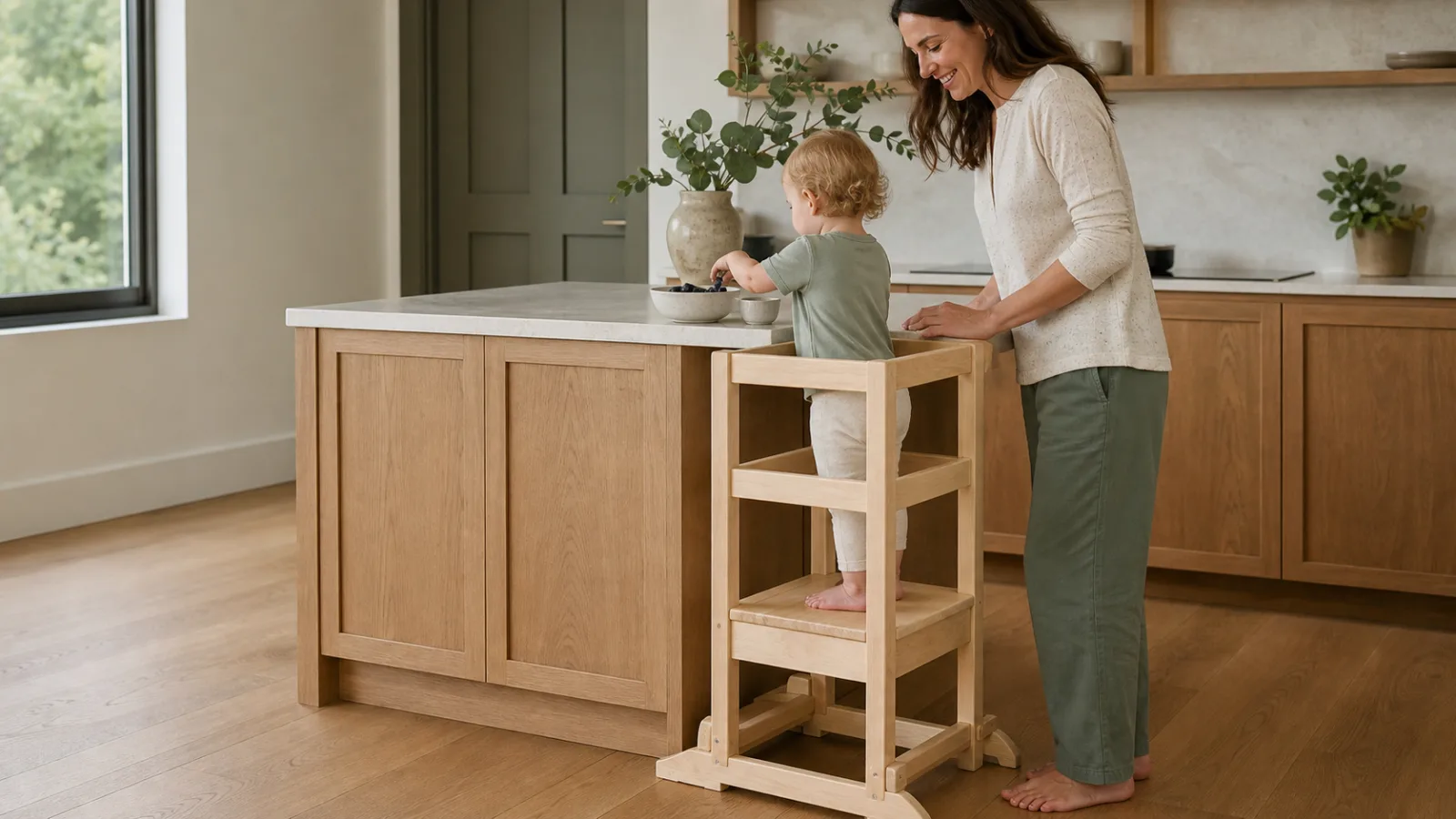
What Age Is a Toddler Tower For?
Use the exact model's age label, the child's observed readiness, physical fit, and recall status to decide when a toddler tower is appropriate and when to stop using it.
Read next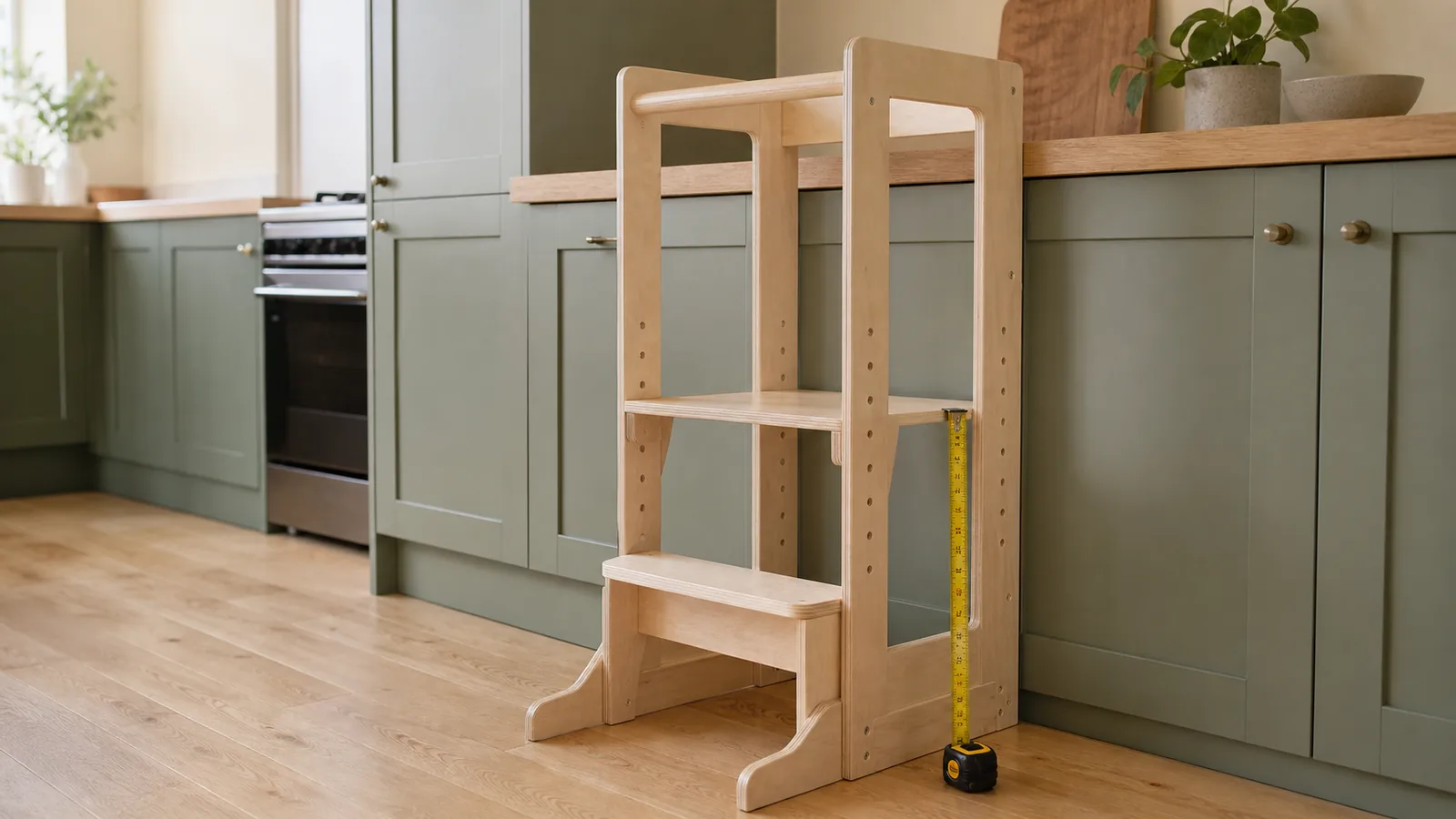
Toddler Tower Height and Counter Fit
Measure your work surface and child, calculate a starting platform height, and compare it with exact published tower positions without mistaking overall height for fit.
Read next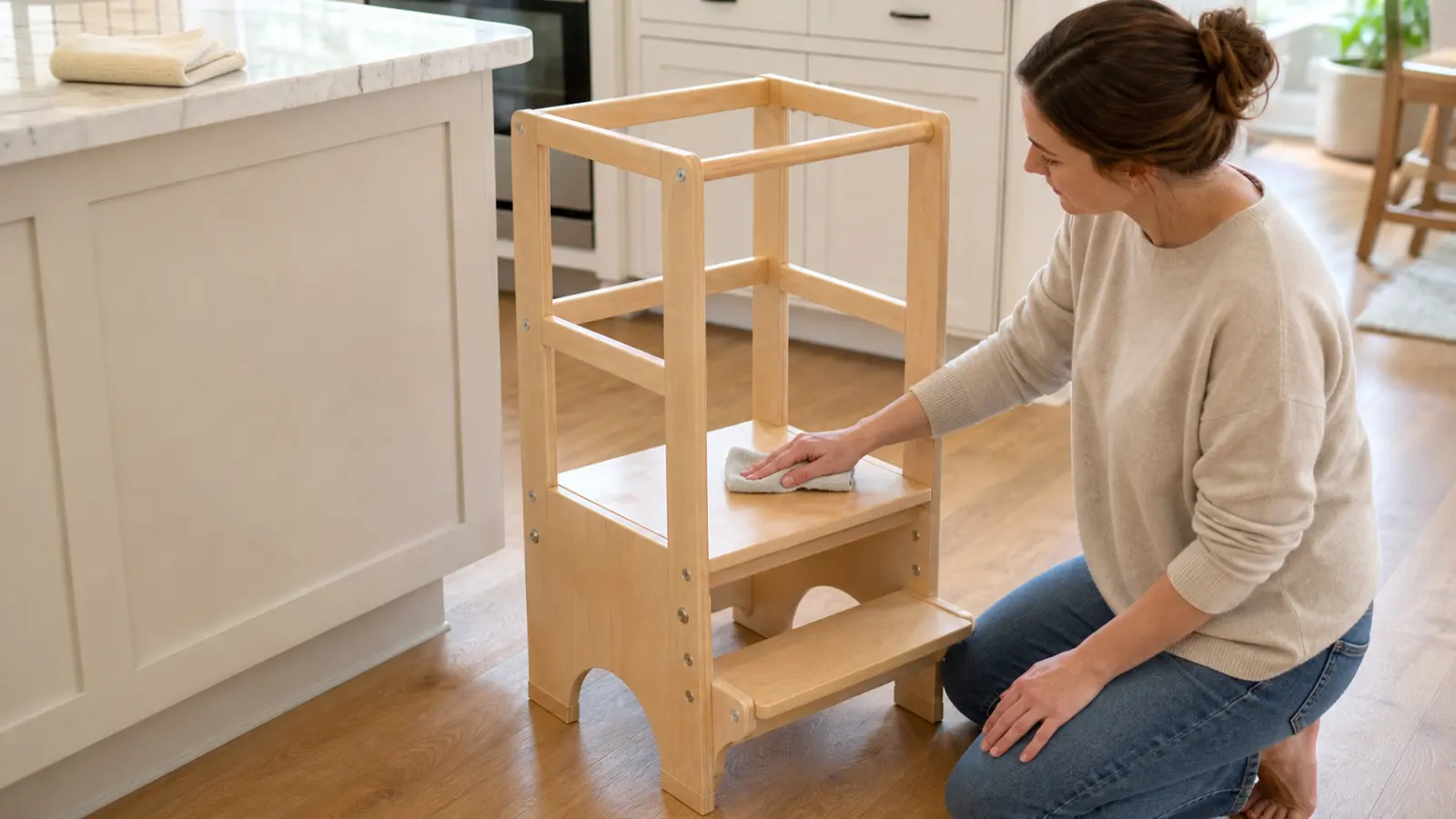
How to Clean and Maintain a Toddler Tower
A model-specific routine for cleaning toddler tower surfaces, drying spills, checking hardware and locks, and recognizing damage that should stop use.
Read next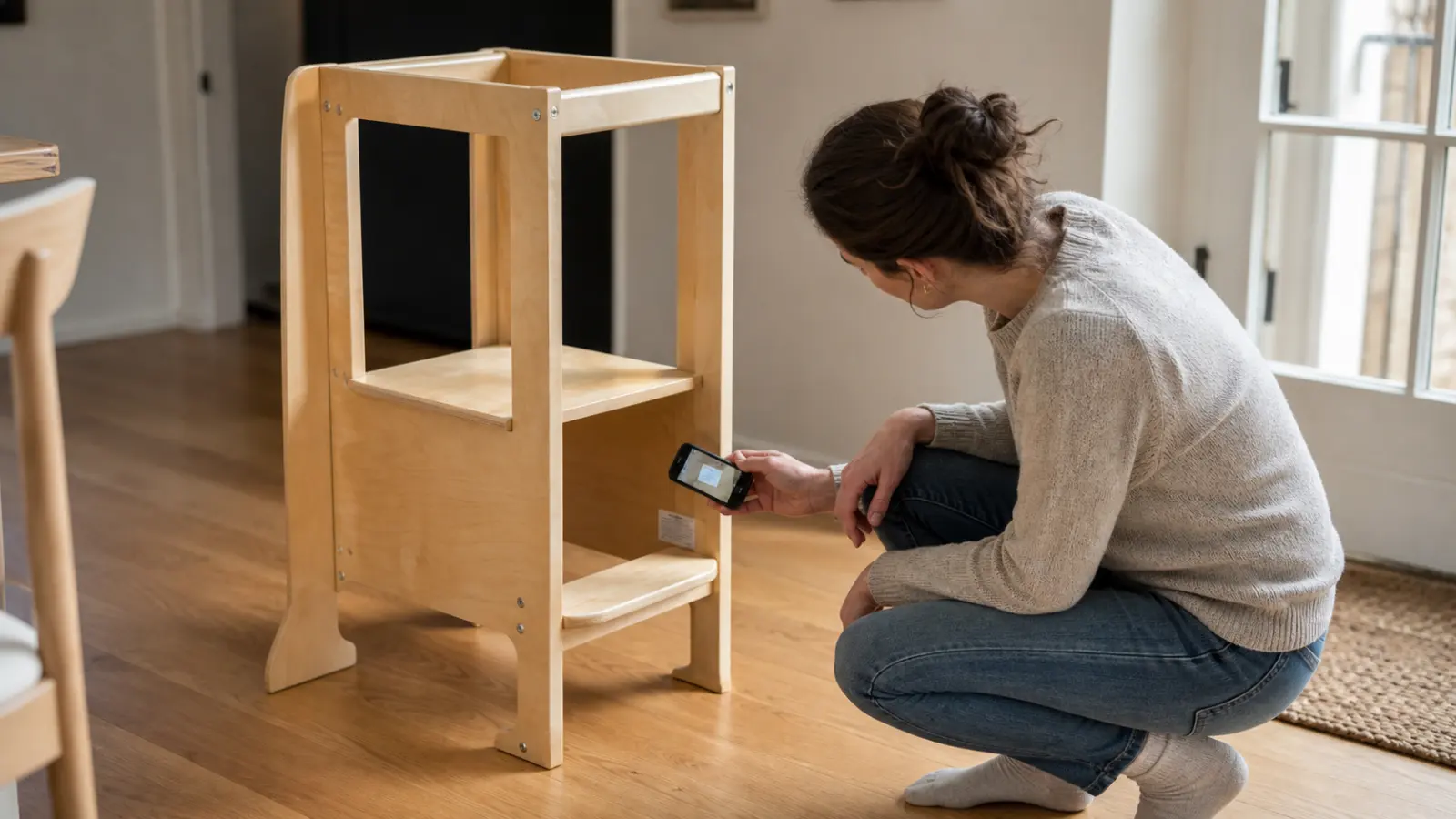
Buying a Used Toddler Tower: Inspection Checklist
How to verify a secondhand toddler tower's model, recall and repair status, hardware, frame, platform, locks, and manual before deciding whether to buy it.
Read next