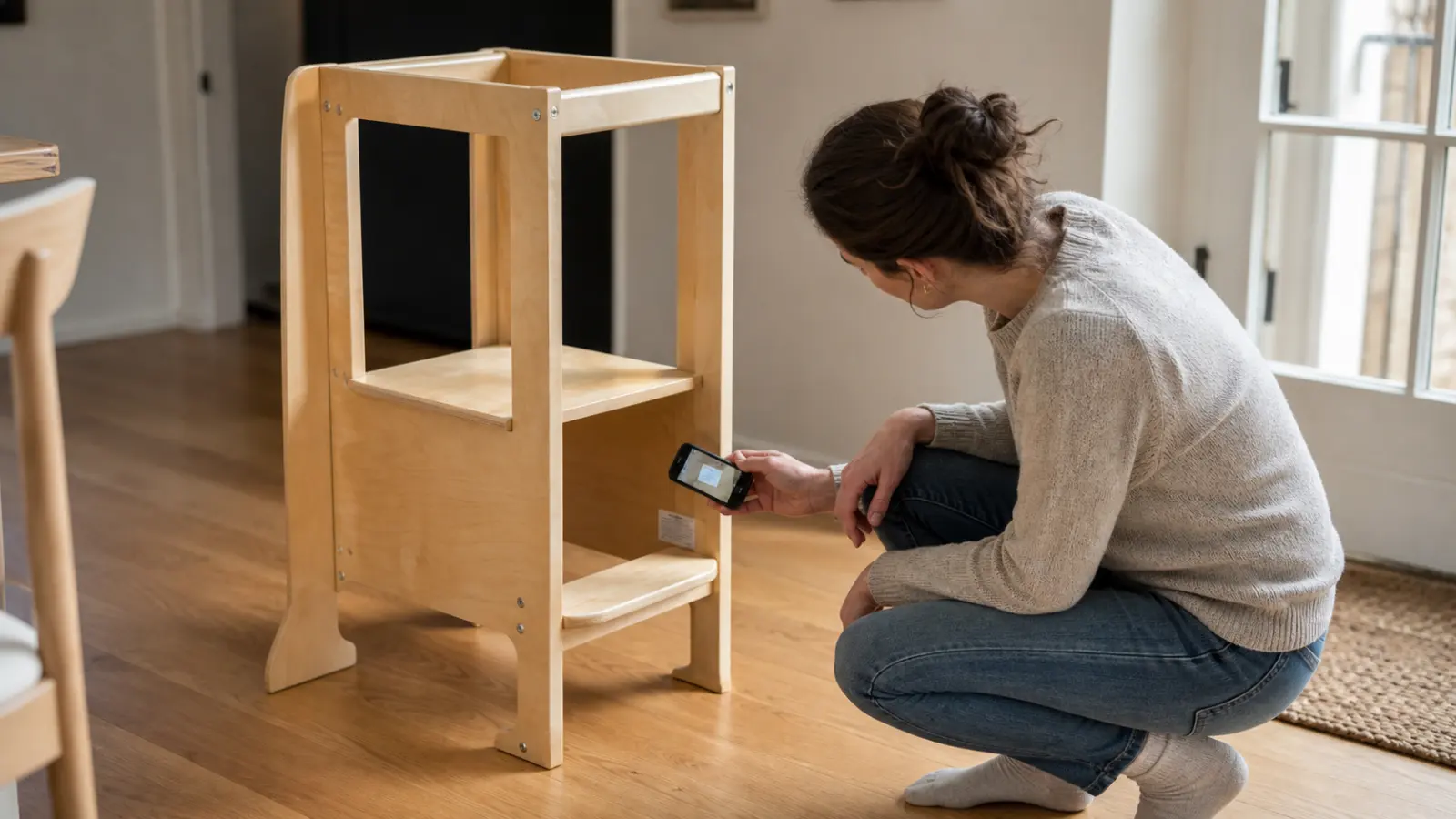
A used toddler tower can be a sensible purchase only when the physical unit can be identified and inspected. Ask for clear photos of the model label before meeting the seller, check the exact model, lot, date code, and repair status against the official recall notice, and inspect the empty tower with the matching manual. Cosmetic wear may be acceptable. A missing label, unresolved recall, substituted hardware, improvised repair, cracked structure, loose platform, or incomplete lock is a reason to pause or walk away, regardless of the price.
The secondhand decision order
1. Prove the identity
Get uncropped photos of the physical model, item, revision, lot, and date-code labels before meeting the seller.
2. Clear the recall gate
Match every identifier to the official notice and verify the exact remedy when the unit is affected.
3. Inspect the empty unit
Use the matching manual to check the frame, guard, platform, steps, feet, fasteners, locks, and accessories.
4. Decide without the discount
Choose buy, hold, skip, or stop use based on evidence and condition before considering the price.
Why the physical label matters
This evidence receipt is generated from the validated 25-model comparison set. It shows how often exact identifiers exist and where revision, lot, date-code, recall, or compatibility details create a unit-level gate.
- Selected model records
- 25
- Published identifiers
- 25
- Recall or version flags
- 6
Current color item numbers: G97329 White, G97343 Natural, G97340 Walnut, G97330 Royal Navy, G97337 Gray, and G97341 Ivory.
Unit gate: Recall 26-490 applies to current Contemporary item numbers only when paired with affected lots C1022 through L1022 or A1023 through J1023 and purchased from 2022-06-01 through 2023-10-31.
Commerce SKU and recalled model LP01711, UPC 680798017710; manual family LP0171.
Unit gate: Recall 26-096 covers LP01711 units dated 202409 through 202501. Affected units are cleared only after the replacement crossbar and official remedy sticker are verified.
The current product page's embedded manufacturer video description identifies SKU 418070 01.
Unit gate: Recall 23-265 covers model 41807-01, 41807-02, and 41807-03 units with date codes from 2018-11 through 2023-06.
Stone Blue tower accessory article 523001535 and required Stone Blue Lemo Chair article 522002309.
Unit gate: Compatible only with the latest Lemo Chair generation whose chair article number begins with 52.
All 25 selected records publish a manufacturer identifier, but only 8 publish revision evidence and 5 publish a lot or date-code scope. A listing photo must be matched to the physical unit. Records checked July 20, 2026.
The short answer: identify first, inspect second, price last
Do not start with the finish, accessories, or discount. Start with the permanent information on the physical unit. You need the brand, model or item number, revision when one exists, and any lot or date code used by the manufacturer. Those fields decide which manual belongs to the tower and whether a recall or repair applies. A seller's listing title is not enough.
CPSC says it is unlawful to sell a recalled consumer product in the United States. Its current buying-and-selling guidance also says a recalled product may be sold after the official remedy has been applied, with the listing making that remedy clear. For a buyer, that means a vague claim such as fixed, updated, or not recalled is not evidence. Match the unit to the official notice and verify the specified replacement part, sticker, refund, or other remedy before money changes hands.
Ask for label photos before arranging pickup
Request one sharp photo of the entire tower and close photos of every label, the underside of the platform, the rear and lower rails, the hardware on both sides, the feet, and every folding or conversion control. Ask the seller not to crop the label. The photo should show the field names and values together so a model number from one product cannot be paired with a date code from another.
Compare the label with the manufacturer page, matching manual, and official CPSC recall search. Product names can stay the same while item numbers, dimensions, mechanisms, or generations change. If the seller cannot find the label, the label is unreadable, or the physical tower differs from the manual, place the decision on hold. A clean recall search for a guessed name does not clear an unidentified unit.
Resolve the exact recall and repair state
Recall scope often uses more than a brand name. Guidecraft recall 26-490 depends on listed item and lot combinations. Little Partners Grow 'N Stow recall 26-096 depends on model LP01711 and a date code from 202409 through 202501. Simplay3 recall 23-265 names three 41807-series models and date codes from November 2018 through June 2023. These are unit-level checks, not brand-wide verdicts.
When the notice offers a repair, read its remedy section before inspecting the product. Verify the exact part and any identifying mark described by the notice. The Grow 'N Stow remedy, for example, uses a replacement crossbar with an official remedy sticker. A homemade crossbar, extra screw, seller receipt for an unrelated part, or verbal assurance does not establish that remedy. Keep an affected unrepaired product out of use and follow the official notice.
Inspect the empty structure from the floor up
Set the empty tower on a level, hard floor in good light. Look at every foot and base extension first. The unit should rest as the manual shows, without a missing foot, bent stabilizer, split base, soft wood, damaged plastic, or improvised pad. Then inspect both side frames, crossbars, rails, steps, and the platform. Look for cracks, delamination, deep splits through fastener holes, bent metal, enlarged holes, movement at joints, and parts that do not sit square.
Minor finish scratches and surface scuffs may be cosmetic, but condition cannot be judged from color alone. Discoloration can hide moisture damage. Fresh paint can hide a crack or mixed parts. Sticker residue can cover a label. If a structural area has been filled, glued, sanded heavily, drilled again, or repainted so that its condition cannot be evaluated, ask the manufacturer whether it is serviceable or skip the unit.
Match every fastener, platform support, and lock to the manual
Open the exact manual and inventory the hardware. Check that bolts, screws, nuts, washers, pins, clips, feet, hinges, latches, platform supports, and accessory brackets match the documented quantity and position. Similar-looking hardware from a home center may have a different diameter, thread, length, head, grade, or shoulder. Do not accept a statement that the substitute is close enough for a child standing at counter height.
For an adjustable platform, confirm that every documented position and support is intact. For a foldable or convertible tower, move the empty product through the manual's sequence and inspect every required usable-state lock on both sides. Stop for a platform that shifts, a latch that will not fully engage, a pin that backs out, a frame that spreads, a hinge with excessive play, or controls that do not match the diagrams. Do not add a child or invent a push, shake, or load test.
Treat missing parts and improvised repairs as decision stops
CPSC's reseller guidance tells sellers not to sell broken or wobbly nursery furniture or durable infant products that are missing parts. A toddler tower should get the same conservative treatment even when a particular regulatory category does not map neatly to its listing name. Missing hardware, a loose platform, a wobbling frame, or a broken guard is not balanced out by a low price.
Contact the manufacturer with the model, revision, label photos, and a description of the missing or damaged part. Use only a replacement and procedure the manufacturer confirms for that exact unit. Tape, cable ties, added brackets, wedges, generic screws, copied wood pieces, and seller-made stabilizers can change load paths or create new pinch, protrusion, entrapment, or collapse hazards. If the maker cannot identify or support the unit, do not make yourself its product engineer.
Transport and reassembly create a new inspection point
Photograph the assembled product before disassembly and keep every part together, but use the manual rather than the photos as the assembly authority. Do not lift the tower by a guard, platform, hinge, or moving rail unless the instructions permit it. Protect the label from abrasion and keep hardware in a closed container identified for that exact tower.
After transport, assemble or open the tower from the beginning on a level surface. Repeat the empty structural and lock checks. Confirm the final platform position against your measured counter and recheck the recall record using the label now in your possession. A tower that looked sound at pickup is not ready merely because it survived the car ride.
Use four outcomes instead of forcing a yes or no
Buy is appropriate only when the unit is fully identified, its recall state is resolved, the matching manual is available, every required part is present, the empty structure and mechanisms match that manual, and its verified dimensions fit your home. Hold means you need a manufacturer answer, clearer label photo, exact replacement part, or remedy proof before deciding.
Skip means the label is missing, the model cannot be reconciled, structural damage or substituted hardware is present, the platform or frame moves, or a required control will not lock. Stop use and follow the official remedy means the unit falls within a recall and the remedy is incomplete. A known hazardous or noncompliant product should not be passed to another family, donated, or relisted.
Cosmetic wear versus decision-stopping evidence
Cosmetic condition never clears identity, recall, fit, or mechanism checks. When damage reaches a structural or identifying area, pause or skip the unit.
| Area | Potentially cosmetic | Hold or skip |
|---|---|---|
| Finish | Light surface scuffs with intact material underneath | Fresh cover-up paint, soft wood, swelling, deep splits, or hidden repairs |
| Identity label | Worn edge while every required field remains legible | Missing, cropped, altered, mismatched, or unreadable model and date fields |
| Hardware | Normal tool marks on complete manufacturer-specified fasteners | Missing, stripped, rusted, bent, loose, or substituted fasteners and enlarged holes |
| Frame and guard | Small finish rubs away from joints and fasteners | Cracks, movement, bent rails, glue repairs, extra brackets, or missing guard parts |
| Platform | Minor surface wear with all supports intact | Rocking, bowing, delamination, incorrect orientation, or incomplete support |
| Folding or conversion controls | Superficial finish wear that does not affect operation | Incomplete engagement, excessive play, stiffness, spring-back, or a manual mismatch |
| Recall remedy | Official part and identifier verified against the notice | Seller assurance, homemade fix, unidentified part, or missing remedy proof |
Complete the unit-level checks
Used toddler tower questions
Is it legal to sell a recalled toddler tower?
What if the used tower's model label is missing?
Can I replace missing screws with hardware-store screws?
Can sanding or repainting make a used toddler tower safe?
Can a repaired recalled tower be resold?
Which photos should I request from the seller?
Method and Sources
How this page is checked
- The identity evidence receipt is derived at render time from the reviewed 25-model comparison set. Counts change only when the validated product records change.
- Recall and remedy statements cite current official CPSC guidance and exact CPSC recall notices. CPSC.gov remains the authoritative final source.
- Condition checks are conservative screening steps, not a certification or hands-on safety test. Toddler Home Brief has not inspected the secondhand unit a reader may be considering.
- A none-found recall result means no matching notice was found for the exact searched identity on the verification date. It is not a safety guarantee and can change.
Sources
- CPSC: Stopping the Online Sale of Recalled Products
- CPSC: For Buying and Selling Products Online
- CPSC Reseller's Guide to Selling Safer Products, February 2025
- CPSC recall listing
- CPSC Little Partners Grow 'N Stow recall, November 2025
- CPSC Guidecraft Kitchen Helper recall, May 2026
- CPSC Simplay3 Toddler Tower recall, August 2023
Keep reading
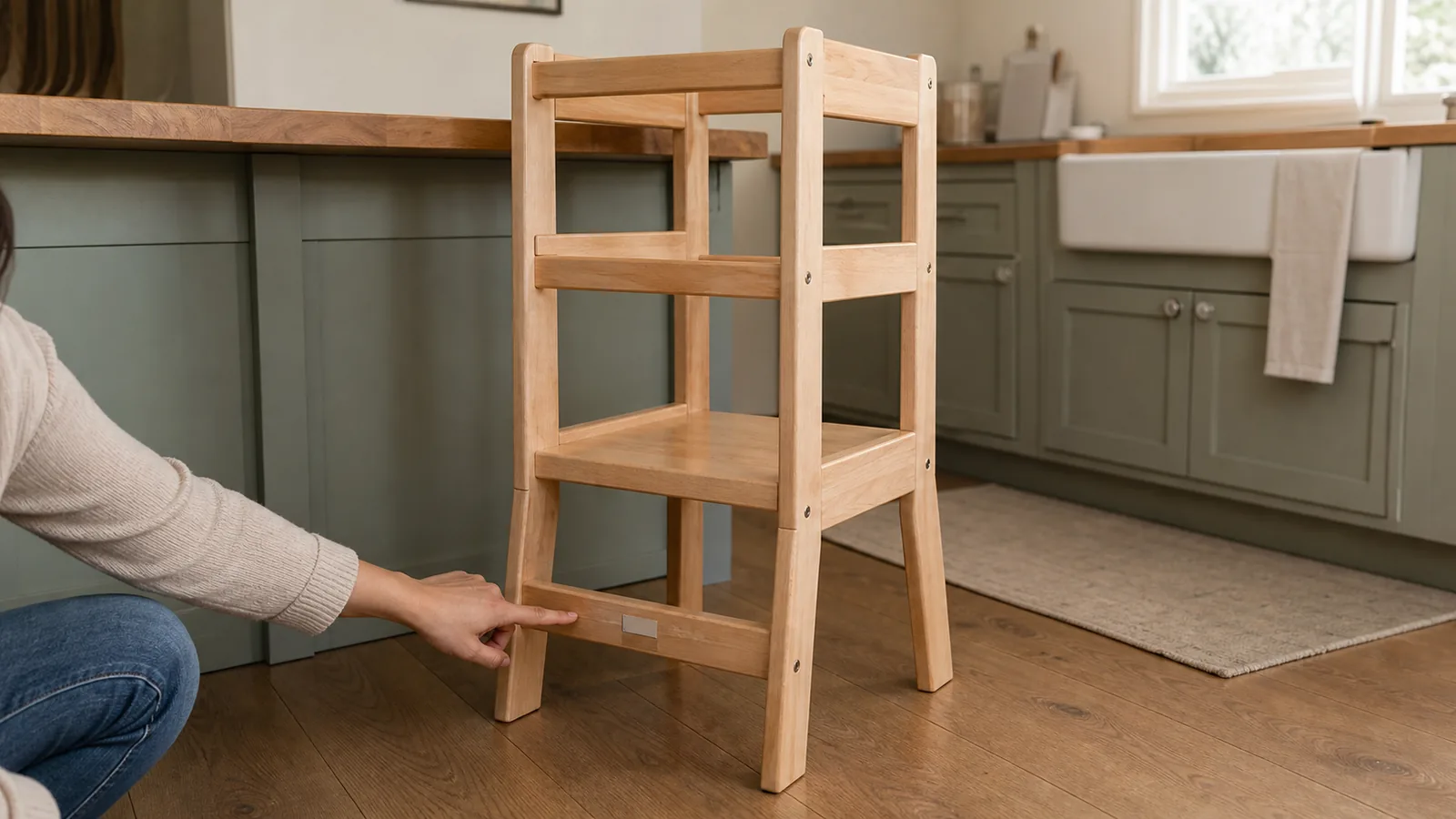
Toddler Tower Safety Standards and Recalls
What safety standards actually exist for toddler towers, every official CPSC tower recall we track, and how to check a specific model before you buy or keep using it.
Read next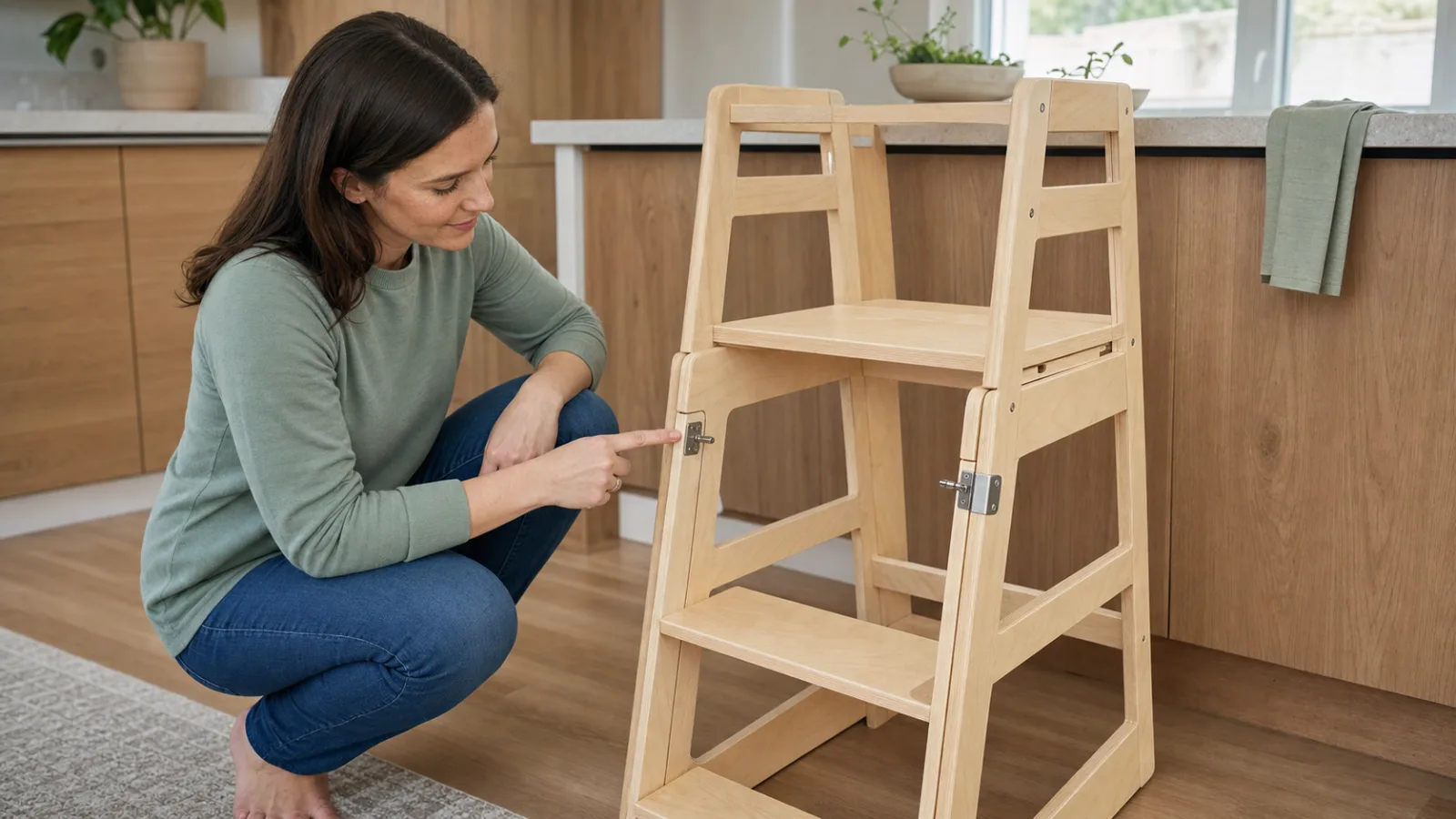
Foldable Toddler Tower Safety: Lock and Setup Checks
How to identify every lock in a foldable toddler tower's manual, check the empty setup before use, recognize stop-use conditions, and interpret folding-related recalls.
Read next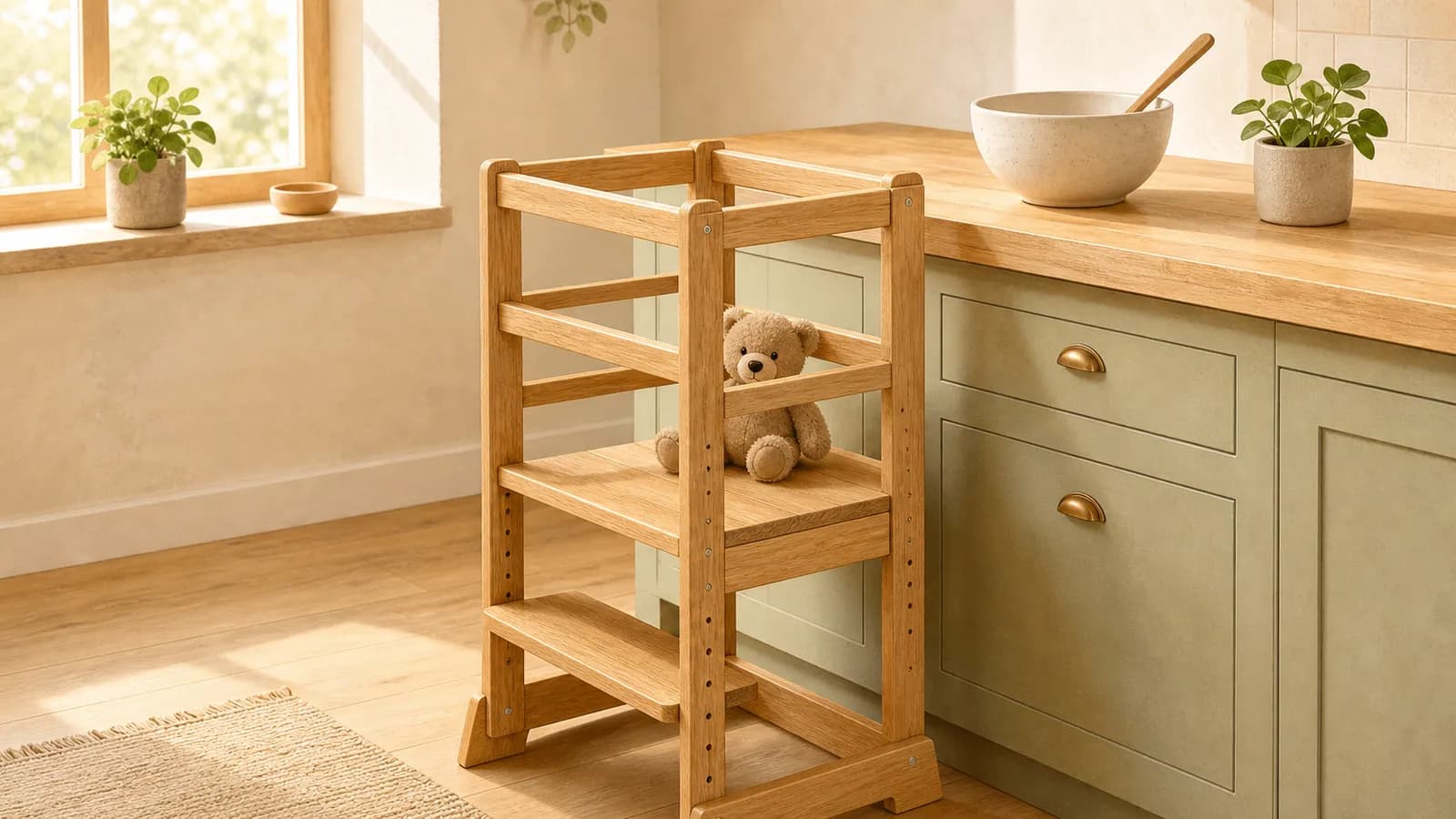
How to Choose a Toddler Tower
A practical, safety-first guide to choosing a toddler tower: how to fit it to your counter height, read guard and stability design against the real recall hazards, judge foldable versus fixed, and run a pre-purchase checklist on any model.
Read next
What Age Is a Toddler Tower For?
Use the exact model's age label, the child's observed readiness, physical fit, and recall status to decide when a toddler tower is appropriate and when to stop using it.
Read next