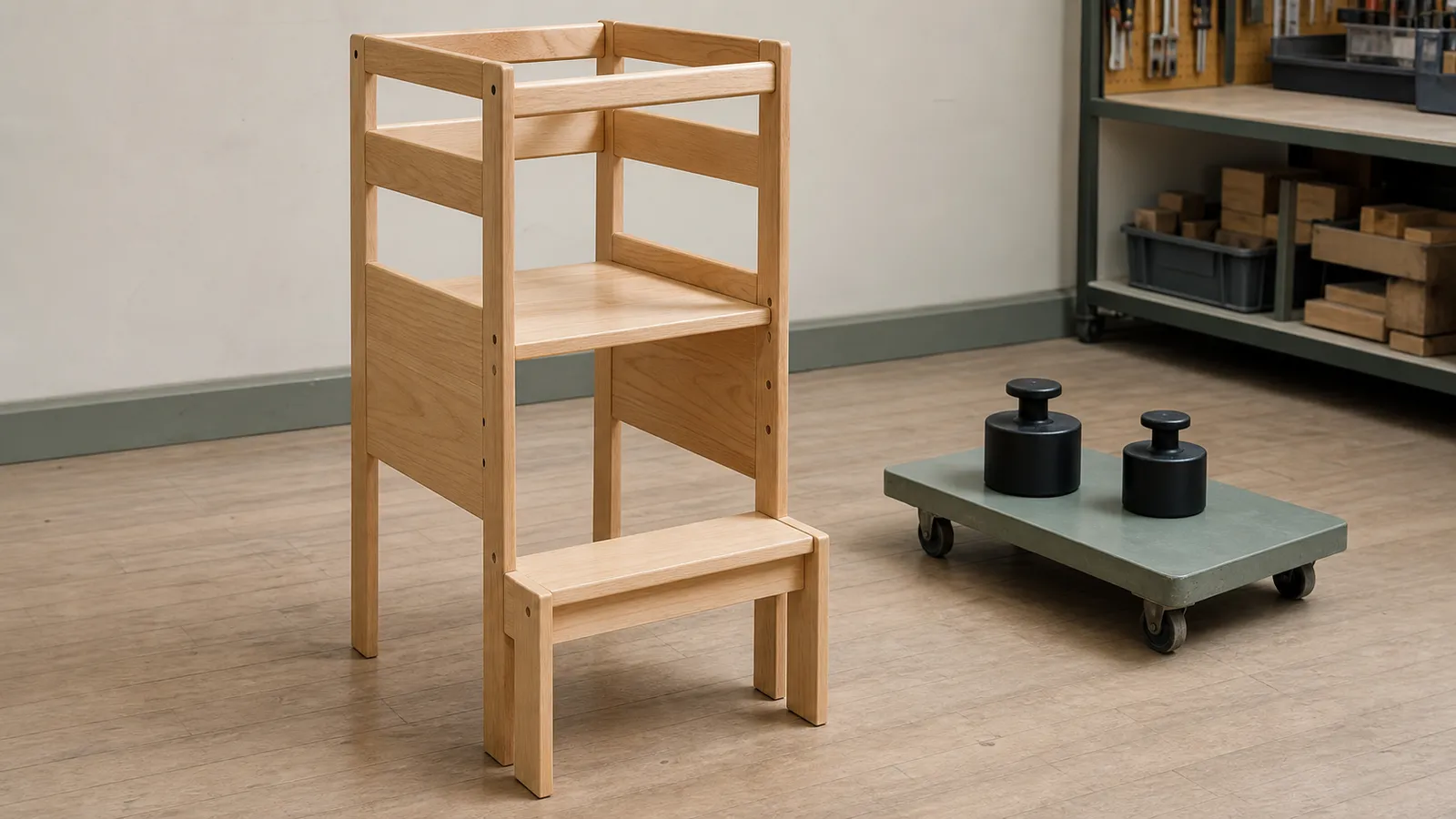
A toddler tower weight limit is not a safety score. It is an attributed maximum for an exact product and, sometimes, one particular configuration. A larger number does not by itself prove better stability, a safer guard, stronger hardware, longer useful life, adult eligibility, or a better fit for your child. Match the physical model and mode, verify the source, keep child capacity separate from the tower's own weight, and stop at whichever age, height, guard-fit, behavior, condition, recall, or weight limit fails first.
Four things a weight limit cannot decide
Stability
Capacity does not show how the base responds to leaning, climbing, an uneven floor, or a directional tip force.
Guard fit
A child can remain below the limit while the waist, bellybutton, or standing position no longer fits the exact guard rule.
Age and readiness
The model can still require a narrower age range, independent standing, controlled entry and exit, or another continuing ability.
Current condition
A recall, missing part, loose fastener, incomplete latch, damaged platform, or incompatible mode overrides the number.
The selected 25-model weight-limit ledger
This receipt is generated from the validated comparison catalog. It keeps child capacity separate from assembled product weight, preserves evidence state and conflicts, links every source, and shows real enlargeable product images.
- Selected model records
- 25
- Published child limits
- 24
- Distinct published values
- 11
This is the range of attributed limits in the selected catalog, not a recommended capacity range.
22 manufacturer-stated and 2 cross-source verified. None are hands-on tested.
The tower's own assembled weight is a separate field and must not be confused with child capacity.
Published child-limit distribution
Each bar counts selected models that publish the exact same value.
The current-linked R4 manual and detailed product information state 150 pounds. Promotional page callouts also state 160 pounds, so the lower documented limit is retained and the conflict remains visible.
The linked generic Kitchen Helper manual states 125 pounds.
The page does not label 250 pounds as a per-child figure. Do not multiply it by the number of users.
No weight limit was found in the current product page or linked manual.
A child-weight limit is a manufacturer-attributed ceiling for the exact product and mode. It does not establish stability, guard fit, age eligibility, platform fit, condition, recall clearance, or suitability for adult use. The unresolved model stays unresolved. Sources checked July 20, 2026.
The short answer: capacity is one ceiling, not a verdict
Use the child-weight limit only for the exact brand, model, revision, and current mode named by its source. Stay below it, but do not treat that as permission to ignore a lower maximum age, child-height limit, waist or bellybutton guard rule, required platform position, compatibility condition, damaged part, unresolved recall, or stop-use instruction.
The current ASTM standing-tower work item treats structural performance as only one part of a larger safety problem that also includes tip-over, entrapment, guards, durability, falls, and pinch points. The draft scope does not turn a manufacturer's capacity claim into proof that every other hazard was cleared, and the product-specific specification remains under development.
Identify the exact tower and mode before copying a number
Photograph the brand, model, item or SKU, revision, lot or date code, and every permanent label. Save the current manual. A product family can contain a single tower, double-width version, folding revision, replacement part, or recalled production window with different instructions. A retailer title or visually similar image is not enough to transfer a limit.
Write down the active configuration. A standalone tower, tower accessory attached to a host chair, high-chair conversion, table mode, slide mode, and folded storage position are not interchangeable. The limit must come from the instructions that govern the mode being used, with every required host product, guard, platform, latch, strap, and stabilizing part installed.
Keep four different weight questions separate
Child capacity asks how much child weight the manufacturer permits in the documented tower mode. Product weight asks how much the assembled tower itself weighs. Shipping weight can include packaging and accessories. A test load describes a particular test method, force direction, duration, and setup. These values answer different questions and must not be substituted for one another.
A heavier tower may feel harder to move, but product weight alone does not establish its resistance to tipping in every direction. A high child limit may indicate a stated structural capacity, but it does not tell you where the child's body sits relative to the guard, how the base reacts to leaning, whether a fold lock is engaged, or whether a loose fastener has reduced the product's current integrity.
Do not use a high limit to extend a failed fit
Lalo publishes a 200-pound child maximum and separately says to discontinue use when the child's waist is above the top rail. Little Partners publishes a 250-pound maximum for its Original Learning Tower while also stating an age range of 2 through 6 years. These are useful examples because the higher number does not erase the separate guard-fit or age instruction.
Check the first controlling limit. A child can remain far below the weight ceiling while becoming too tall for the guard, exceeding the maximum age, losing a safe platform relationship, climbing the exterior, or reaching a hazardous surface. Conversely, an open-ended age field does not permit use above a published weight or height maximum.
Do not infer adult use from a large child-capacity claim
A number above the weight of many adults can be tempting to read as permission for an adult to climb into the tower. Do not make that inference. The intended user, entry route, standing area, guard geometry, balance assumptions, and foreseeable movement are part of the product context. Use by an adult requires explicit instructions for that exact product and mode, not arithmetic alone.
The same rule applies to two children. A combined weight below the published limit does not automatically authorize simultaneous use. The product source must explicitly permit the number of users and the configuration. Body position, available standing area, guard access, and competing movement remain separate from the sum on a scale.
Treat source conflicts as a stop-and-resolve signal
The selected Guidecraft Double record preserves a real conflict: its double-specific product page states 175 pounds, while a linked generic Kitchen Helper manual states 125 pounds. We do not choose the larger number or average them. Keep the exact unit out of any use that depends on the disputed range until Guidecraft confirms which current document controls the physical item.
Missing values stay missing. The current Franklin+Emily product page publishes the tower's own 15-pound product weight and an age range, but our review did not find a child-weight limit on that page or in the linked assembly and care manual. Product weight is not a fallback capacity, and another birch tower's limit is not evidence for this one.
Use the lowest applicable limit in a multi-mode product
Convertible products can publish different limits for tower, chair, stool, desk, table, slide, or high-chair modes. An accessory-based tower can depend on the compatible generation of a host chair. Record the limit beside the mode name and required components rather than keeping one unlabeled number for the whole product family.
After every conversion, verify the manual sequence while the product is empty. Confirm the guard, platform, hinges, latches, hardware, host-chair connection, feet, and anti-tip parts before applying the mode's child limit. A successful conversion does not inherit the limit of a different setup unless the manufacturer explicitly says so.
Never test the published maximum with a child or home load stack
Do not place a child at the limit, add another person, hang weights from a rail, or climb into the tower to see whether it holds. A one-time home load can miss off-center forces, tipping, repeated cycles, loosened hardware, platform retention, guard deformation, fold-lock behavior, and damage that appears after the load is removed.
A home inspection can still identify reasons to stop. Look for missing or mismatched labels, unresolved recall identity, loose or stripped fasteners, split or swollen material, bent parts, damaged guards, incomplete latches, worn straps or nets, unstable feet, platform movement, or any unexpected sound or flex. Finding none is not an independent capacity test.
Build a continued-use record around the first failed gate
Record the date, exact model and mode, child weight, child height, age guidance, guard relationship, platform position, entry and exit behavior, product condition, recall check, and the source for every limit. Repeat after a growth spurt, platform change, conversion, fold, impact, repair, move, long storage period, or new behavior.
Mark each field pass, adjust, pause, stop, or unresolved. Stop or pause at the first failure. A documented record prevents a memorable large capacity number from overpowering the quieter facts that actually changed, such as waist height, a damaged fastener, an incompatible host chair, or a newly identified recall scope.
How to read every number before use
Do not let an easy-to-compare capacity value replace a harder exact-model check.
| Field | What it answers | What it does not answer | Action |
|---|---|---|---|
| Child-weight limit | The attributed maximum child load for the named product and mode | Stability, guard fit, age, height, behavior, condition, recall clearance, or adult use | Stay below it and still check every separate gate |
| Product weight | The stated weight of the assembled product | Child capacity or resistance to tipping in every direction | Use it for handling and space planning only within its source context |
| Age range | The manufacturer's stated age boundary for the product or mode | Current readiness, height, guard fit, weight, behavior, or condition | Stop at the maximum or sooner when another gate fails |
| Height or guard rule | Whether the standing child remains within a published numeric or relative fit limit | Structural capacity, recall status, or room hazards | Use the exact platform position and stop when no documented position works |
| Test load | Only what a defined method, setup, direction, duration, and pass criterion evaluate | Every hazard outside that test or the condition of a different physical unit | Do not invent a home test or convert a test load into a user rating |
| Combined user weight | Arithmetic only | Permission for two children or an adult and child to use the tower together | Require explicit exact-model instructions for user count and configuration |
Complete the limit check
Toddler tower weight-limit questions
How much weight can a toddler tower hold?
Does a higher weight limit mean a toddler tower is safer?
Can an adult use a toddler tower rated for 200 or 250 pounds?
Can two children share a tower if their combined weight is below the limit?
What if the product page and manual list different weight limits?
Can I test a toddler tower's weight limit at home?
What should I do when no weight limit is published?
Method and Sources
How this page is checked
- Child-weight and product-weight counts, distribution, limits, evidence states, source links, notes, and images are rendered from the 25 selected catalog records rather than copied into the article.
- Manufacturer-stated and source-verified are provenance states, not hands-on test results or comparative safety verdicts. No selected model currently carries a hands-on-tested child-capacity field.
- The Guidecraft Double conflict is preserved exactly as recorded: the double-specific product page states 175 pounds while a linked generic Kitchen Helper manual states 125 pounds.
- Franklin+Emily remains not yet verified because the current product page and linked manual publish product weight and age information but no child-weight maximum found by this review.
- The conclusion that capacity cannot prove every other hazard is an evidence-boundary inference from the separate tip-over, entrapment, guard, durability, fall, and pinch topics in ASTM WK86690 and the separate product fields in this catalog.
Sources
- ASTM WK86690 proposed specification for children's standing towers
- Little Partners Original Learning Tower product page
- Lalo Safety Guidelines for the Tower
- Guidecraft Kitchen Helper Toddler Tower Double
- Guidecraft generic Kitchen Helper instruction manual
- Franklin+Emily Toddler Tower product page
- Franklin+Emily Toddler Tower assembly and care instructions
- CYBEX Lemo Training Tower
- CYBEX Lemo Training Tower Set user guide
Keep reading
When to Stop Using a Toddler Tower: Outgrowing Checklist
Use the first exact-model age, height, weight, guard-fit, behavior, condition, or recall limit that fails instead of relying on one universal toddler tower cutoff.
Read next
What Age Is a Toddler Tower For?
Use the exact model's age label, the child's observed readiness, physical fit, and recall status to decide when a toddler tower is appropriate and when to stop using it.
Read next
Toddler Tower Height and Counter Fit
Measure your work surface and child, calculate a starting platform height, and compare it with exact published tower positions without mistaking overall height for fit.
Read next
Toddler Tower Safety Standards and Recalls
What safety standards actually exist for toddler towers, every official CPSC tower recall we track, and how to check a specific model before you buy or keep using it.
Read next