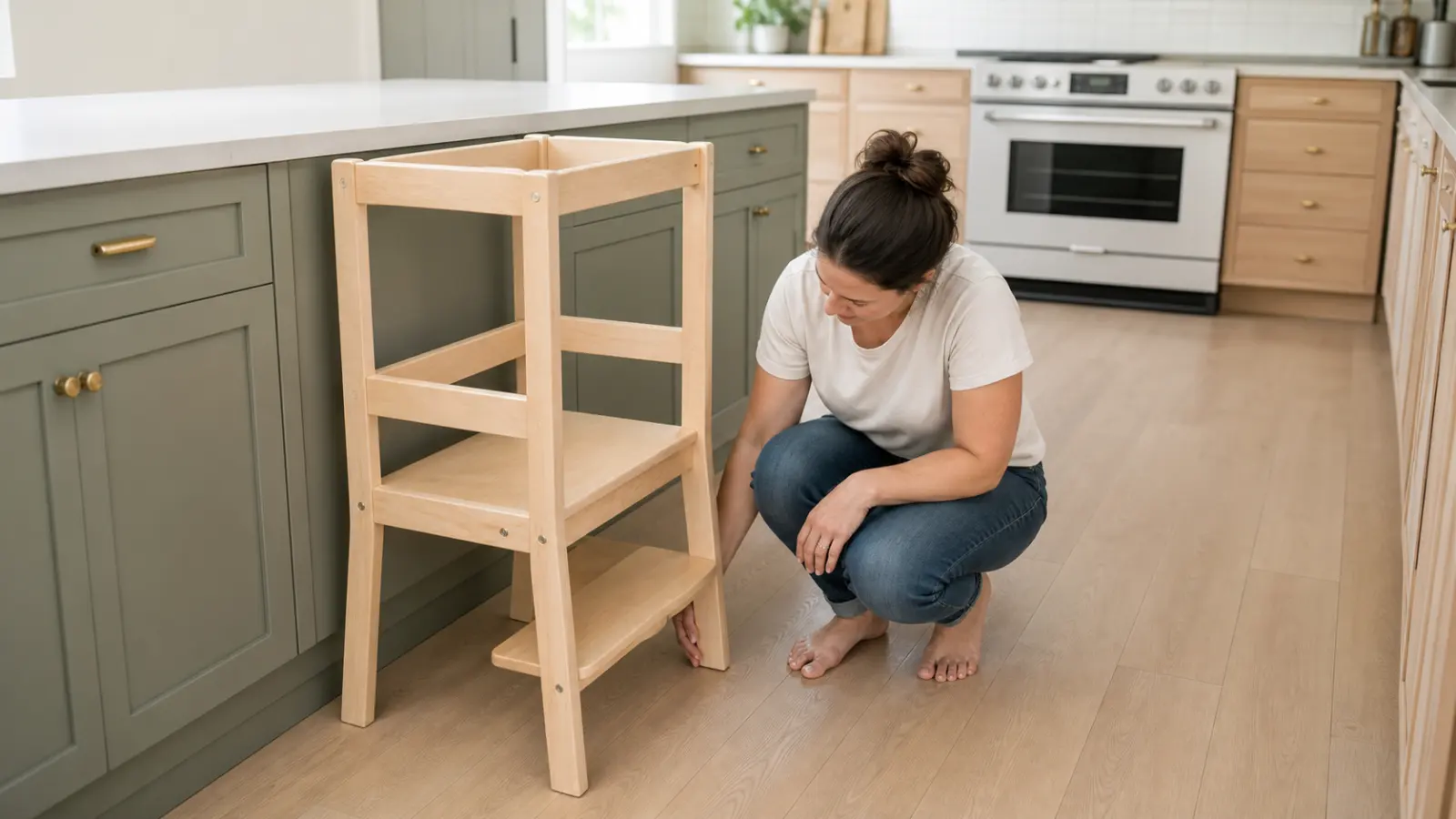
Set the kitchen before the child enters the tower. Match the physical unit to its manual and recall status, assemble and lock every required control while the tower is empty, place it on the floor and against or away from nearby surfaces exactly as that manual directs, then remove hot, sharp, electrical, strangulation, and fall hazards from the newly reachable zone. Stay close enough to intervene throughout use. Placement rules are not interchangeable: Piccalio and Franklin+Emily require their reviewed models against a wall, counter, or solid surface, while the Ingenuity Table-to-Tower manual says to position its model away from walls and other solid structures. The exact model manual decides.
Set the room before the child enters
1. Match the unit
Use the physical label to match the current manual, revision, recall status, parts, and usable mode.
2. Set the empty tower
Complete the platform, guard, fastener, lock, floor, and exact wall or counter placement checks.
3. Clear the reach zone
Remove cooking heat, hot liquids, sharp items, cords, windows, chemicals, and trip or slip hazards.
4. Stay close and watch
Keep the adult route open and end the session before attention, placement, or conditions change.
What placement evidence is actually published
This receipt combines current dimensions, guard, and anti-tip coverage from the validated 25-model catalog with six placement and supervision protocols reviewed in exact manufacturer manuals. Conflicting surface rules remain model-specific instead of being averaged into one instruction.
- Selected model records
- 25
- Numeric overall dimensions
- 21
- Published anti-tip records
- 19
33.14 × 23.18 × 38.07 in overall
The manufacturer describes a heavy build intended to resist child movement and a frame that fits flush against counters.
The manual requires a flat, level surface, keeps the tower away from stairs, dangerous objects, and appliances such as a stove, and says the child must remain within an adult's arm's reach.
23 × 20 × 35 in overall
Manufacturer describes non-tip feet; no wall anchor is specified.
The setup sequence requires both guard rails locked, the platform unfolded, and the safety latch engaged before the product is used. Its exact control sequence remains part of placement, not a separate optional check.
18 × 18 × 36 in overall
The manual requires a flat, level floor and firm placement against a wall or counter. Separate Grip Slippers are not included.
The manual requires firm placement against a wall or counter on a flat, level floor, excludes windows, stairs, elevated surfaces, sharp objects, and hot appliances, and keeps the child within arm's reach.
16 × 17.25 × 33.375 in overall
The manufacturer requires use against a counter or solid surface on a level floor and warns that rocking can tip the tower. No separately named anti-tip component is specified.
The manual requires a counter or solid surface, a level floor rather than carpet or grass, the leather strap facing outward, and placement beyond the child's reach of sharp, hot, or dangerous items.
33.27 × 23.03 × 35.24 in overall
No published anti-tip record
The manual requires a flat, level surface and one child at a time, excludes stoves, sharp objects, windows, hot liquids, heat sources, and cords, and says to stay near and watch the child throughout use.
18 × 14 × 35.4 in overall
Silicone anti-slip mats are included on the tower accessory; the required chair uses front silicone caps and rear castors.
The guide requires a flat, even, horizontal surface, keeps the tower away from hot surfaces and liquids plus window and electrical cords, and says the protective ring should sit at the child's hip height.
Guard information is published for 25 of 25 selected records, but only 19 publish anti-tip or placement evidence. The six manual protocols apply only to the exact named models. Sources checked July 20, 2026.
The short answer: set the room, then bring the child
Treat placement as part of assembly. Identify the exact model and current recall status, open or convert it fully, install the platform and guard at the documented positions, engage every required latch or fastener, and inspect the empty structure. Only then place it on the type of floor and beside the type of work surface its own manual permits.
Clear the floor and every surface the child can now reach. Keep the tower outside cooking, hot-liquid, knife, appliance, window, cord, stair, and traffic zones. Choose a low-risk task at a clear counter and stay beside the child. If you need to move the tower, change its height, fold it, answer the door, handle hot cookware, or leave the room, take the child out first.
Clear the identity and recall gate first
Read the permanent model, item or SKU, revision, lot, and date code from the physical product. Match those fields to the current manual rather than relying on a retailer title, color name, secondhand listing, or a manual for a similar-looking tower. A different revision can change the hardware, lock sequence, guard, placement rule, or recall scope.
Check the exact identity against the official CPSC recall notice before first use and after any ownership change or relevant alert. A related-model recall does not automatically include or clear the tower in front of you. Stop when the label is missing, the unit cannot be reconciled to a manual, a recall condition is unresolved, or a manufacturer remedy cannot be verified.
Map the entire footprint and the adult route
Measure the open product, not just the standing platform. Include feet, stabilizers, rear legs, steps, side rails, hinges, a conversion panel, and any slide or accessory used in that mode. Our selected-model data shows why the full dimensions matter: 21 of 25 records publish numeric overall dimensions, and the open lengths and widths vary substantially. A narrow-looking upper frame can still have a broad floor base.
Leave a clear route for the supervising adult to stand beside the opening, guide entry and exit, and reach the child without stepping over a foot or backing into another hazard. Keep doors, drawers, stools, pets, toys, mats, and household traffic from crossing that route. Do not improvise a smaller footprint by removing a stabilizer, folding a control halfway, or using a different mode than the manual specifies.
Use the exact floor and surface relationship
A flat, level floor is a recurring rule in the reviewed Little Partners, Piccalio, Ingenuity, CYBEX, and Franklin+Emily manuals. That excludes elevating the tower on a table or other structure. Franklin+Emily also excludes uneven surfaces such as carpet or grass. Clear crumbs, cords, rug edges, pooled water, and other material that can change foot contact or create a trip or slip path.
Do not invent one universal wall rule. The Piccalio Foldable manual requires the tower firmly against a wall or counter, and Franklin+Emily requires a counter or solid surface with its leather strap facing outward. The Ingenuity Table-to-Tower manual instead tells users to position that product away from walls and other solid structures. Follow the exact orientation for the exact model, and ask the manufacturer if the manual is ambiguous in your kitchen.
Create an exclusion zone around heat, sharp objects, cords, and windows
A tower increases reach. Clear knives, peelers, graters, skewers, scissors, breakable containers, medicines, cleaners, matches, small appliances, electrical cords, hot drinks, and hot food from the entire reachable counter and nearby drawers. Several reviewed manuals expressly exclude stoves, sharp objects, hot surfaces or liquids, windows, and cords. CYBEX names window and electrical cords; Ingenuity names hot liquids and multiple heat sources.
Keep the tower out of the active cooking area. Current CPSC cooking guidance tells caregivers to keep children and pets at least three feet from the cooking area, turn pot handles inward, and keep watch while cooking. A tower beside an active range defeats that separation by lifting the child closer to burners, controls, cookware, steam, and scalding contents. Use a separate clear, cool work surface for child participation.
Make active supervision physically possible
Supervision is not being somewhere in the room. Little Partners and Piccalio say to keep the child within arm's reach. Ingenuity says to stay near and watch the child. Arrange the task so one attentive adult can see the child's hands, feet, guard position, and surrounding counter while remaining close enough to intervene. A phone call, another child, cooking pan, or trip to a cabinet can break that condition even when the adult has not left the kitchen.
If attention must shift, end the session: help the child exit, keep the tower inaccessible if its manual requires that, and return only after the room and product are reset. Do not ask an older child to supervise, and do not assume a guard or broad base replaces the adult. The Ingenuity manual explicitly notes that accidents can happen even when children are supervised.
Control entry, exit, and the task
Use only the documented entry side, step, platform, and guard configuration. Show the child how to climb in and out while the adult stays beside the opening. Do not permit climbing on the exterior, standing on a guard, leaning over a top rail, reaching down outside the enclosure, rocking, jumping, or pushing sideways. Piccalio specifically warns against leaning over and reaching down from the top rail, and Franklin+Emily warns that rocking can tip its tower.
Choose tasks that keep both feet on the platform and hands at a clear, cool work surface: washing cool produce in an empty basin, transferring large ingredients, kneading dough, or stirring a cooled mixture can reduce exposure compared with cooking at the range. These are room-planning examples, not endorsements by every manufacturer. Stop the activity if the child tries to reach beyond the guard, the adult needs both hands elsewhere, or the task introduces heat, sharp tools, glass, choking hazards, or a spill that changes footing.
Treat sink use and spills as a reset
A sink is not automatically a safe zone. Control water temperature, keep cleaning chemicals and breakable items locked away, move electrical appliances and cords, and prevent the child from operating a hot-water control. Keep splashes off the platform, steps, feet, and adult route. The reviewed Little Partners manual says children should not climb when the product is wet, and CYBEX says anti-slip mats and wooden surfaces must be dry before placement.
After any spill, remove the child before cleaning. Dry the floor and all permitted product surfaces using the exact care instructions, then inspect foot contact, grip surfaces, fasteners, joints, mats, latches, and the platform before reuse. Keep the tower out of service if wood swells, a finish lifts, a mat slips, a joint moves, or a lock changes feel.
Move, fold, convert, or adjust only while empty
Never carry or slide the tower with a child inside. Remove the child and keep them clear before moving the product, changing platform height, installing or removing a guard, folding rails, engaging a latch, converting modes, or repositioning an accessory. Ingenuity expressly says never to lift and carry the child in the product. Piccalio says never to let a child fold or unfold its tower.
After every change, complete the manual's full usable-state sequence from the beginning. Confirm the correct mode, all required parts, platform support, fasteners, guard, locks, feet, orientation, floor contact, and reachable zone. Do not rely on the control having worked earlier in the day.
Know when the kitchen session stops
Stop immediately for looseness, wobble, movement at the platform or guard, a missing or substituted part, a crack, bent hardware, a latch that will not reach its documented position, a changed foot or mat, an unreadable label, unresolved recall scope, or any fit that places the child's torso outside the manual's guard guidance. Keep the child away while you identify the cause.
Also stop for environmental changes: cooking begins, a hot drink arrives, the floor becomes wet, a cord enters reach, a drawer or appliance must open into the tower, traffic becomes crowded, or the supervising adult cannot stay focused and close. A structurally sound tower does not make an unsafe kitchen zone acceptable.
Kitchen placement decision table
Use this to audit the room after completing the exact model's assembly and placement sequence. A pass in one row does not override a stop in another.
| Zone | Use condition | Stop condition |
|---|---|---|
| Tower and floor | Correct mode, complete parts, dry level floor, every foot or stabilizer in full contact | Wobble, loose part, wet or uneven floor, rug edge, elevation, or incomplete lock |
| Wall or counter relationship | Exact manual orientation and clearance, with the documented side facing the work surface | A generic rule, uncertain manual, blocked opening, pinching gap, or tower moved from position |
| Reachable work surface | Clear, cool, stable surface with one controlled low-risk task | Hot food or liquid, sharp or breakable item, cleaner, medicine, match, or small appliance |
| Cooking area | Tower remains outside the active cooking zone and separate from burners, controls, cookware, and steam | Active range or oven, hot pan, exposed control, inward adult traffic, or less than the required separation |
| Windows and cords | No reachable window opening, blind cord, appliance cord, charging cable, string, leash, or hanging loop | The tower creates a climbing route or brings any cord or window within reach |
| Adult route | One attentive adult stands near the entry and can reach the child without crossing a hazard | Adult turns to cook, leaves, uses a phone, steps over the base, or cannot see hands and feet |
| Child behavior | Both feet remain on the platform and the child uses the documented entry, guard, and task area | Leaning, reaching outside, rocking, jumping, exterior climbing, sitting on a rail, or resisting exit |
Complete the safety chain
Toddler tower kitchen safety FAQ
Does a toddler tower need to touch the counter or wall?
Can a toddler use a learning tower beside the stove?
Can I step away if the toddler tower has four-sided rails?
Can two children stand in one toddler tower?
Can a toddler tower be used at the kitchen sink?
Can I move or adjust the tower with my child inside?
Method and Sources
How this page is checked
- The placement receipt is rendered from the validated selected-model catalog and six exact manufacturer manuals, not hand-maintained display counts.
- Manual instructions are paraphrased and remain model-specific. Conflicting wall or counter rules are presented as conflicts rather than combined into a site-wide instruction.
- The three-foot cooking-area separation and current cooking controls cite CPSC guidance published November 19, 2025 and checked July 20, 2026.
- This guide does not establish that a tower, kitchen, task, or level of supervision is risk-free. The physical product, current manual, recall status, child, room, and activity must all be reconciled for each session.
Sources
- CPSC cooking safety guidance
- CPSC window covering cord safety guidance
- Little Partners Learning Tower assembly instructions
- Guidecraft Kitchen Helper FLEX instruction manual
- Piccalio Foldable Helper Tower assembly manual
- Franklin+Emily Toddler Tower use and care guide
- Ingenuity Table-to-Tower 2-in-1 Step Stool owner's manual
- CYBEX Lemo Training Tower Set user guide
Keep reading
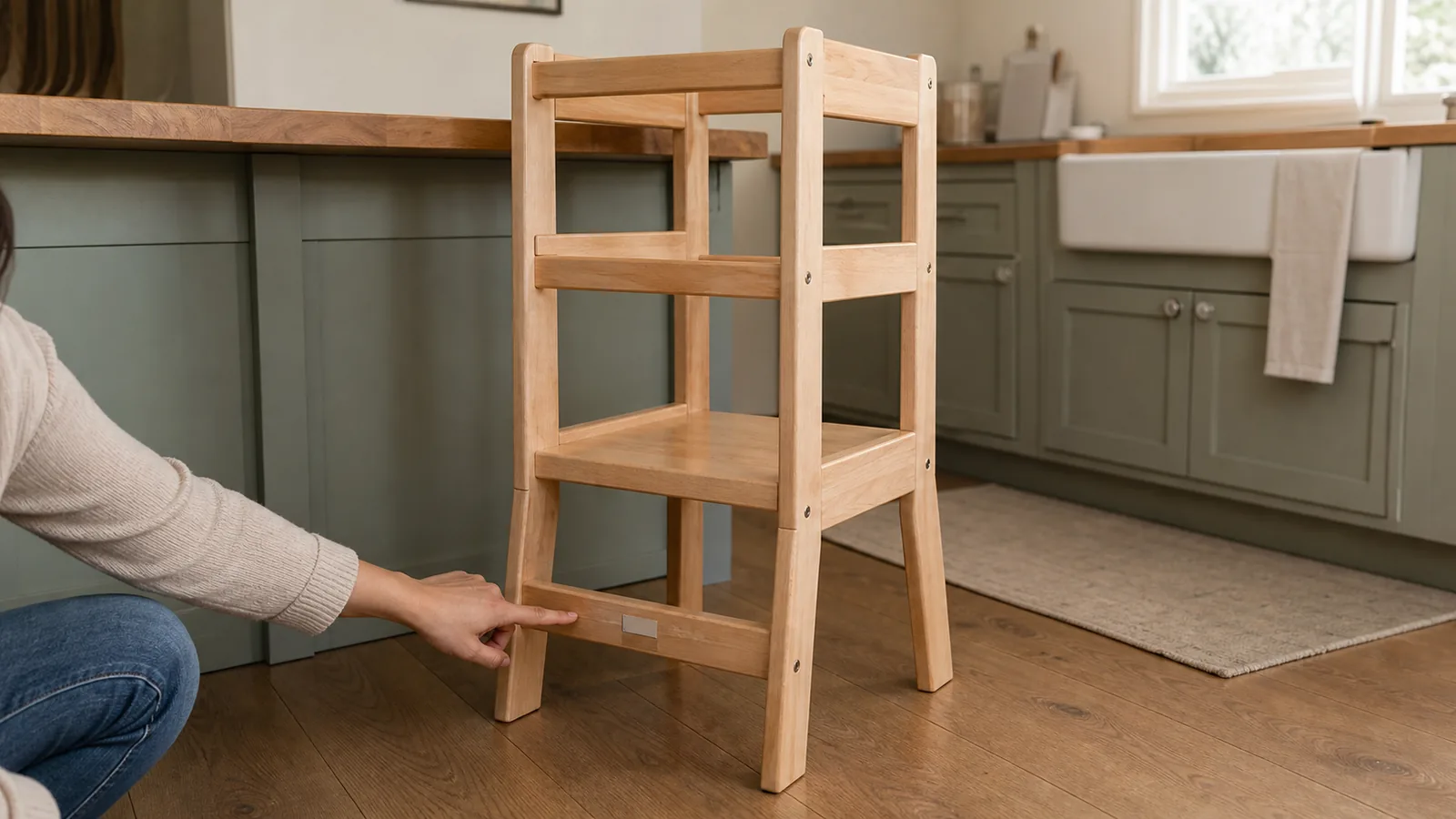
Toddler Tower Safety Standards and Recalls
What safety standards actually exist for toddler towers, every official CPSC tower recall we track, and how to check a specific model before you buy or keep using it.
Read next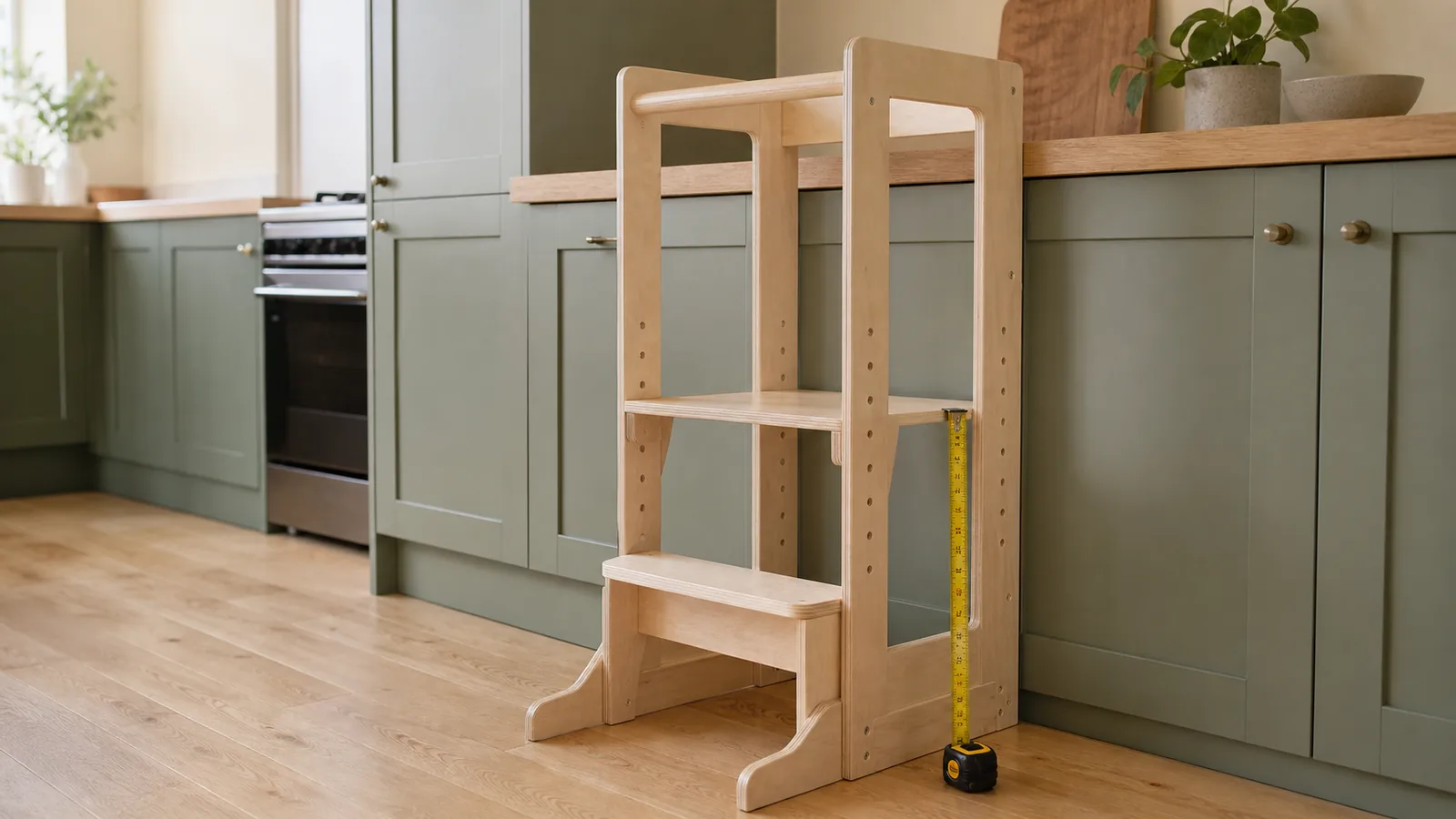
Toddler Tower Height and Counter Fit
Measure your work surface and child, calculate a starting platform height, and compare it with exact published tower positions without mistaking overall height for fit.
Read next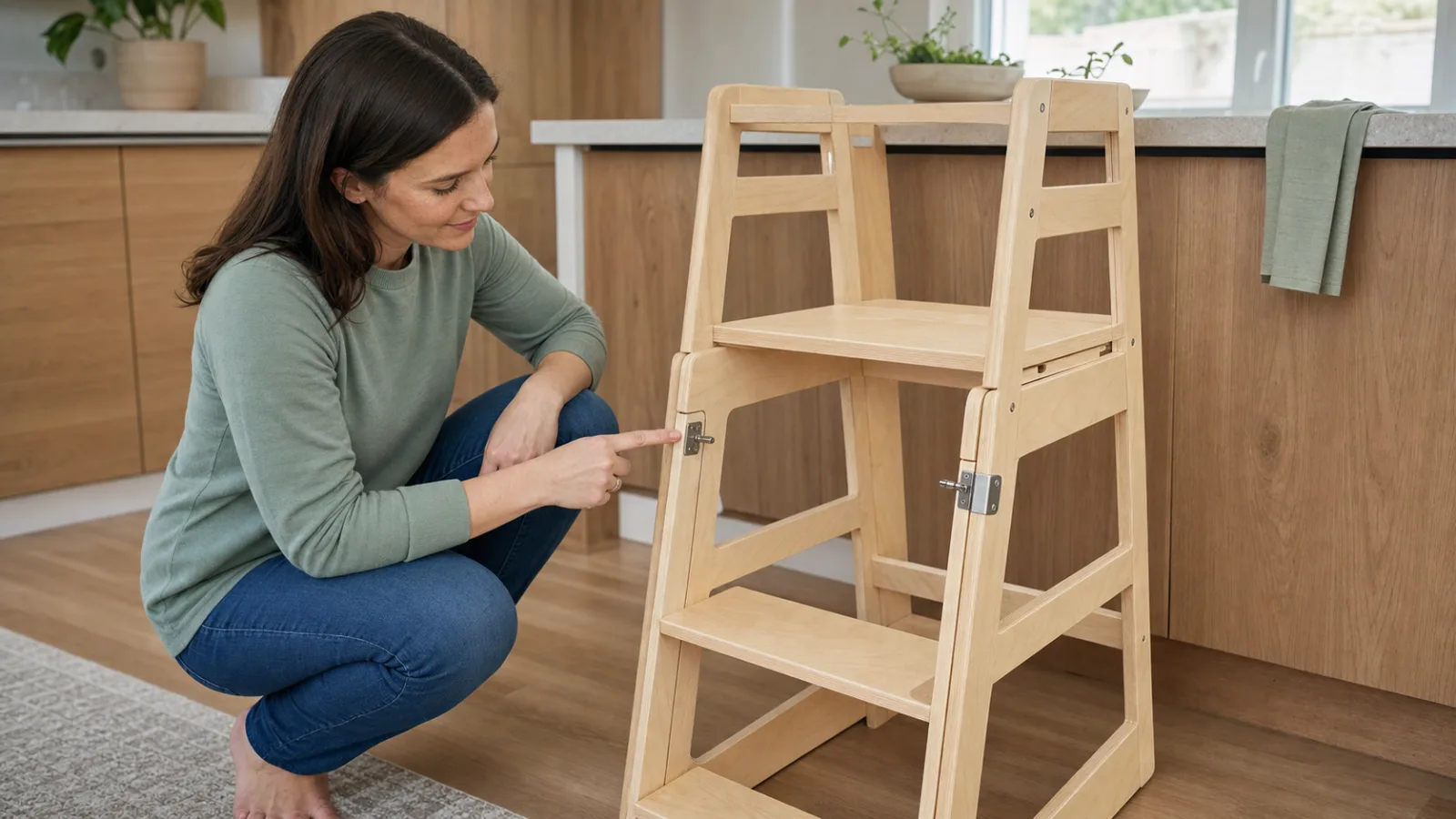
Foldable Toddler Tower Safety: Lock and Setup Checks
How to identify every lock in a foldable toddler tower's manual, check the empty setup before use, recognize stop-use conditions, and interpret folding-related recalls.
Read next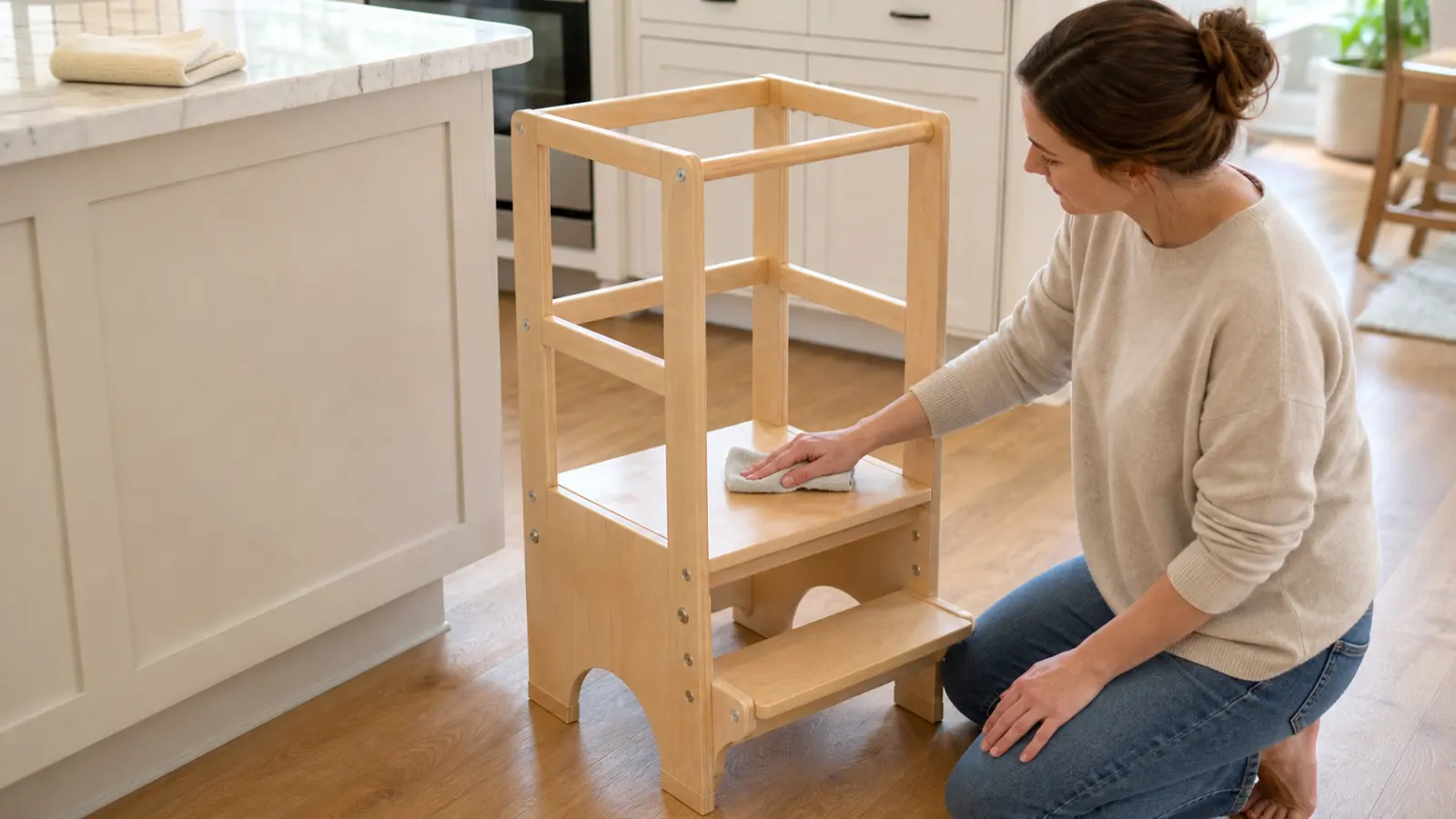
How to Clean and Maintain a Toddler Tower
A model-specific routine for cleaning toddler tower surfaces, drying spills, checking hardware and locks, and recognizing damage that should stop use.
Read next