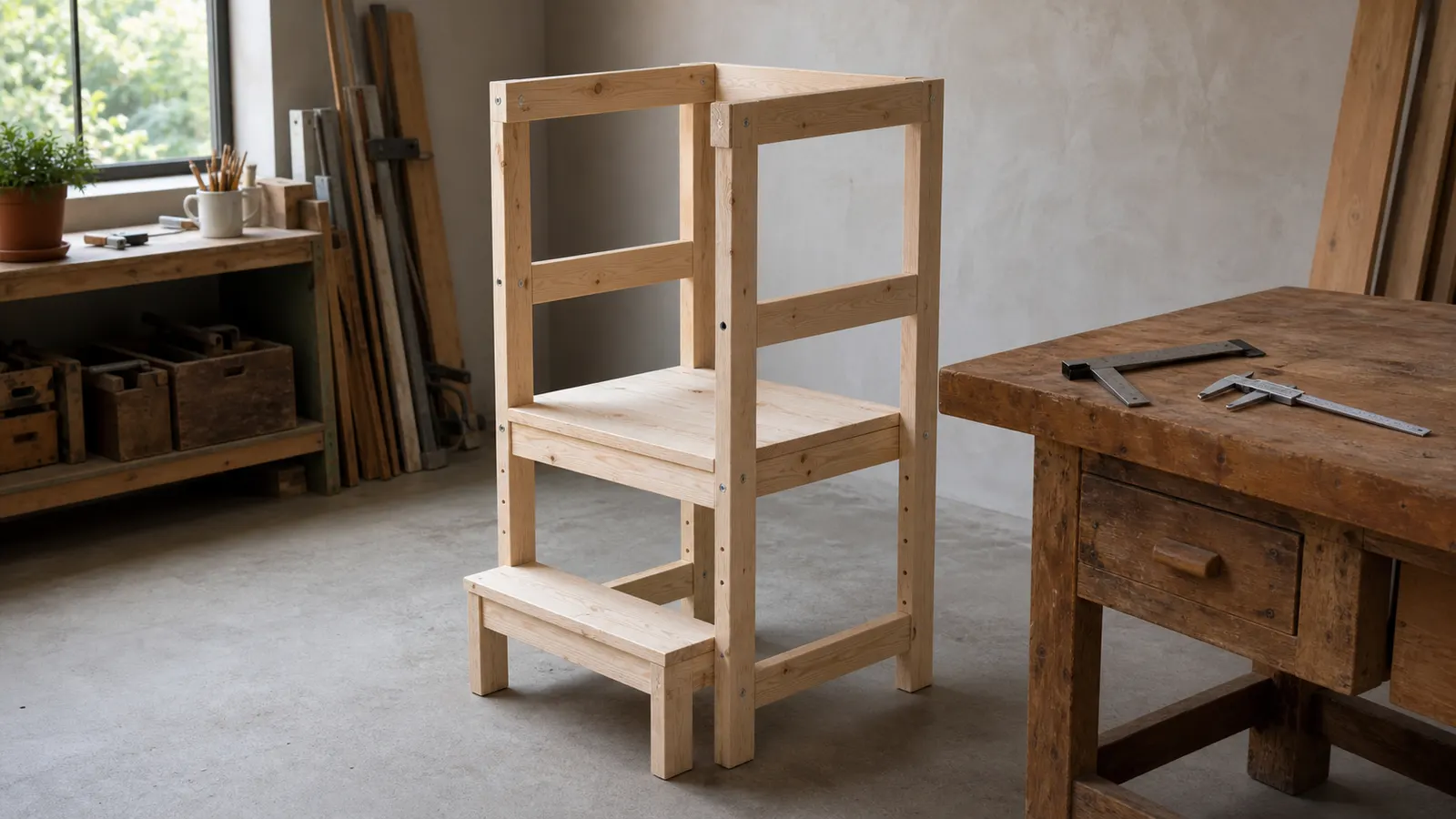
A DIY toddler tower plan can describe lumber, dimensions, hardware, and assembly. It cannot prove that the finished build resists tip-over, keeps a child out of hazardous openings, retains its platform over time, avoids pinch and protrusion hazards, or remains sound after repeated use. Those are separate product-safety questions, and the proposed ASTM standing-tower specification is still under development. This guide does not provide construction instructions. It shows what evidence a plan or furniture hack leaves missing, how official recalls map to those gaps, and when the responsible decision is to keep the child out of the build.
Four claims a DIY build cannot earn at home
A plan is not a test report
Dimensions and assembly steps do not establish stability, entrapment, durability, guard, or pinch performance.
An adult load is not a child-use simulation
One downward load misses edge forces, climbing, leaning, movement, repeated cycles, and opening hazards.
Added rails are not automatic protection
Rails, straps, mesh, posts, and nearby surfaces create bounded openings and new places to pull or become caught.
Base-furniture evidence does not transfer
A tested household stool becomes a different configuration when parts, users, height, loads, and intended use change.
What the official evidence asks that a plan cannot answer
This receipt connects every current tower recall in the validated ledger with representative failure modes, then keeps the proposed ASTM topics and manufacturer modification limits visibly separate from proof about any home build.
- Tower recalls
- 10
- U.S. units recorded
- 414,655
- Reported incidents
- 136
- Reported injuries
- 49
A broad base, adult weight limit, or brief push test does not establish resistance to the ways a child can shift, lean, climb, or pull at counter height.
11 incidents · 0 injurys
Official CPSC noticeA platform or crossbar can fail after assembly. The connection design, hardware, material, installation, fatigue, and continued condition all matter.
14 incidents · 1 injury
Official CPSC noticeA platform that looks seated can loosen over time. Visual inspection and one successful use do not prove long-term retention.
11 incidents · 3 injurys
Official CPSC noticeAdding rails can create bounded openings that admit a child's torso or trap the head. A familiar silhouette does not prove safe opening geometry.
8 incidents · 4 injurys
Official CPSC noticeFive separate topics in the proposed standing-tower work
These are draft-work topics, not pass criteria you can apply at home and not proof that a product complies.
ASTM lists tip-over and falls in the proposed scope. The May task-group log records continuing discussion of stability and tip-over testing.
The May task-group log records detailed discussion of wood screws for key structural elements and a possible torque test. The requirement is still under development.
The February and May logs discuss bounded-opening probes, guardrail function, cords or straps, and entrapment. A rail is part of the hazard geometry, not a decorative add-on.
CPSC staff proposed protrusion and post requirements in February. The May group continued work on corner posts and protrusions.
The ASTM work item names durability, falls, and pinch points in its minimum proposed scope. A single static load does not exercise those separate hazards.
The original stool's identity and test claim do not cover the new standing-tower assembly. The added rails also create openings, guards, connections, and new load paths.
ASTM WK86690 standing-tower work itemIKEA warns that painting its BEKVAEM step stool may increase slipping risk and recommends anti-slip strips if the surface is treated. That warning applies to the IKEA stool and illustrates why a finish change is not automatically cosmetic.
IKEA BEKVAEM step-stool safety and compliance guidanceAn adult standing once on the platform does not test bounded openings, guard function, protrusions, pinch points, fatigue, tip-over directions, or a connection loosening over time.
CPSC ASTM F15.59 task-group meeting log, May 2026The draft work treats structural fasteners, straps, nets, openings, and guard function as interacting safety questions. A stronger-looking part can still change geometry or load transfer.
CPSC ASTM F15.59 task-group meeting log, May 2026Recall totals are generated from the validated toddler-tower ledger. Incident and injury figures are the counts in the cited CPSC notices, not estimates of all events. The ASTM work item remains a proposed specification under development. Sources checked through July 15, 2026.
Start with the limit: a home build is not safety-proven
A finished-looking tower can still have unsafe stability, openings, guards, platform retention, fasteners, protrusions, folding clearances, or materials. A copied commercial silhouette does not inherit the manufacturer's tests, factory controls, exact hardware, instructions, traceability, or recall remedy. A plan with many successful builds is still a plan, not an exact-unit test report.
This does not mean every home-built tower will fail. It means the evidence needed to make a positive safety claim is missing. Treat that uncertainty as a stop sign when the product will elevate a young child to counter height. Do not describe a build as certified, compliant, approved, or safe because it matches a drawing, feels sturdy, or has held an adult.
Why an adult weight test answers the wrong question
Standing on the platform once may reveal an immediate break or severe flex. It does not reproduce a child climbing one side, leaning through a guard, pulling against a counter, rocking, bouncing, missing a step, or shifting weight near an edge. It also does not show whether a screw loosens, a platform migrates, a joint fatigues, or a finish becomes slippery over time.
ASTM WK86690 names head entrapment, tip-over, restraints or bars, durability, falls, and pinch points as separate topics in the proposed standing-tower specification. CPSC task-group logs add bounded openings, protrusions, adjustable guards, structural fasteners, drop testing, and stability methods. Passing one improvised load test cannot stand in for that set of different questions.
Treat stability as a full load-path problem
Stability depends on the base footprint, center of mass, platform height, child position, direction of force, floor friction, guard geometry, nearby counter, and how every connection transfers load. Adding a rail to an existing stool changes more than the rail. It gives the child a new place to pull, lean, climb, and transfer force into a base that was not documented in that configuration.
Do not use wall screws, counter hooks, improvised outriggers, adhesive feet, floor shims, or added weight as an informal clearance. Each change creates a new configuration and can move force into another joint or surface. If the build rocks, racks, lifts a foot, slides, twists, or depends on contact with the counter to remain upright, keep the child away.
Added rails can create an entrapment hazard
Guard rails are not automatically protective. The spaces between rails, posts, platform, stool, counter, straps, or mesh can admit part of a child's body and stop another part. CPSC's 2026 tower notices repeatedly describe torso entry through tower openings, while the ASTM task group continues to work on bounded-opening probes, guard function, cords, straps, corner posts, and protrusions.
Do not copy an opening from a photo or choose a gap because a child's head does not fit during an informal check. The proposed test geometry is still being developed, and a child should never be used as the probe. A rope, elastic cord, removable dowel, fabric net, or loose mesh is not a simple fix because it adds tension, loop, detachment, and changing-opening questions.
Fasteners and platforms need more than a torque check
A screw can be tight today and still loosen, split the wood, enlarge its hole, crush soft material, or pull out under repeated off-center loading. A bracket can move the stress to a thin panel. Glue can hide a poor joint or fail after moisture exposure. Generic replacement hardware can change thread engagement, head shape, protrusion, corrosion behavior, or the way parts clamp together.
Two recent CPSC examples show why platform retention deserves its own gate. The Grow 'N Stow recall states that its platform could collapse and specifies an official replacement crossbar. The Guidecraft recall states that affected platforms could loosen over time, become unstable, or detach and specifies manufacturer repair parts. Neither problem is cleared by adding extra hardware of your own choosing.
An IKEA or furniture hack changes the intended configuration
IKEA's current U.S. BEKVAEM page describes the product as a home-use step stool and cites EN 12520. It does not describe that stool as a child standing tower. Adding a second stool, rails, panels, straps, or a platform creates a different assembly with a different user, height, access pattern, load path, and opening geometry. The original product statement does not transfer to the modified structure.
Even a finish change can matter. IKEA warns that painting the BEKVAEM step stool may increase slipping risk and recommends anti-slip strips if the surface is treated. That manufacturer warning applies to the stool itself, not to a tower hack, but it illustrates the broader rule: a modification that looks cosmetic can change a safety-relevant surface.
Use empty-product inspection only as a stop-use screen
With the child elsewhere, document the base furniture, every added part, fastener, finish, platform, step, rail, strap, opening, foot, label, and connection. Look for rocking, racking, lifted feet, cracks, splits, enlarged holes, loose hardware, sharp edges, protrusions, detachable parts, moving guards, slippery surfaces, moisture damage, and any place a hand, foot, limb, torso, clothing, cord, or head could become caught.
Finding one of those conditions is a reason not to use the build. Finding none of them is not a pass. A visual and hand inspection cannot establish fatigue life, stability margins, dynamic behavior, opening-probe performance, coating chemistry, manufacturing consistency, or compliance with a specification that is still being drafted.
If the tower is already built, choose a defensible next step
Keep the child out while you preserve photos, dimensions, part identities, receipts, the original furniture instructions, and the exact plan version. Do not make a series of improvised fixes and treat the final version as cleared. If a recalled product or part is involved, follow the exact official remedy and do not sell, donate, or give away an unresolved recalled product.
The lowest-uncertainty path is to retire the elevated child-use configuration and move the activity to floor level or a seated child workstation. If you want the structure evaluated, seek a qualified product-safety engineer or accredited laboratory and ask what evidence can actually be produced for the exact build. An informal opinion, woodworking inspection, or adult load demonstration is not the same as product testing or certification.
Do not pass the uncertainty to another family
Do not list a homemade or modified tower as safe, certified, tested, CPSC approved, or built to a current toddler-tower standard unless you possess exact, applicable documentation that supports the precise statement. ASTM WK86690 remains a work item under development. A plan author, marketplace seller, or social post cannot convert that draft work into a household compliance claim.
If the structure is dismantled, prevent identifiable tower parts from being reassembled into the same child-elevation configuration without the missing evidence. Preserve any original furniture components only for uses the manufacturer documents. A clear disclosure of uncertainty is better than transferring an attractive but unverified structure to someone who cannot reconstruct its history.
What a home check can and cannot tell you
Use these observations to stop, not to certify. No clean observation converts the build into a tested child product.
| Observation | What it can reveal | What it cannot prove |
|---|---|---|
| All feet touch the empty floor | An obvious warp, uneven foot, floor mismatch, or severe rocking condition | Tip-over resistance under child climbing, leaning, pulling, bouncing, or off-center loads |
| Hardware is present and hand-tight | A missing, loose, substituted, protruding, or visibly damaged fastener | Joint capacity, pull-out resistance, fatigue life, or correct load transfer |
| Platform looks level and seated | Visible misalignment, damage, movement, or incomplete engagement | Retention over repeated use or resistance to dynamic and edge loading |
| Openings are measured | A reproducible record of the current geometry | Passage of the correct probes under the correct force or freedom from entrapment |
| An adult stands on the platform | An immediate gross failure under that one load and position | Stability, guard function, pinch points, repeated cycles, loosening, or child behavior |
| The build matches online photos | Only a visual resemblance to another structure | Exact materials, hardware, tolerances, testing, revision, quality control, or recall status |
Choose the next lower-risk path
DIY toddler tower safety questions
Is a DIY toddler tower safe?
Can I turn an IKEA BEKVAEM stool into a toddler tower?
Does holding an adult prove a homemade learning tower is strong enough?
What is the safe gap between toddler tower rails?
Can I add a safety net, strap, or extra rail to fix an opening?
What should I do with a DIY tower I already built?
Method and Sources
How this page is checked
- Recall counts and totals are generated from the validated toddler-tower recall ledger. Each representative failure card links to its exact official CPSC notice.
- ASTM WK86690 is identified as a proposed specification under development. Draft topics are not presented as final requirements, home test instructions, or certification criteria.
- Statements about what a plan, modification, or one-time adult load cannot prove are conservative evidence limits inferred from the multiple distinct hazards in the ASTM work item, CPSC task-group logs, and official recall notices.
- The IKEA BEKVAEM discussion is limited to IKEA's current U.S. product statement and finish warning. It does not evaluate or endorse any third-party IKEA hack.
- This page intentionally does not publish construction dimensions, opening limits, hardware substitutions, test loads, or a build sequence because those details could be mistaken for a validated safety specification.
Sources
- ASTM WK86690 proposed specification for children's standing towers
- CPSC ASTM F15.59 standing-tower task-group meeting log, May 2026
- CPSC ASTM F15.59 standing-tower task-group meeting log, February 2026
- IKEA BEKVAEM step-stool safety and compliance guidance
- CPSC TOMY Boon PIVOT toddler tower recall, July 2026
- CPSC SDADI kitchen step-stool recall, July 2026
- CPSC Guidecraft standing-tower recall, May 2026
- CPSC Little Partners Grow 'N Stow recall, November 2025
Keep reading
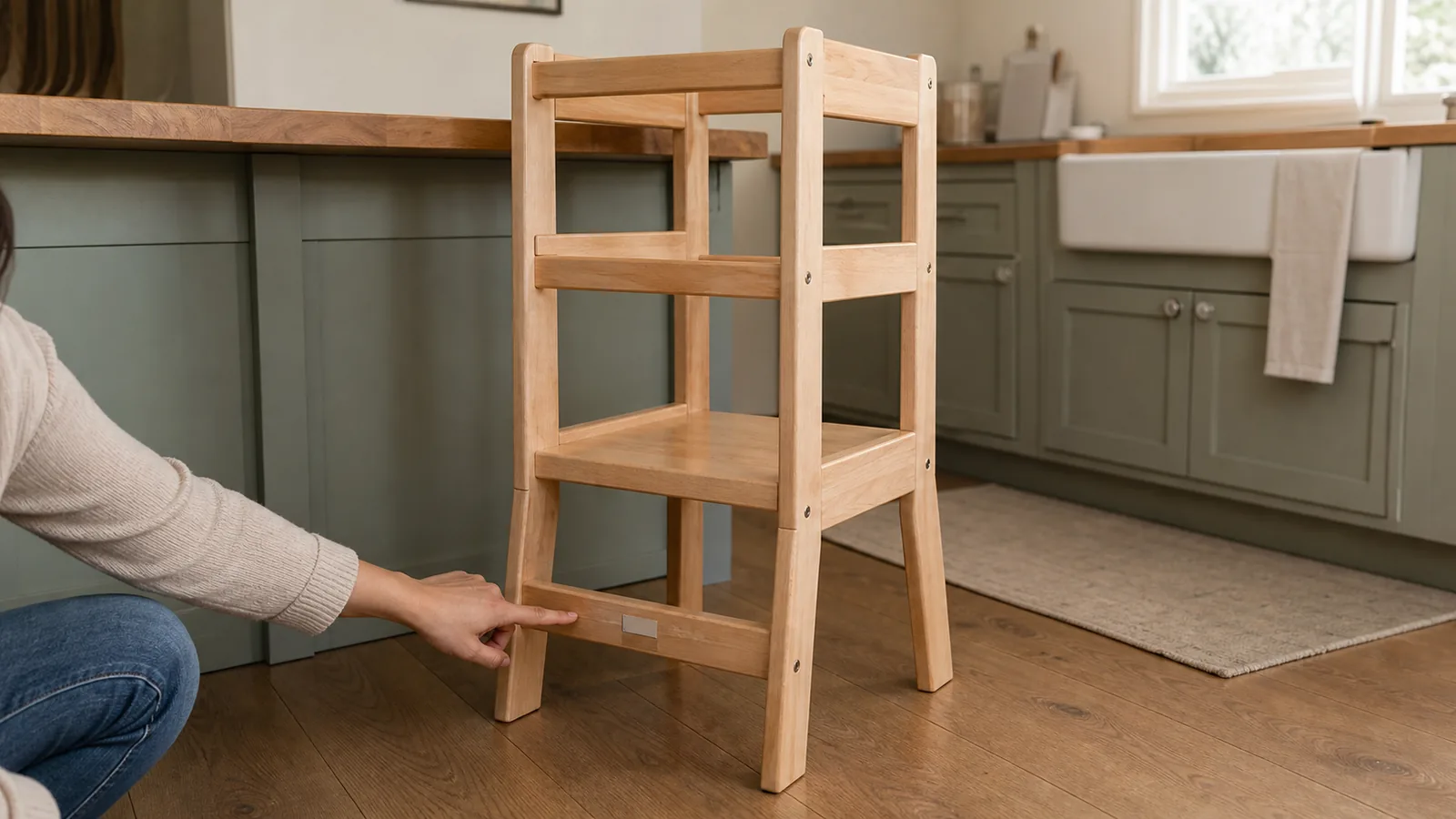
Toddler Tower Safety Standards and Recalls
What safety standards actually exist for toddler towers, every official CPSC tower recall we track, and how to check a specific model before you buy or keep using it.
Read next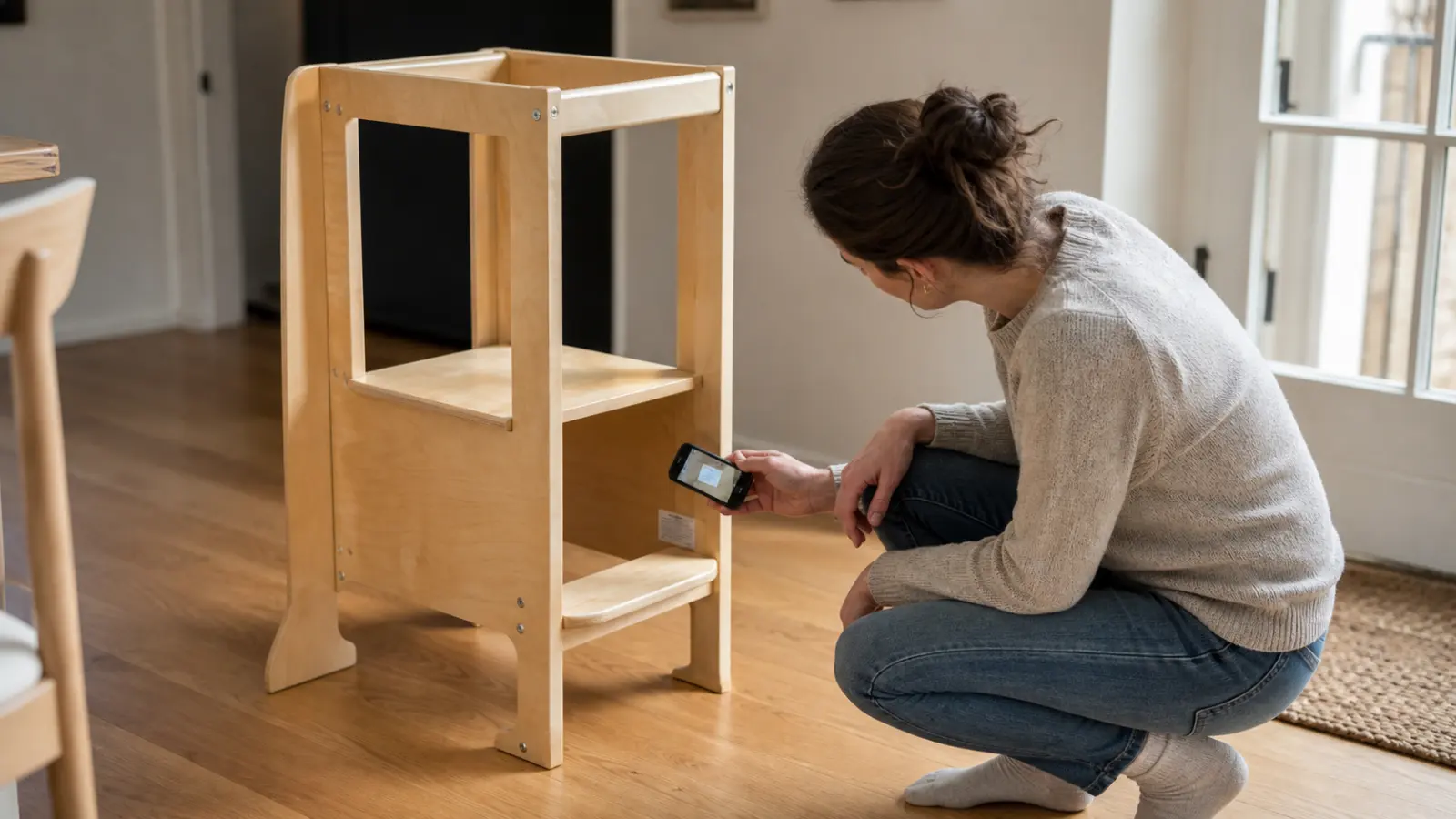
Buying a Used Toddler Tower: Inspection Checklist
How to verify a secondhand toddler tower's model, recall and repair status, hardware, frame, platform, locks, and manual before deciding whether to buy it.
Read next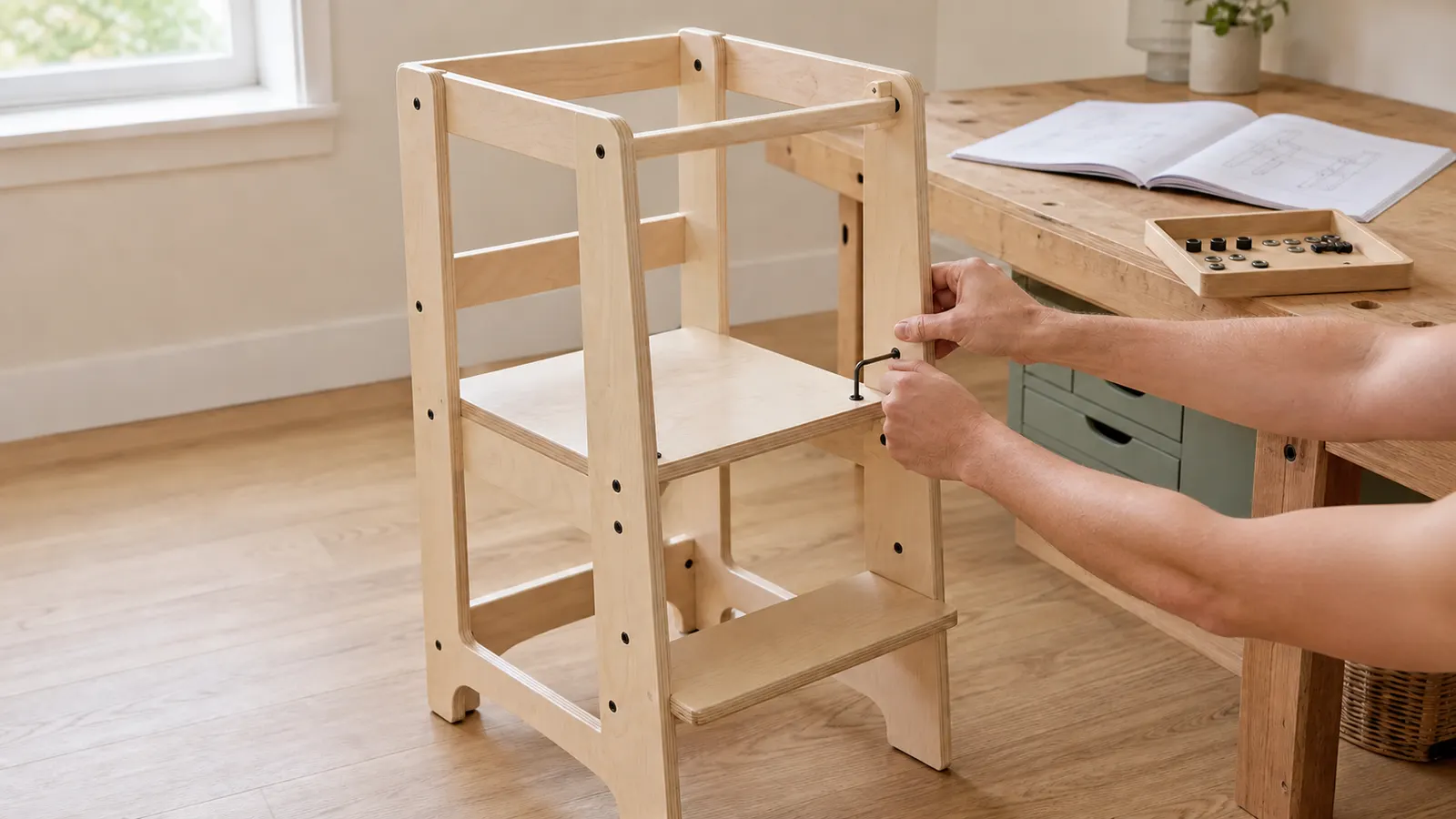
How to Assemble a Toddler Tower: First-Use Checklist
Match the exact toddler tower manual, inventory every part, follow the model-specific sequence, verify guards and locks, and complete an empty-product first-use check.
Read next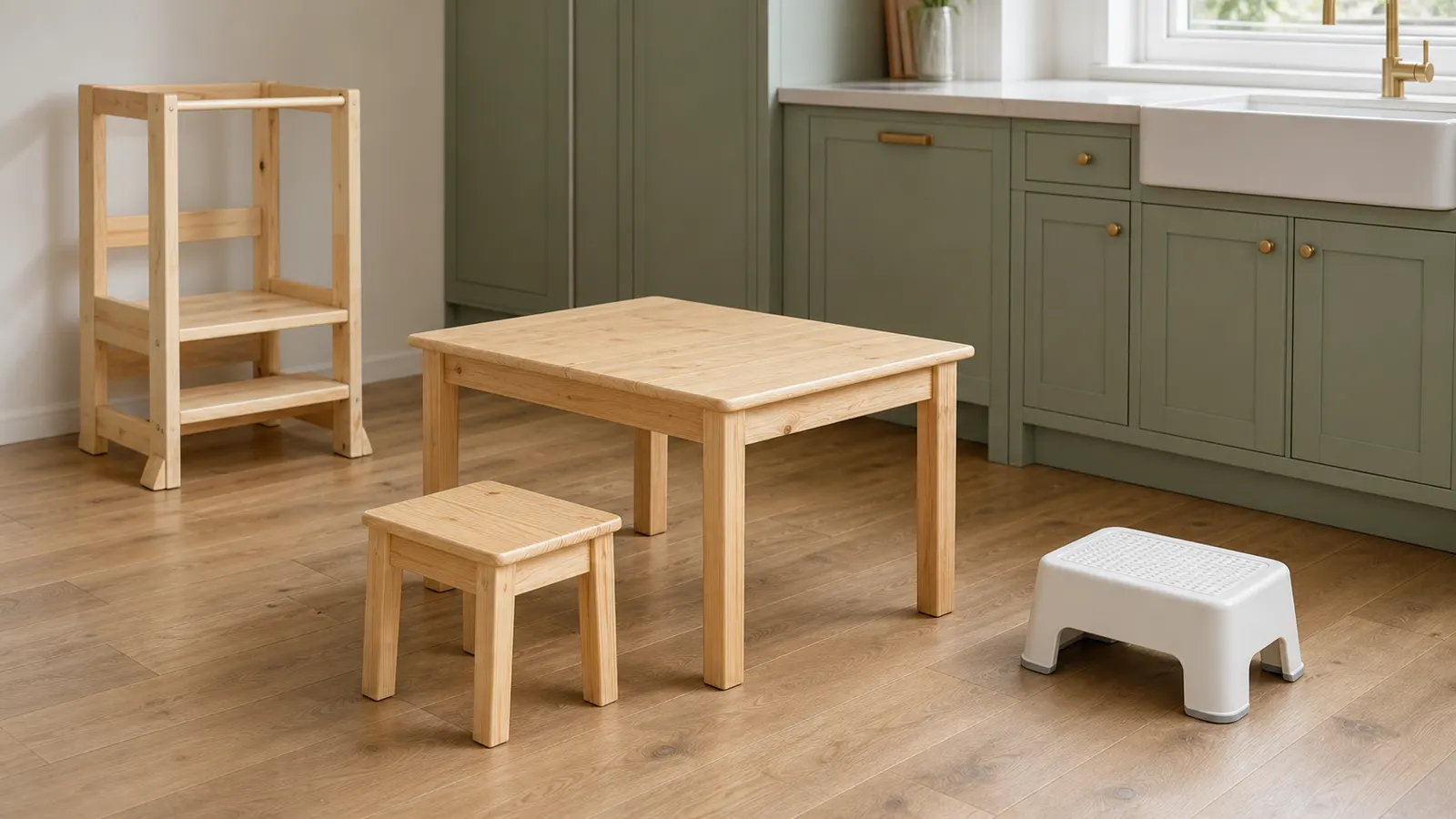
Toddler Tower Alternatives: What to Use After Outgrowing It
Choose a post-tower setup by the task, the reason tower use ended, and the replacement's exact intended use instead of treating every stool as interchangeable.
Read next