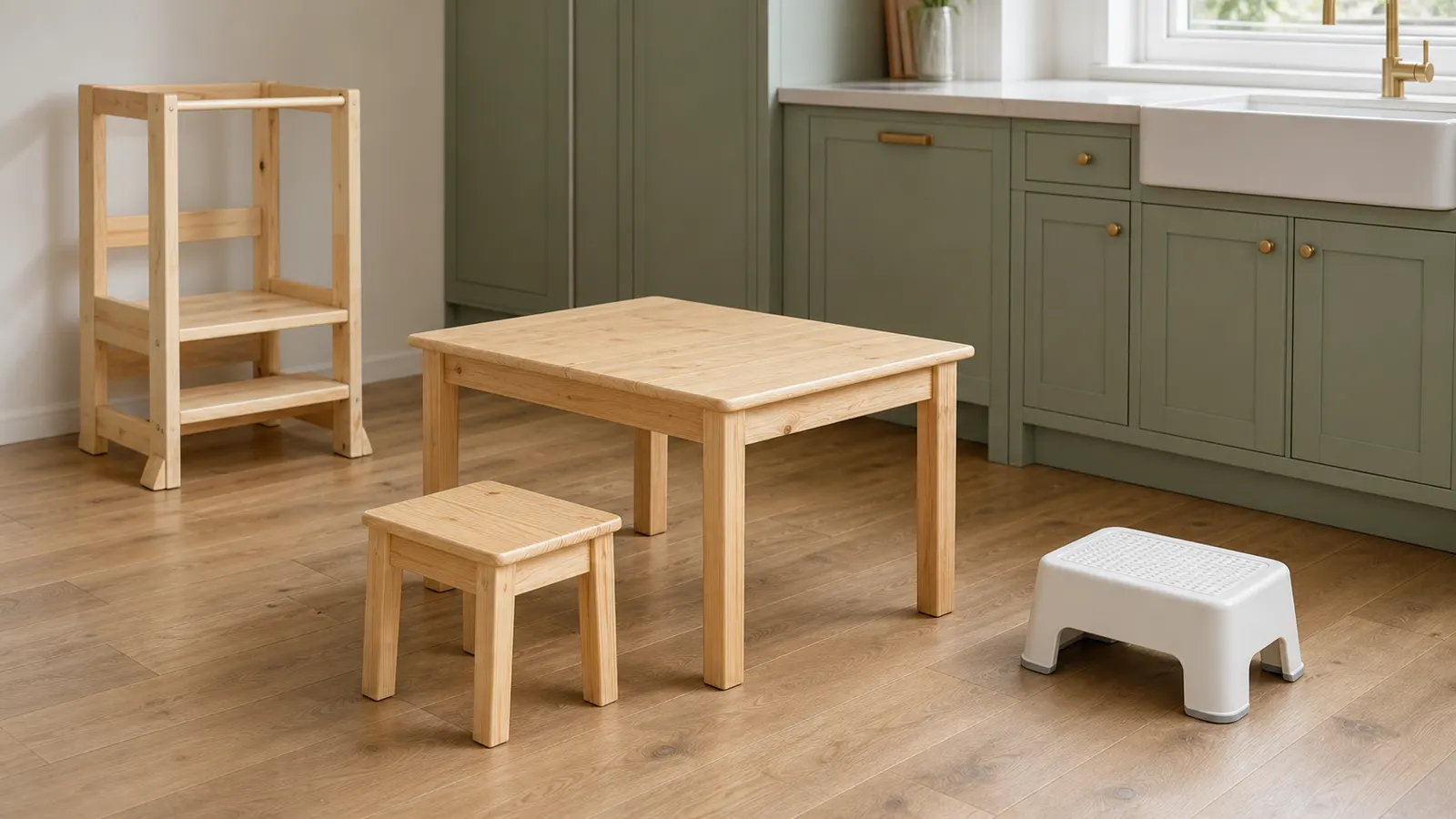
The next setup does not have to look like a smaller toddler tower. Start with why tower use ended and what your child still needs to do. A task may move to a lower surface, become a seated activity, use a child-standing stool for a small lift, or continue in a documented conversion mode. Each path has different evidence. A seat is not a standing platform, a high weight rating is not a child-fit test, and outgrowing tower mode does not automatically approve another configuration.
Choose from the reason tower mode ended
Guard or height fit failed
A lower child-standing product may fit only if the new product expressly permits standing and every other gate passes.
Balance or behavior failed
Move toward no elevation or sitting. A different frame does not resolve jumping, rocking, exterior climbing, or unsafe reach.
Product condition failed
Remove the damaged or incomplete unit. Evaluate the replacement independently instead of transferring parts or repairs.
Recall or stop-use notice applies
Follow the official remedy first. Do not repurpose, sell, donate, or modify the affected unit unless the notice permits it.
Four evidence paths after tower mode ends
This source receipt separates no-elevation task design, seated children's furniture, child-standing stools, and exact conversion modes. It keeps intended use, load, age gaps, standards status, source links, and category boundaries visible.
- Transition pathways
- 4
- Child-standing examples
- 2
- Exact conversion example
- 1
Seating evidence stays separate from permission to stand.
A published capacity does not resolve age, balance, reach, or intended use.
Children's step-stool and standing-tower work items are not final standards.
No elevation
Move the task down- Use when:
- The activity can move to a child-height table, seated surface, or floor-level tray without moving heat, sharp tools, chemicals, cords, or heavy appliances into reach.
- Proof required:
- Confirm that the lower task still preserves the kitchen hazard controls and direct supervision required for the activity.
- Example:
- Transfer a cool mixing bowl or dry sorting task to a child-height surface while the adult keeps cooking hazards at the counter.
Boundary: Do not lower a dangerous item merely to preserve participation. Change the task instead.
Sitting only
Use a seated child workstation- Use when:
- The child can participate while sitting for reading, drawing, sorting, kneading, or another task that does not require counter-height standing.
- Proof required:
- Use furniture explicitly intended for sitting and verify its age, load, assembly, stability, placement, and folding lock when applicable.
- Example:
- IKEA describes the FLISAT children's stool for sitting while playing, reading, drawing, or doing crafts and publishes a 77-pound maximum load.
Boundary: A seat or children's stool is not a standing platform. CPSC's folding-stool rule covers seating furniture, not children's standing step stools.
Small lift
Use an exact child-standing stool- Use when:
- The child needs only a small vertical lift and can step on, stand, and step off as the exact product instructs while the adult remains close.
- Proof required:
- Verify that the manufacturer expressly permits a child to stand on it, then check step height, load, anti-slip surfaces, floor contact, task reach, age guidance, and current recall status.
- Example:
- FÖRSIKTIG is 5 1/8 inches high with a 77-pound limit. BOLMEN is 9 7/8 inches high with a 220-pound limit and is described for children and adults. Neither current page publishes an age range.
Boundary: No guard surrounds the child. A high load rating does not establish age, balance, reach, or placement fit, and it does not turn an adult step stool into a child product.
Exact model only
Use a documented conversion mode- Use when:
- The existing product has a manufacturer-documented seated table, bench, or desk mode and the exact physical unit still passes its identity, condition, parts, lock, and recall checks.
- Proof required:
- Follow the exact conversion sequence and verify every required lock plus any separate mode-specific age, load, and use instruction.
- Example:
- Piccalio documents a 17-inch-high table and bench configuration and requires the side locks in both tower and table positions. Its current page does not publish separate table-mode limits.
Boundary: Outgrowing tower mode does not automatically clear another mode. Family-wide limits are not proof that every configuration shares the same limit.
These are screening paths, not ranked recommendations. Verify intended use, exact instructions, current recall status, child fit, environment, and supervision for the replacement itself. Sources checked July 20, 2026.
The short answer: replace the task setup, not just the tower
Choose the next path from two facts: why tower use stopped and what task remains. If guard fit failed but the child still follows directions and needs only a few inches of lift, an exact child-standing stool may fit the new task. If balance, exterior climbing, unsafe reaching, or supervision failed, moving the activity down or making it seated may be the better screening path. If the tower is recalled or damaged, remove that unit first and evaluate any replacement independently.
Do not choose by product name alone. Manufacturers use stool for seating, standing, toilet access, and household step ladders. Verify whether the exact product is intended for a child to sit, stand, or climb, then check age, load, height, floor contact, instructions, condition, recall status, task reach, and supervision.
Start with the reason tower use ended
A maximum age, child-height, weight, waist or bellybutton guard relationship, missing platform position, behavior change, product defect, or recall can end tower use. Write down the controlling reason. It tells you which feature must change and which problem cannot be carried into the next setup.
For example, a child who is too tall for the tower guard may still be able to use a low standing stool that is expressly intended for children. A child who repeatedly jumps, rocks, climbs furniture, or moves a stool while standing has not solved that behavior by switching products. A damaged or recalled tower cannot be repurposed as a table unless the official remedy and instructions explicitly allow continued use in that mode.
First option: move the activity down
The lowest-elevation path is often a child-height table, seated surface, or floor-level tray. It works when the useful part of the activity can move away from the adult counter without moving the hazard. Cool mixing, sorting closed packages, tearing lettuce, arranging utensils, or wiping a child-safe surface may work below counter height. The adult can keep knives, heat, raw ingredients, appliances, chemicals, and cords at the controlled work area.
This is a task redesign, not a product recommendation. Recheck the room from the child's new position. The American Academy of Pediatrics advises keeping sharp tools and dangerous products out of reach, preventing dangling cords, turning pot handles back, and controlling access to cooking appliances. A lower table is not useful if it puts a different hazard within reach.
Second option: use a seated child workstation
Choose a seated setup when the child does not need to stand to complete the activity. Verify that the exact chair, bench, or stool is intended for sitting. Check its assembly, floor placement, age guidance, load, condition, and folding lock if it folds. Pair the seat with a stable work surface at a height that does not require the child to kneel, perch, or stand on the seat.
The category boundary matters. CPSC defines a children's folding stool under 16 CFR part 1232 as seating furniture without a back or armrests. That rule includes requirements for folding locks, pinching, stability, strength, labels, and other hazards, but it does not turn the seat into a standing step. IKEA, for example, describes its FLISAT children's stool for sitting while playing, reading, drawing, or doing crafts and publishes a 77-pound maximum. The stated sitting use controls.
Third option: screen an exact child-standing stool
A child-standing stool can provide a small lift for a sink or low task. Use only a product whose current manufacturer instructions expressly allow a child to stand on it. Record the step height, top dimensions, load, anti-slip surface, feet, floor type, intended room, age guidance, and whether the child can step up, stand centered, and step down while you remain close.
Two current IKEA examples show why the fields must stay separate. FÖRSIKTIG is 5 1/8 inches high, has anti-slip protection on top and underneath, and publishes a 77-pound maximum. BOLMEN is 9 7/8 inches high, publishes a 220-pound maximum, and is described for children and adults. Neither current page publishes an age range. The higher capacity does not answer which child fits, whether the task is reachable, or whether the added height works in your room.
Do not treat an adult household step stool as child-approved
Adult and general-use step stools may publish high duty ratings, handrails, household standards, or non-slip surfaces without publishing child standing use. Those fields support the uses the manufacturer states. They do not establish a child's age, balance, reach, supervision, or behavior fit.
ASTM's proposed children's step-stool work item explicitly distinguishes children's standing products from adult step stools and seated furniture. As of July 20, 2026, WK92953 for children's step stools and WK86690 for children's standing towers remain proposed work items. Do not treat a seller's reference to either work item as proof of compliance with a final published standard.
Fourth option: use a documented conversion mode
Some towers convert into a table, bench, desk, chalkboard station, slide, chair, or household step. A conversion is a separate configuration, not an improvised use. Match the exact model and revision, install every required part, follow the conversion sequence, engage every lock, and look for mode-specific age, load, posture, and placement instructions.
Piccalio documents a table and bench configuration measuring about 17 inches high by 16 inches wide by 36 inches long. Its instructions require the side locks in both tower and table positions. The current product page publishes family-wide age and load fields but does not publish separate table-mode limits. That gap stays visible. Outgrowing the guard in tower mode does not by itself prove the child fits the table configuration.
Keep kitchen hazards separate from the participation setup
The replacement changes the child's height and reach envelope. Set the empty stool, seat, or table in the intended location and view the room from the child's hand level. Check the cooktop, oven, microwave, sink, hot liquids, knives, glass, cords, cleaning products, drawers, traffic routes, and anything that can be pulled down.
A lower standing stool may put the counter edge above the child's comfortable working height and invite tiptoe standing or side reaching. A higher stool may expand access to hazards that the tower guard previously limited. A seated table may be lower but easier to move. Choose the task and placement together, then keep direct supervision appropriate to that exact activity.
Reject makeshift height
Do not substitute a dining chair, folding chair, storage bin, crate, stack of books, loose cushion, or a stool placed on another surface. Do not add a booster board to a standing product, attach an improvised rail, drill a new platform position, or stack two steps. Those changes create a use and load path that the exact instructions do not document.
Also reject a product whose label, model, manual, load, intended use, or recall status cannot be matched. A familiar shape or years of incident-free use is not evidence that the next child, task, floor, or room fits it.
Run a replacement screening record
Save the product name, item number, manual, intended-use wording, published age and load, overall and step dimensions, floor and anti-slip instructions, folding or conversion sequence, current recall search, and source dates. Measure the child's standing or seated task height, the surface height, the reach to the near and far edges, and the space required to enter and exit without crossing the adult work path.
Mark every missing or conflicting field unresolved. Weight capacity alone never clears a product. Neither does a product photo showing a child. Continue only when intended use, fit, condition, environment, and supervision all agree for the specific task.
Trial one simple task before expanding use
Begin with the empty product on the real floor. Confirm all feet stay planted and every lock is complete. Then try one cool, simple, short task while the adult remains within reach. Watch entry, exit, posture, foot placement, side reaching, product movement, response to direction, and whether the child can stop and step down without rushing.
Stop if the child jumps, rocks, climbs the outside, stands on a seat, reaches beyond the intended area, moves the product while elevated, defeats a lock, or cannot use the documented route. Reassess the path instead of adding a restraint or homemade modification.
Retire the old tower before the new routine begins
Remove the old tower from the child's access. Follow the exact manual and any official recall remedy for storage, conversion, return, destruction, or disposal. Keep labels, original parts, and repair records together. Do not sell, donate, or hand down a recalled product when the official notice prohibits redistribution or requires destruction.
If the tower remains in a documented non-tower mode, store unused guards, platforms, hardware, and instructions together. Recheck the unit after every conversion, impact, move, long storage period, or transfer to another child. The new routine should not leave the retired tower available as an unsupervised climbing object.
Toddler tower alternative screening table
Use the first row that fits the remaining task and the reason tower use ended. A later row is not automatically a better or more independent option.
| Path | Use when | Evidence to verify | Stop or reject when |
|---|---|---|---|
| Move the task down | The useful activity can happen at child height without moving the hazard | Task, surface, adult work zone, reach, traffic, supervision, safe materials | Heat, sharp tools, chemicals, cords, raw-food risks, or heavy items enter the child's reach |
| Seated workstation | The child can complete the task while sitting with feet and body supported | Sitting use, age, load, seat and table height, stability, assembly, folding lock, recall status | The child must stand, kneel, perch, lean far, or use the seat as a step |
| Child-standing stool | Only a small lift is needed and the exact product permits child standing | Intended standing use, age, load, step height, top area, anti-slip surfaces, floor, reach, recalls | Age is unresolved for your child, the task needs a guard, the child tiptoes or reaches sideways, or the stool moves |
| Documented conversion | The exact unit has a published seated or other non-tower mode | Model and revision, parts, sequence, locks, mode-specific limits, condition, recalls | The mode is improvised, parts differ, locks do not engage, or tower limits are being assumed to apply |
Complete the transition record
Toddler tower alternatives FAQ
What can I use instead of a toddler tower?
Can an older child use a step stool after outgrowing a toddler tower?
Is a dining chair an acceptable toddler tower alternative?
Does a 200-pound step-stool rating mean it is suitable for a child?
Can we keep using a convertible tower as a table after tower mode is outgrown?
Do children's step stools and children's folding stools follow the same standard?
Method and Sources
How this page is checked
- The four pathways are decision categories, not rankings or product recommendations. The no-elevation path is an editorial task-design inference constrained by American Academy of Pediatrics kitchen hazard guidance.
- The FÖRSIKTIG, BOLMEN, and FLISAT examples use current official manufacturer pages. Published load, height, anti-slip, and intended-use statements remain attributed manufacturer claims.
- CPSC's mandatory folding stool rule applies to seating furniture. ASTM WK92953 and WK86690 are shown as proposed work items, not final standards or certifications.
- The Piccalio conversion example is generated from the validated toddler-tower catalog. The separate table-mode limit remains unresolved because the current official sources do not publish one.
Sources
- American Academy of Pediatrics kitchen safety guidance
- CPSC children's folding chairs and stools business guidance
- ASTM WK92953 proposed children's step stool specification
- ASTM WK86690 proposed children's standing tower specification
- IKEA FÖRSIKTIG Children's stool
- IKEA BOLMEN Step stool
- IKEA FLISAT Children's stool
- Piccalio Convertible Toddler Tower
- Piccalio Convertible Helper Tower assembly manual
Keep reading
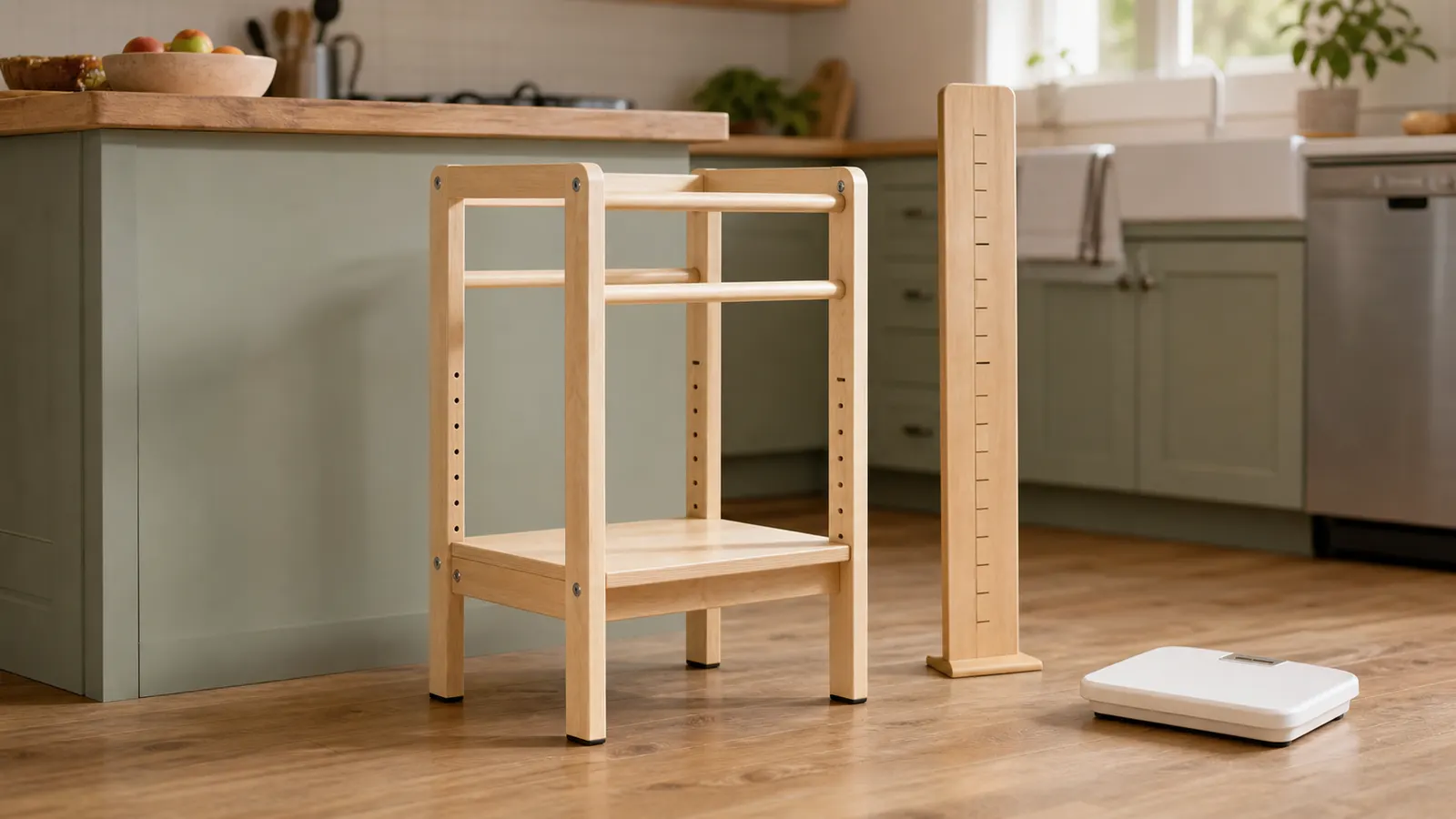
When to Stop Using a Toddler Tower: Outgrowing Checklist
Use the first exact-model age, height, weight, guard-fit, behavior, condition, or recall limit that fails instead of relying on one universal toddler tower cutoff.
Read next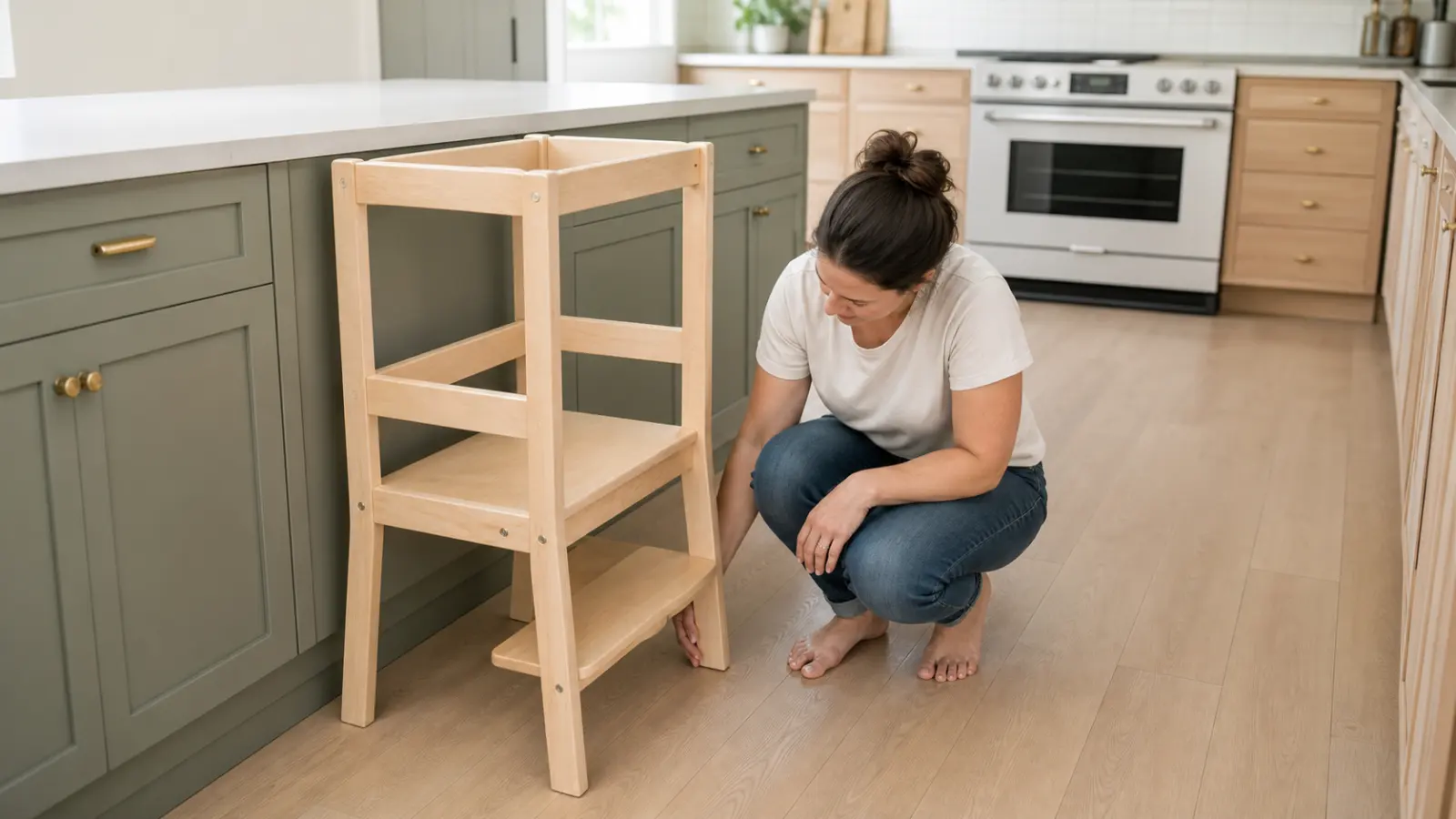
How to Use a Toddler Tower Safely in the Kitchen
A room-first toddler tower safety guide covering exact-manual placement, active supervision, cooking and cord exclusions, entry and exit, wet floors, and stop-use checks.
Read next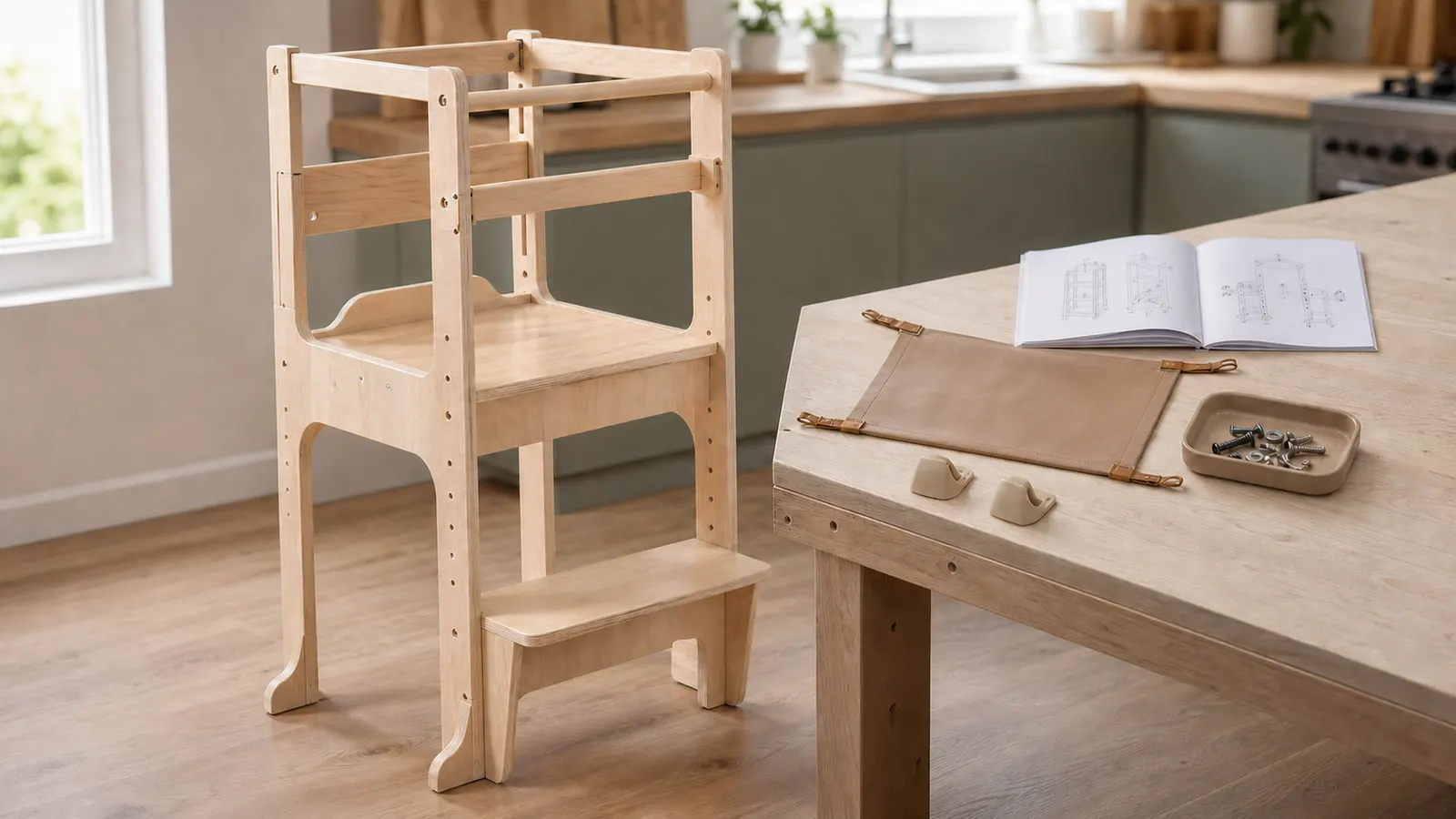
Toddler Tower Accessories and Compatibility: What Fits What?
Separate optional toddler tower accessories from required host products, included components, and built-in conversion features before checking fit, price, and installation.
Read next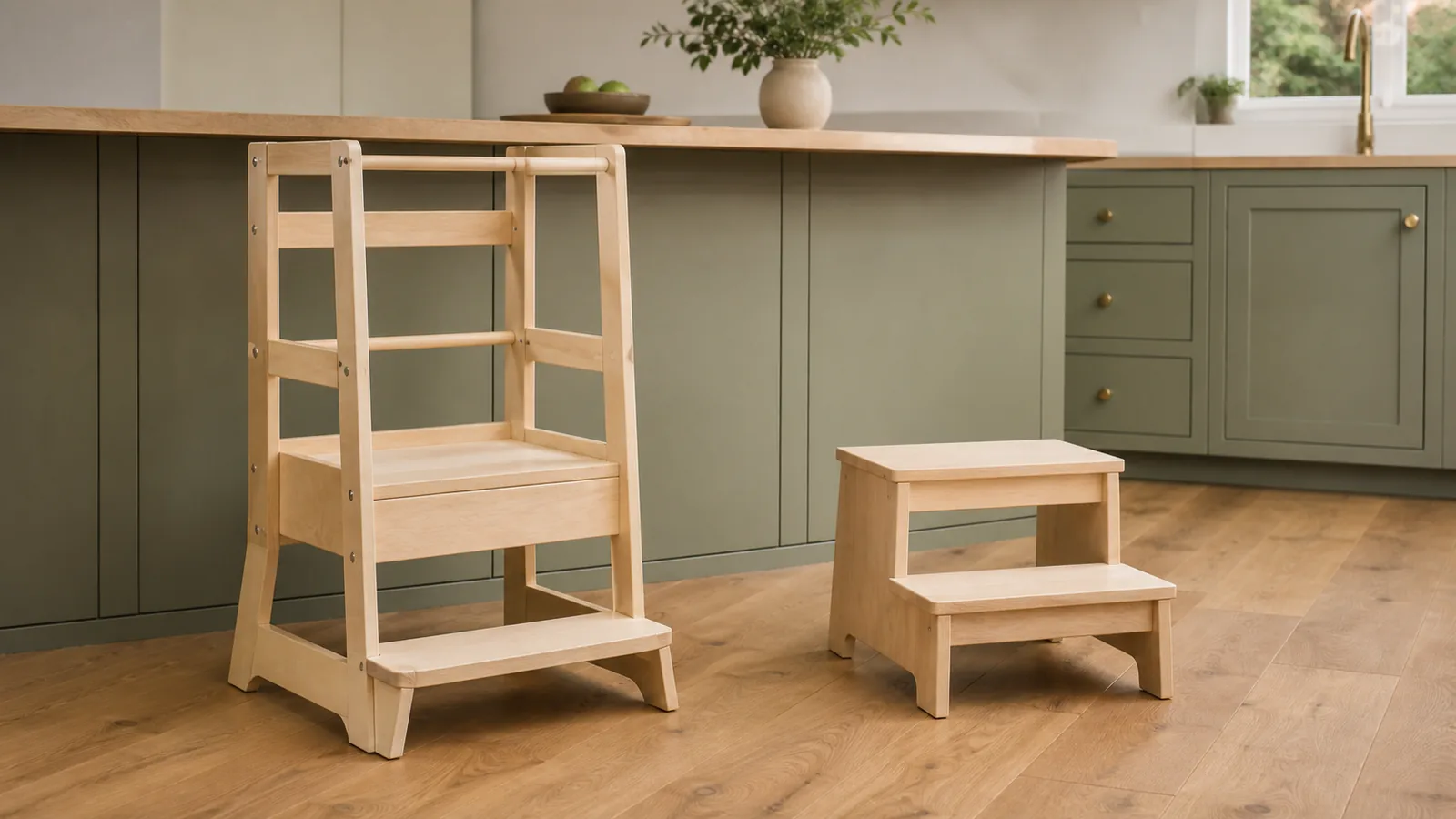
Toddler Tower vs Step Stool
How a guarded toddler tower differs from a low child step stool, and how to choose by readiness, surface height, task, footprint, and exact-product evidence.
Read next